MCQ
Evidence for the wave nature of light cannot be obtained from
  • Reflection
  • B
    Doppler effect
  • C
    Interference
  • D
    Diffraction

Answer

Correct option: A.
Reflection
Reflection phenomenon is shown by both particle and wave nature of light.

Need a full question paper?

Generate a complete, print-ready paper with questions like this in minutes — across 16+ boards, with answer keys.

Start Generating Free

Similar questions

A musical scale is constructed by providing intermediate frequencies between a note and its octave which
A cell of internal resistance $3\  \mathrm{ohm}$ and $\mathrm{emf}\  10\  \mathrm{volt}$ is connected to a uniform wire of length $500 \mathrm{~cm}$ and resistance $3 \ \mathrm{ohm}$. The potential gradient in the wire is
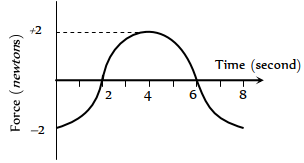
A force-time graph for a linear motion is shown in figure where the segments are circular. The linear momentum gained between zero and 8 second is

Image

A thin disc of radius $R$ and mass $M$ has charge $q$ uniformly distributed on it. It rotates with angular velocity $\omega$. The ratio of magnetic moment and angular momentum for the disc is
A stone is just released from the window of a train moving along a horizontal straight track. The stone will hit the ground following
In Newton's experiment of cooling, the water equivalent of two similar calorimeters is $10 \mathrm{gm}$ each. They are filled with $350 \mathrm{gm}$ of water and $300 \mathrm{gm}$ of a liquid (equal volumes) separately. The time taken by water and liquid to cool from $70^{\circ} \mathrm{C}$ to $60^{\circ} \mathrm{C}$ is $3 \mathrm{~min}$ and $95 \mathrm{sec}$ respectively. The specific heat of the liquid will be
Magnetic permeability is maximum for
Voltage and current in an ac circuit are given by $V=5 \sin \left(100 \pi t-\frac{\pi}{6}\right)$ and $I=4 \sin \left(100 \pi t+\frac{\pi}{6}\right)$
When an ideal monoatomic gas is heated at constant pressure, fraction of heat energy supplied which increases the internal energy of gas, is
At room temperature, copper has free electron density of $8.4 \times 10^{28}$ per $\mathrm{m}^3$. The copper conductor has a cross-section of 10. $m$ and carries a current of $5.4 \mathrm{~A}$. The electron drift velocity in copper is