Question
Exlplain ac voltage applied on a series LCR circuit. Explain its solution by phasor diagram.
Answer

SELF

Need a full question paper?

Generate a complete, print-ready paper with questions like this in minutes — across 16+ boards, with answer keys.

Start Generating Free

Similar questions

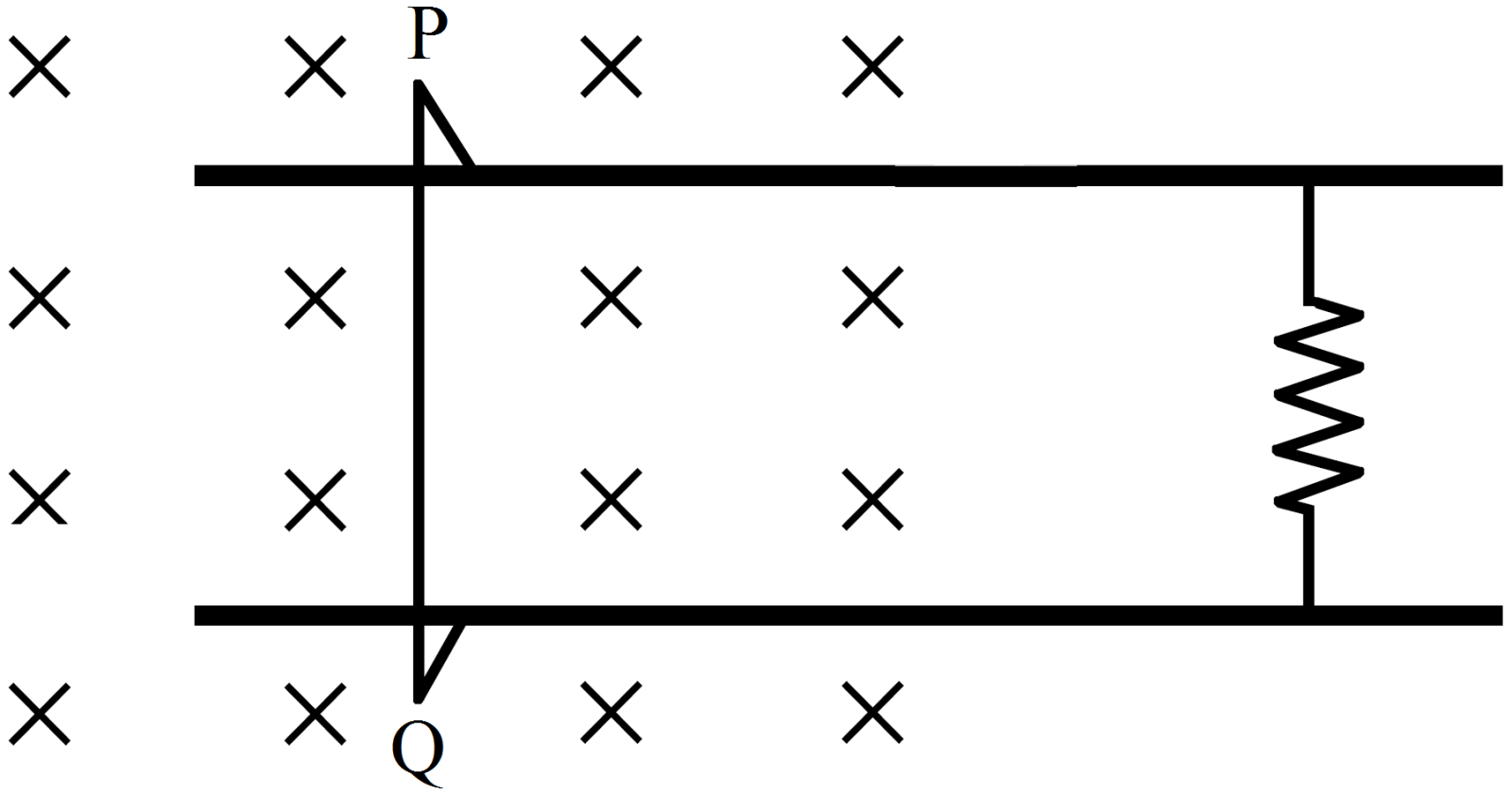
Consider the situation shown in figure. The wire PQ has mass m, resistance r and can slide on the smooth, horizontal parallel rails separated by a distance l. The resistance of the rails is negligible. A uniform magnetic field B exists in the rectangular region and a resistance R connects the rails outside the field region. At t = 0, the wire PQ is pushed towards right with a speed v0. Find

  1. The current in the loop at an instant when the speed of the wire PQ is v.
  2. The acceleration of the wire at this instant.
  3. The velocity vas a functions of x.
  4. The maximum distance the wire will move.

Two charges 2.0 × 10-6C and 1.0 × 10-6C are placed at a separation of 10cm. Where should a third charge be placed such that it experiences no net force due to these charges?
  1. An object is placed in front of a concave mirror. It is observed that a virtual image is formed. Draw the ray diagram to show the image formation and hence derive the mirror equation $\frac{1}{\text{f}}=\frac{1}{\text{u}}+\frac{1}{\text{v}}.$
  2. An object is placed 30cm in front of a plano-convex lens with its spherical surface of radius of curvature 20cm. If the refractive index of the material of the lens is 1.5, find the position and nature of the image formed.
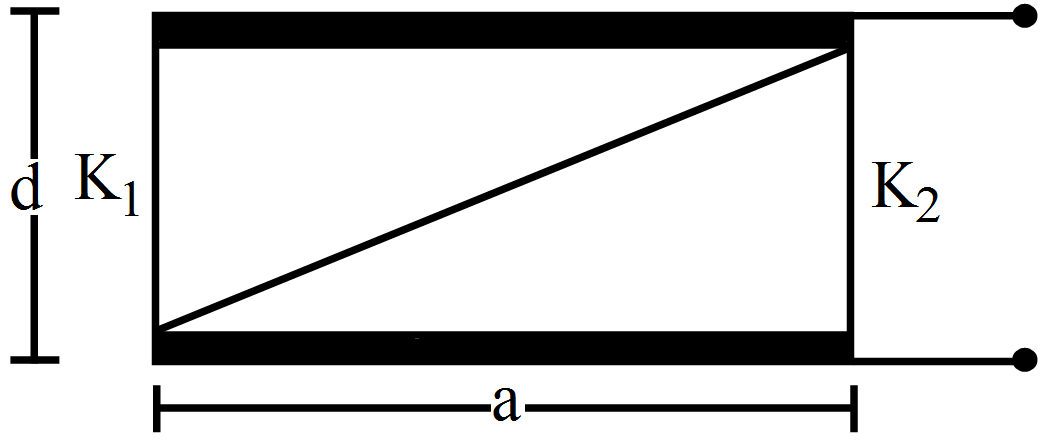
A capacitor is formed by two square metal-plates of edge a, separated by a distance d. Dielectrics of dielectric constants K1 and K2 are filled in the gap as shown in figure. Find the capacitance.

An ideal gas having density 1.7 × 10-3g-cm-3 at a pressure 1.5 × 105Pa is filled in a Kundt tube. When the gas is resonated at a frequency of 3.0KHz, nodes are formed at a separation of 6.0cm. Calculate the molar heat capacities CP and Cv of the gas.
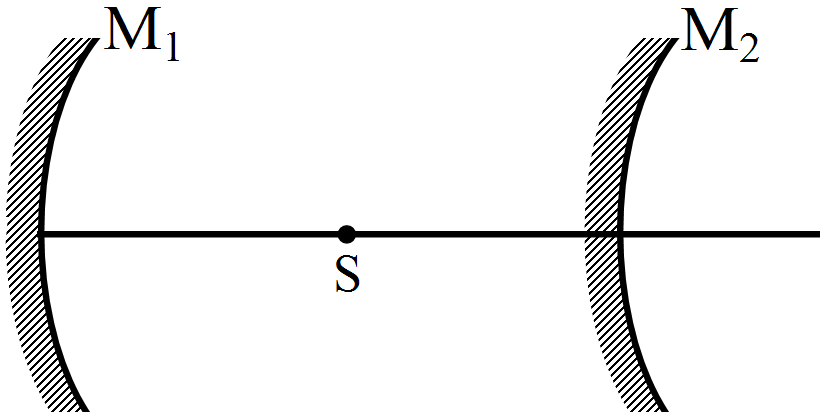
A converging mirror M1, a point source S and a diverging mirror M2 are arranged as shown in figure. The source is placed at a distance of 30cm from M1. The focal length of each of the mirrors is 20cm. Consider only the images formed by a maximum of two reflections. It is found that one image is formed on the source itself.
  1. Find the distance between the two mirrors.
  2. Find the location of the image formed by the single reflection from M2.

A capacitor of capacitance $10\mu\text{F}$ is connected to a battery of emf 2V. It is found that it takes 50ms for the charge of the capacitor to become $12.6\mu\text{C}.$ Find the resistance of the circuit.
A pin of length 2.0cm lies along the principal axis of a converging lens, the centre being at a distance of 11cm from the lens. The focal length of the lens is 6cm. Find the size of the image.
In a Young's double slit experiment, the separation between the slits = 2.0mm, the wavelength of the light = 600nm and the distance of the screen from the slits = 2.0m. If the intensity at the centre of the central maximum is 0.20W/ m2, what will be the intensity at a point 0.5cm away from this centre along the width of the fringes?
The optical properties of a medium are governed by the relative permitivity $(\in_\text{r})$ and relative permeability $(\mu_\text{r})$. The refractive index is defined as $\sqrt{\mu_\text{r}\in_\text{r}}=\text{n}$.For ordinary material $\in_\text{r}=0\text{ and }\mu_\text{r}<0$ and the positive sign is taken for the square root. In 1964, a Russian scientist V. Veselago postulated the existence of material with $\in_\text{r}=0\text{ and }\mu_\text{r}<0$. Since then such 'metamaterials' have been produced in the laboratories and their optical properties studied. For such materials $\text{n}=-\sqrt{\mu_1\in_1}$. As light enters a medium of such refractive index the phases travel away from the direction of propagation.
  1. According to the description above show that if rays of light enter such a medium from air (refractive index = 1) at an angle ? In 2nd quadrant, them the refracted beam is in the 3rd quadrant.
  2. Prove that Snell's law holds for such a medium.