Question
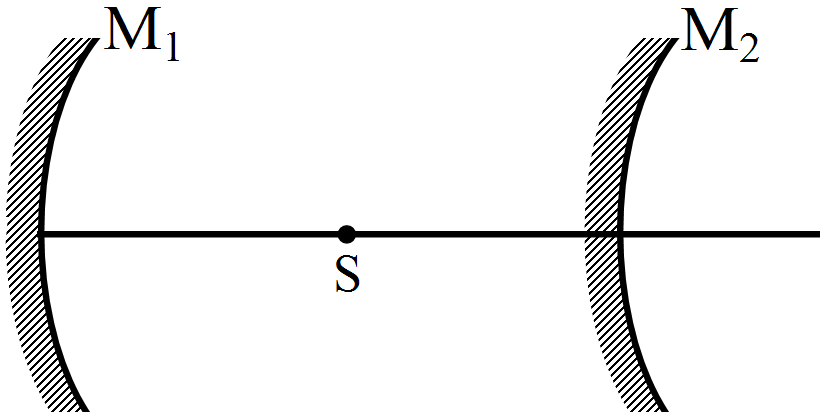
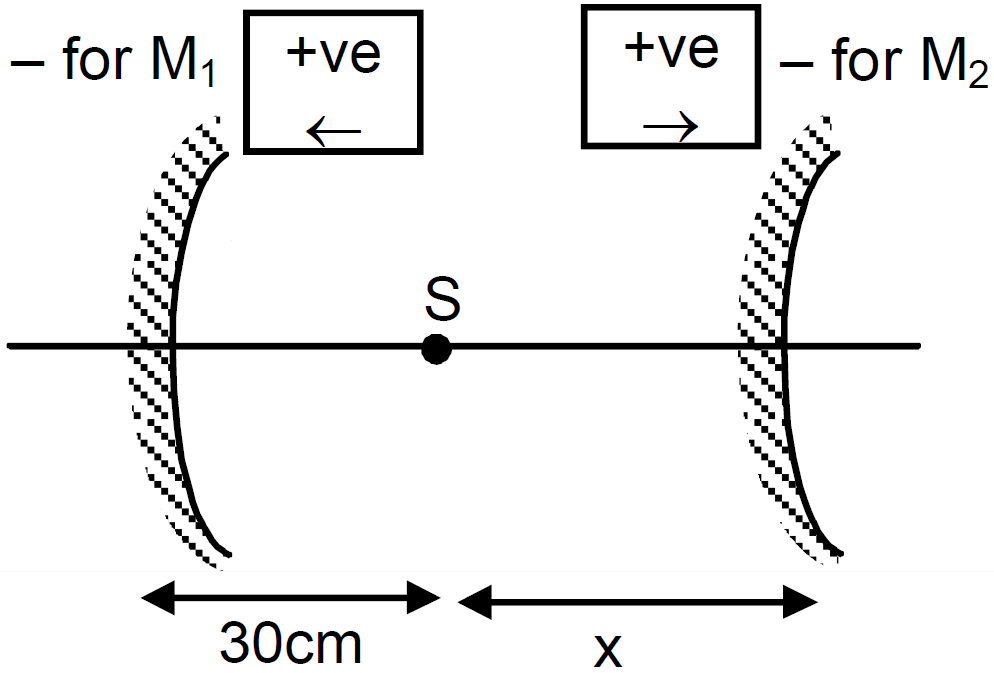
A converging mirror M1, a point source S and a diverging mirror M2 are arranged as shown in figure. The source is placed at a distance of 30cm from M1. The focal length of each of the mirrors is 20cm. Consider only the images formed by a maximum of two reflections. It is found that one image is formed on the source itself.
  1. Find the distance between the two mirrors.
  2. Find the location of the image formed by the single reflection from M2.
Answer


  1. As shown in figure, for 1st reflection in M1, u = -30cm, f = -20cm

$\Rightarrow\frac{1}{\text{v}}+\frac{1}{-30}=-\frac{1}{20}\Rightarrow\text{v}=-60\text{cm}.$

So, for 2nd reflection in M2

u = 60 - (30 + x) = 30 - x

v = -x; f = 20cm

$\Rightarrow\frac{1}{30-\text{x}}-\frac{1}{\text{x}}=\frac{1}{20}$

$\Rightarrow \frac{\text{x}-30+\text{x}}{\text{x}(30-\text{x})}=\frac{1}{20}$

$\Rightarrow40\text{x}-600=30\text{x}-\text{x}^2$

$\Rightarrow\text{x}^2+10\text{x}-600=0$

$\Rightarrow\text{x}=\frac{10\pm50}{2}=\frac{40}{2}=20\text{cm}$ or $-30\text{cm}$

$\therefore$ Total distance between the two lines is 20 + 30 = 50cm.

Need a full question paper?

Generate a complete, print-ready paper with questions like this in minutes — across 16+ boards, with answer keys.

Start Generating Free

Similar questions

What is the speed of a photon with respect to another photon if:
  1. The two photons are going in the same direction and.
  2. They are going in opposite directions?
Suppose there is a circuit consisting of only resistances and batteries. Suppose one is to double (or increase it to n-times) all voltages and all resistances. Show that currents are unaltered.
A rod of length L has a total charge Q distributed uniformly along its length. It is bent in the shape of a semicircle. Find the magnitude of the electric field at the centre of curvature of the semicircle.
Obtain the binding energy of the nuclei $^{56}_{26}\text{Fe }\text{ and }\ ^{209}_{83}\text{Bi}$ in units of MeV from the following data:
$\text{m}(^{56}_{26}\text{Fe})=55.934939\text{ u }$ $\text{ m}(^{209}_{83}\text{Bi})=208.980388\text{ u}$
  1. Derive the expression for the torque on a rectangular current carrying loop suspended in a uniform magnetic field.
  2. A proton and a deuteron having equal momenta enter in a region of uniform magnetic field at right angle to the direction of the field. Depict their trajectories in the field.
A wave travelling on a string, at a speed of 10m/s causes each particle of the string to oscillate with a time period of 20ms.
  1. What is the wavelength of the wave?
  2. If the displacement of a particle is 1.5mm at a certain instant, what will be the displacement of a particle 10cm away from it at the same instant?
Gautam went for a vacation to the village where his grandmother lived. His grandmother took him to watch ‘nautanki’ one evening. They noticed a blackbox connected to the mike lying nearby. Gautam’s grandmother did not know what that box was. When she asked this question to Gautam, he explained to her that it was an amplifier.
  1. Which values were displayed by the grandmother? How can inculcation of these values in students be promoted?
  2. What is the function of an amplifier?
  3. Which basic electronic device is used in the amplifier?
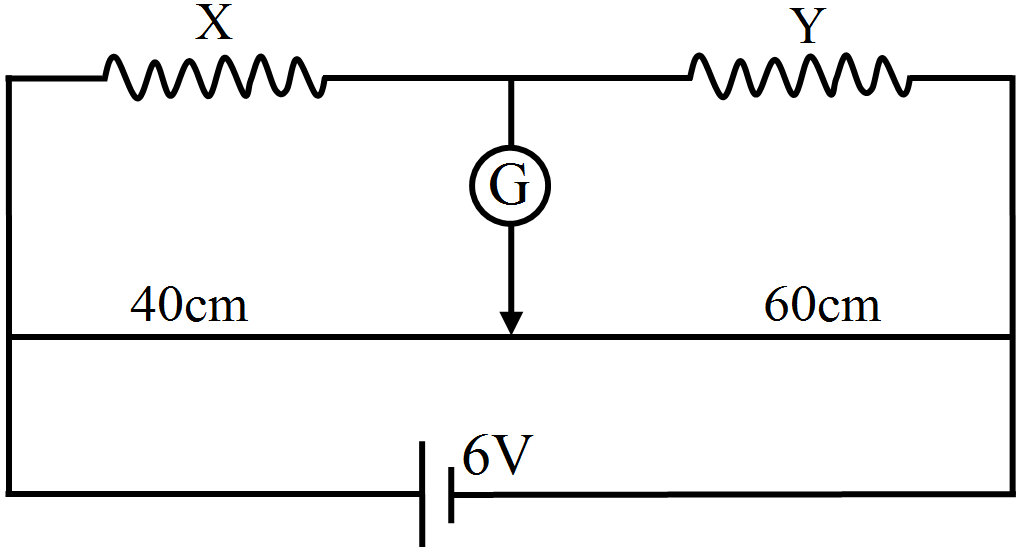
In the given circuit, a metre bridge is shown in the balanced state. The metre bridge wire has a resistance of $1\Omega\text{cm}-1$. Calculate the unknown resistance X and the current drawn from the battery of a negligible internal resistance if the magnitude of Y is $6\Omega$ If at the balancing point, we interchange the position of galvanometer and the cell, how it will affect the position of the galvanometer?

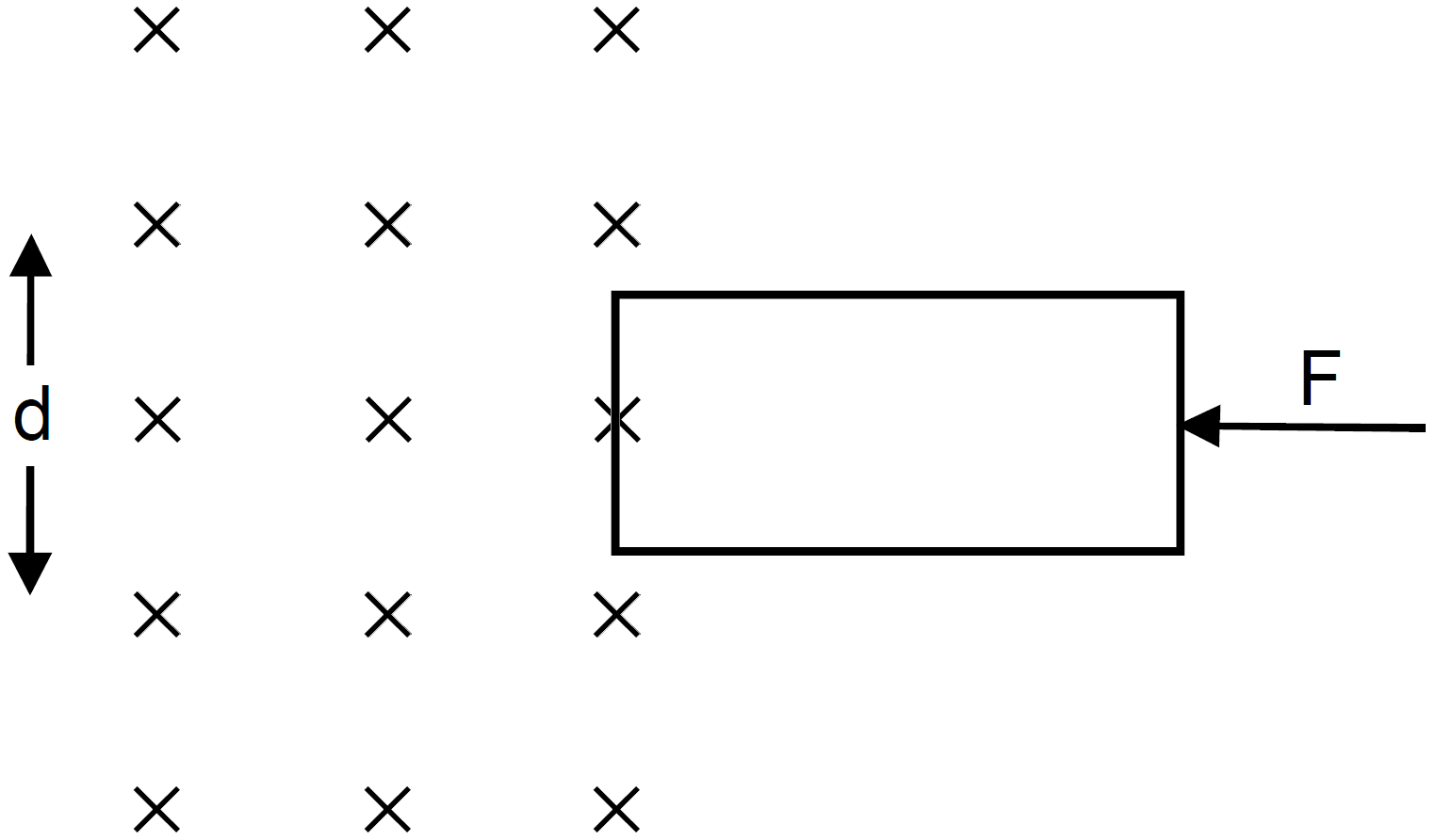
The rectangular wire-frame, shown in figure, has a width d, mass m, resistance R and a large length. A uniform magnetic field B exists to the left of the frame. A constant force F starts pushing the frame into the magnetic field at t = 0.
  1. Find the acceleration of the frame when its speed has increased to v.
  2. Show that after some time the frame will move with a constant velocity till the whole frame enters into the magnetic field. Find this velocity v0.
  3. Show that the velocity at time t is given by $\text{v}=\text{v}_0\Big(1-\text{e}^{-\frac{\text{ft}}{\text{mv}_0}}\Big)$

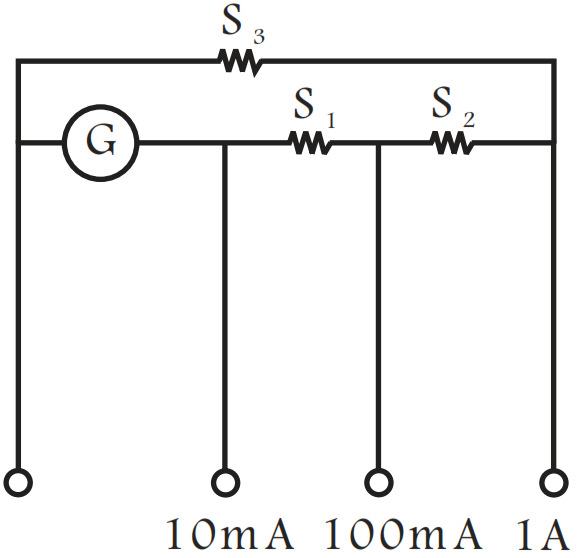
A multirange current meter can be constructed by using a galvanometer circuit as shown in Fig. We want a current meter that can measure 10mA, 100mA and 1A using a galvanometer of resistance 10Ω and that prduces maximum deflection for current of 1mA. Find S1, S2 and S3 that have to be used.