Question
Experimental confirmation of semiconservative replication of $\text{DNA.}$
Answer

Image
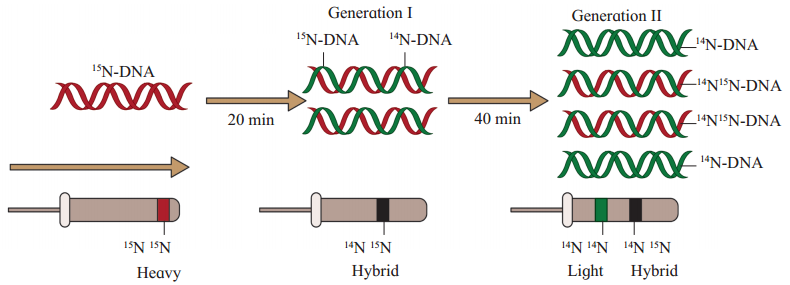
$(1)$ Matthew Meselson and Franklin Stahl $(1958)$ used equilibrium – density – gradient – centrifugation technique to experimentally prove semiconservative $\text{DNA.}$ replication.
$(2)$ They cultured bacteria $E.$coli in the medium containing $^{14}N ($light nitrogen$).$ They obtained equilibrium density gradient band by using $6M \ CsCl_2.$ The position of this band is recorded.
$(3) \ E$. coli cells were then transferred to $^{15}N$ medium $($heavy isotopic nitrogen$)$ and allowed to replicate for several generations. At equilibrium point density gradient band was obtained, by using $6M \ CsCl_2.$ The position of this band is recorded.
$(4)$ The heavy $\text{DNA.} (^{15}N)$ molecule can be distinguished from normal $\text{DNA.}$ by centrifugation in a $6M$ Cesium chloride $(CsCl_2)$ density gradient. At the equilibrium point $^{15}N \text{DNA.}$ will form a band. In this both the strands of $\text{DDNA.}$ are labelled with $^{15}N.$
$(5)$ Such $E.$ coli cells were then transferred to another medium containing $^{14}N$ i.e. normal $($light$)$ nitrogen. After first generation, the density gradient band for $^{14}N ^{15}N$ was obtained and its position was recorded. After second generation, two density gradient bands were obtained – one at $^{14}N ^{15}N$ position and other at $^{14}N$ position.
$(6)$ The position of bands after two generations clearly proved that $\text{DNA.}$ replication is semiconservative.

Need a full question paper?

Generate a complete, print-ready paper with questions like this in minutes — across 16+ boards, with answer keys.

Start Generating Free