Question
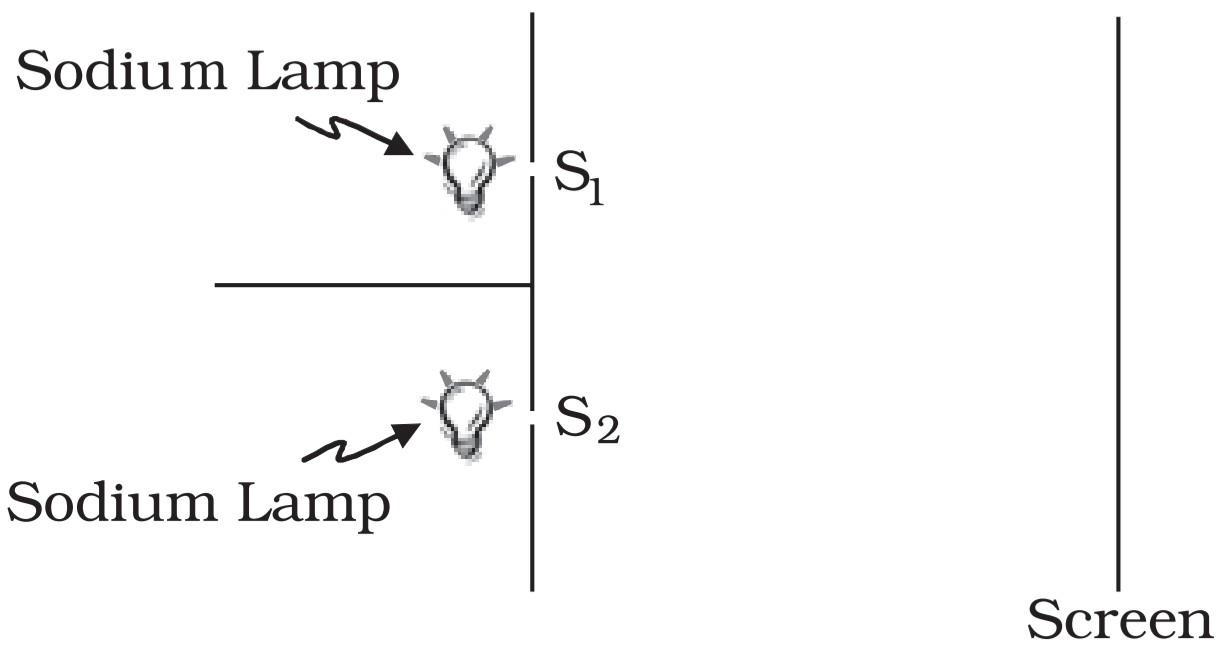
✓
Answer
- (c) 19.72
Explanation:
Given $\text{I}_1=\text{10 }\frac{\text{W}}{\text{m}^2}$ and $\text{I}_2=\text{25 }\frac{\text{W}}{\text{m}^2}$
$\frac{\text{I}_1}{\text{I}_2}=\frac{\text{a}^2_1}{\text{a}^2_2}=\frac{10}{25}\Rightarrow\frac{\text{a}_1}{\text{a}_2}=\frac{3.16}{5}$ or
$\text{a}_1=\frac{3.16}{5}\text{a}_2=0.6324\text{a}_2$
$\frac{\text{I}_\text{max}}{\text{I}_\text{min}}=\frac{(\text{a}_1+\text{a}_2)^2}{(\text{a}_1-\text{a}_2)^2}=\frac{[0.6324\text{a}_2+\text{a}_2]^2}{[0.6324\text{a}_2-\text{a}_2]^2}=19.724$
- (b) Excessively thin film.
Explanation:
In an excessively thin film, the thickness of the film is negligible. Thus the path difference between the reflected rays becomes $\frac{\lambda}{2}$ which produces a minima.
- (a) 2D
Explanation:
Since, $\beta=\frac{\lambda\text{D}}{\text{d}}$ for d = 2d,
$\beta'=\frac{\lambda\text{D}'}{2\text{d}}=\beta$ (Gives)
$\therefore$ D1 = 2D
- (b) Five
Explanation:
The condition for possible interference maxima on the screen is, $\text{d}\sin\theta=\text{n}\lambda$
where d is slit separation and $\lambda$ is the wavelength.
As $\text{d}=2\lambda$ (given) $\therefore2\lambda\sin\theta=\text{n}\lambda$ or $2\sin\theta=\text{n}$
For number of interference maxima to be maximum,
$\sin\theta=1\ \ \ \therefore\ \ \ \text{n}=2$
The interference maxima will be formed when
$\text{n}=0,\pm1,\pm2$
Hence the maximum number of possible maxima is 5.
-
(d) $\sqrt3\text{a}$
Explanation:
$\text{y}_1=\text{a}\sin\Big(\omega\text{t}\frac{\pi}{3}\Big)$ and $\text{y}_2=\text{a}\sin\omega\text{t}$
$\text{A}=\sqrt{\text{a}_1^2+\text{a}^2_2+2\text{a}_1\text{a}_2\cos\phi}$, where $\phi=\frac{\pi}{3}$
$=\sqrt{\text{a}^2+\text{a}^2+2\text{aa}\cos\frac{\pi}{3}}=\sqrt3\text{a}$
Need a full question paper?
Generate a complete, print-ready paper with questions like this in minutes — across 16+ boards, with answer keys.
Explore more
Similar questions
A magnetic dipole of magnetic moment $0.72\sqrt{2}\text{ A-m}^2$ -is placed horizontally with the north pole pointing towards east. Find the position of the neutral point if the horizontal component of the earth's magnetic field is $18\mu\text{T.}$
→Shows a rod PQ of length 20.0cm and mass 200g suspended through a fixed point O by two threads of lengths 20.0cm each. A magnetic field of strength 0.500T exists in the vicinity of the wire PQ, as shown in the figure. The wires connecting PQ with the battery are loose and exert no force on PQ.
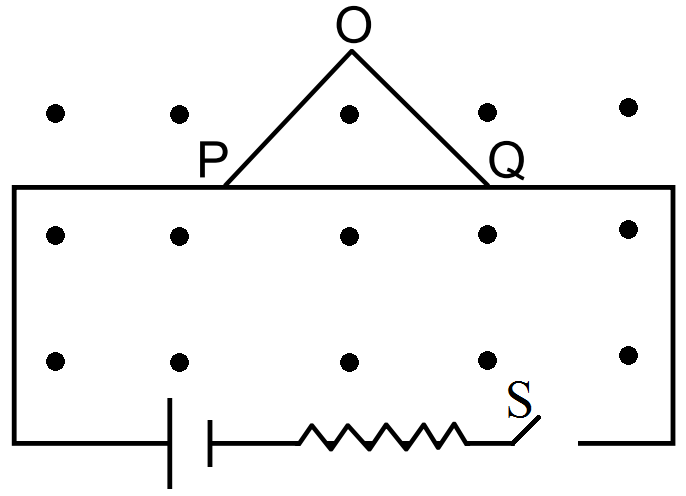
- Find the tension in the threads when the switch S is open.
- A current of 2.0A is established when the switch S is closed. Find the tension in the threads now.
Potential difference $(\triangle\text{V})$ between two points A and B separated by a distance x, in a uniform electric field E is given by $\triangle\text{V}=-\text{Ex},$ where xis measured parallel to the field lines. If a charge q0 moves from P to Q, the change in potential energy $(\triangle\text{U})$ is given as $\triangle\text{U}=-\text{q}_0\triangle\text{V}.$ A proton is released from rest in uniform electric field of magnitude 4.0 × 10⁸Vm-1 directed along the positive X-axis. The proton undergoes a displacement of 0.25m in the direction of E. Mass of a proton = 1.66 × 10⁻²⁷kg and charge of proton = 1.6 × 10⁻¹⁹C.
→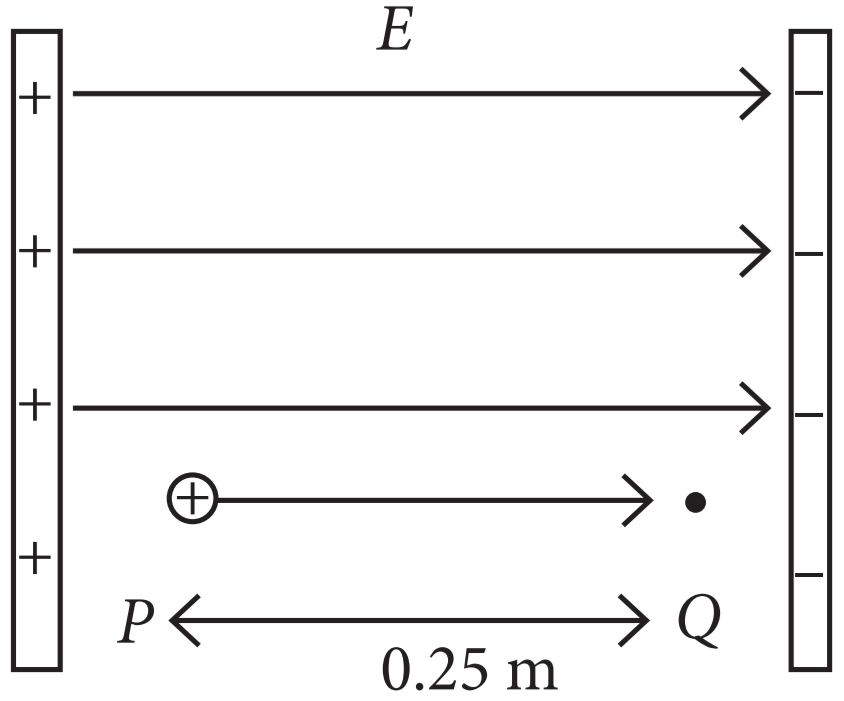
- The change in electric potential of the proton between the points A and B is:
- -1 × 10⁸V
- 1 × 10⁸V
- 6.4 × 10⁻¹⁹V
- -6.4 × 10⁻¹⁹V
- The change in electric potential energy of the proton for displacement from A to B is:
- 1.6 × 10¹¹J
- 0.5 × 10²³J
- -1.6 × 10⁻¹¹J
- 3.2 × 10²²J
- The mutual electrostatic potential energy between two protons which are at a distance of 9 × 10-15m, in 92U235 nucleus is:
- 1.56 × 10⁻¹⁴J
- 5.5 × 10⁻¹⁴J
- 2.56 × 10⁻¹⁴J
- 4.56 × 10⁻¹⁴J
- If a system consistsoftwocharges 4mC and -3mC with no external field placed at (-5cm, 0, 0) and (5cm, 0, 0) respectively. The amount of work required to separate the two charges infinitely away from each other is:
- -1.1J
- 2J
- 2.5J
- 3J
- As the proton moves from P to Q, then:
- The potential energy of proton decreases.
- The potential energy of proton increases.
- The proton loses kinetic energy.
- Total energy of the proton increases.
The household supply of electricity is at 220V (rms value) and 50Hz. Find the peak voltage and the least possible time in which the voltage can change from the rms value to zero.
In motor vehicles, a convex mirror is attached near the driver's seat to give him the view of the traffic behind. What is the special function of this convex mirror which a plane mirror can not do?
If a mosquito is dipped into water and released, it is not able to fly till it is dry again. Explain.
Why don't we have interference when two candles are placed close to each other and the intensity is seen at a distant screen? What happens if the candles are replaced by laser sources?
A magnetic needle is free to rotate in a vertical plane which makes an angle of 60° with the magnetic meridian. If the needle stays in a direction making an angle of $\tan^{-1}\Big(\frac{2}{\sqrt{3}}\Big)$ with the horizontal, what would be the dip at that place?
→A thick wire of $15 \Omega$ is stretched to three times its original length. Assuming that the density of the wire remains unchanged, calculate the resistance of the new wire.
→A bar magnet whose area of cross-section is $0.25 cm^2$ is kept in a magnetising field of intensity of $5000 A / m$. If magnitude of magnetic flux passing through the bar is $2.5 \times 10^{-5}$ weber, then calculate :(a) Magnetic induction (b) Magnetic susceptibility (c) Intensity of magnetisation.
→