Question
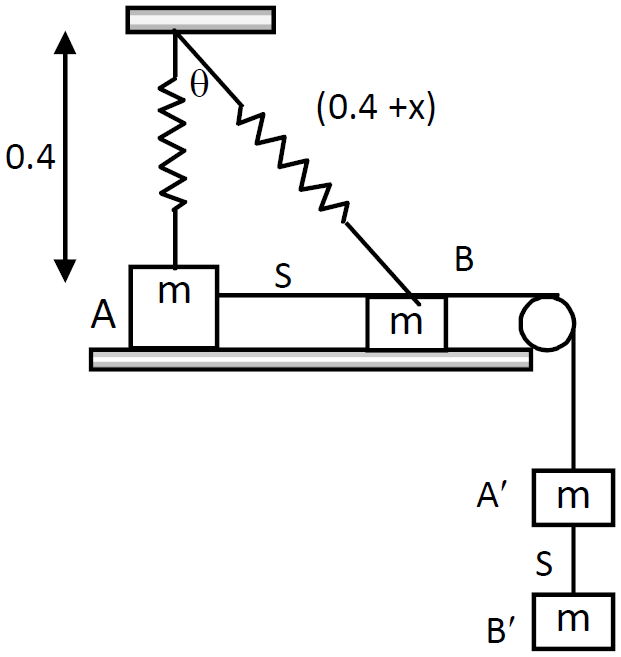
Figure shows two blocks $A$ and $B,$ each having a mass of $320g$ connected by a light string passing over a smooth light pulley. The horizontal surface on which the block $A$ can slide is smooth. The block $A$ is attached to a spring of spring constant $40N/m$ whose other end is fixed to a support $40\ cm$ above the horizontal surface. Initially, the spring is vertical and unstretched when the system is released to move. Find the velocity of the block $A$ at the instant it breaks off the surface below it. Take $g = 10m/s^2.$
Answer

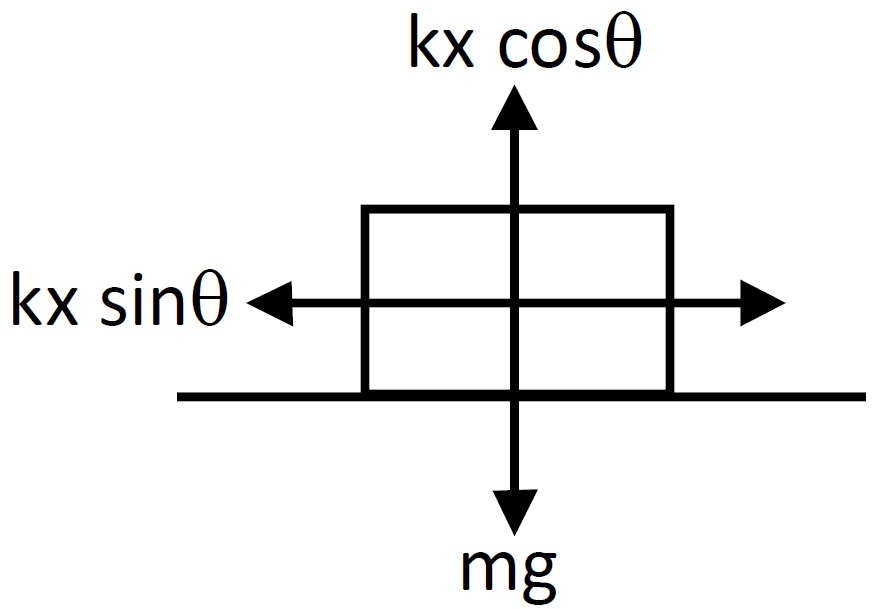
$m = 320g = 0.32\ kg, k = 40N/m h = 40\ cm = 0.4m, g = 10 m/s^2$ From the free body diagram,

$\text{kx}\cos\theta=\text{mg}$
$($when the block breaks off $R = 0)$
$\Rightarrow\cos\theta=\frac{\text{mg}}{\text{kx}}$
So, $\frac{0.4}{0.4+\text{x}}=\frac{3.2}{40+\text{x}}$
$\Rightarrow16\text{x}=3.2\text{x}+1.28$
$\Rightarrow\text{x}=0.1\text{m}$
So, $\text{s}=\text{AB}$
$\Rightarrow\sqrt{(\text{h}+\text{x})^2-\text{h}^2}$
$\Rightarrow\sqrt{(0.5)^2-(0.4)^2}=0.3\text{m}$
Let the velocity of the body at $B$ be $v,$ Charge in $K.E. =$ work done $($for the system$)\Big(\frac{1}{2}\text{mv}^2+\frac{1}{2}\text{mv}^2\Big)=\frac{-1}{2}\text{kx}^2+\text{mgs}$
$\Rightarrow(0.32)\times\text{v}^2=-\Big(\frac{1}{2}\Big)\times40\times(0.1)^2+0.32\times10\times(0.3)$
$\Rightarrow\text{v}=1.5\text{m}/\text{sec}$

Need a full question paper?

Generate a complete, print-ready paper with questions like this in minutes — across 16+ boards, with answer keys.

Start Generating Free

Similar questions

A source of sound emitting a 1200Hz note travelg along a straight line at a speed of 170m/s. A detector is placed at a distance of 200m from the line of motion of the source.
  1. Find the frequency of sound received by the detector at the instant when the source gets closest to it.
  2. Find the distance between the source and the detector at the instant it detects the frequency 1200Hz. Velocity of sound in air = 340m/s.
(i) How will you show that Lenz's law is a conclusion of energy conservation law? Explain with suitable examples.

(ii) Using the expression for Lorentz force applied on charge carriers of any conductor, obtain an expression for that induced emf which is induced in a conductor of length $l$ moving with a velocity $v$, perpendicular to any magnetic field $B$.
A glass surface is coated by an oil film of uniform thickness $1.00 \times 10^{-4}cm.$ The index of refraction of the oil is $1.25$ and that of the glass is $1.50.$ Find the wavelengths of light in the visible region $(400\ nm - 750\ nm)$ which are completely transmitted by the oil film under normal incidence.
  1. State Huygen’s principle. Using this principle draw a diagram to show how a plane wave front incident at the interface of the two media gets refracted when it propagates from a rarer to a denser medium. Hence verifiy Snell’s law of refraction.
  2. When monochromatic light travels from a rarer to a denser medium, explain the following, giving reasons:
    1. Is the frequency of reflected and refracted light same as the frequency of incident light?
    2. Does the decrease in speed imply a reduction in the energy carried by light wave?
Write the name of different waves in electromagnetic spectrum and give brief introduction of their discovery, wavelength range, properties and applications.
Derive a mathematical expression for the force per unit length experienced by each of the two long current carrying conductors placed parallel to each other in air. Hence define one ampere of current.Explain why two parallel straight conductors carrying current in the opposite direction kept near each other in air repel?
A magnetic field $B$ is confined to a region $ r \leq$ a and points out of the paper $($the $z-$ axis$), r = 0$ being the centre of the circular region. $A$ charged ring $ ($charge $= Q)$ of radius $b, b > a$ and mass m lies in the $x-y$ plane with its centre at the origin. The ring is free to rotate and is at rest. The magnetic field is brought to zero in time $\triangle t$. Find the angular velocity $\omega$ of the ring after the field vanishes.
What is interference of light? Write two essential conditions for sustained interference pattern to be produced on the screen.
Draw a graph showing the variation of intensity versus the position on the screen in Young’s experiment when (a) both the slits are opened and (b) one of the slits is closed.
What is the effect on the interference pattern in Young’s double slit experiment when:
  1. Screen is moved closer to the plane of slits?
  2. Separation between two slits is increased?
Explain your answer in each case.
A hollow sphere is released from the top of an inclined plane of inclination $\theta.$
  1. What should be the minimum coefficient of friction between the sphere and the plane to prevent sliding?
  2. Find the kinetic energy of the ball as it moves down a length 1 on the incline if the friction coefficient is half the value calculated in part (a).
A compound microscope consists of an objective of focal length $1\ cm$ and an eyepiece of focal length $5\ cm$. An object is placed at a distance of $0.5\ cm$ from the objective. What should be the separation between the lenses so that the microscope projects an inverted real image of the object on a screen $30\ cm$ behind the eyepiece?