Question
Explain: Acquired Immunity.
Answer

Acquired immunity, on the other hand, is pathogen specific. It is characterised by memory.
This means that our body, when encounters a pathogen for the first time, produces a response called primary response which is of low intensity.
Subsequent encounter with the same pathogen elicits a highly intensified secondary or anamnestic response.
The primary and secondary immune responses are carried out with the help of two special types of lymphocytes present in our blood, i.e., B-lymphocytes and T- lymphocytes.
Image
There are two type of acquired immune response.
→(i) Antibody Mediated Immune response or / Humoral Immune response."
The B-lymphocytes produce an army of proteins in response to pathogens into our blood to fight with them. These proteins are called antibodies.
The T-cells themselves do not secrete antibodies but help B cells produce them.
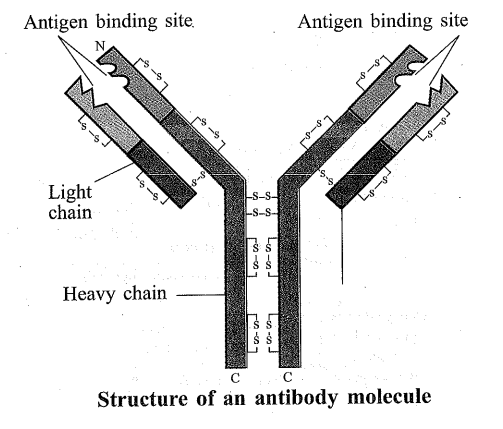
Each antibody molecule has four peptide chains, two small called light chains and two longer, called heavy chains."
Hence, an antibody is represented as H2L2. Different 22 types of antibodies are produced in our body
IgA, IgM, IgE, IgG are some of them. A structure of an antibody is given in Figure 7.4. Because these antibodies are found in the blood, the response is also called humoral immune response.
(ii) Cell Mediated Immune response
The second type is called cell-mediated immune response or cell- mediated immunity (CMI). The T-lymphocytes mediate CМІ.

Need a full question paper?

Generate a complete, print-ready paper with questions like this in minutes — across 16+ boards, with answer keys.
Start Generating Free

Similar questions

Read the following and answer any four questions from (i) to (v) given below:
A group of teenagers was involved in drug abuse. 'They used syringes and needles to inject drugs. 'They indulged in this habit when they became adults. Administration of drug through needles became a piece of cake for them. Raj was the most active drug abuser amongst them and used to take drugs in high profile parties. In a span of time he started losing weight and suffered persistent diarrhoea. He developed constant low grade fever and used to catch opportunistic infection. When he consulted a doctor, he got himself tested for HIV in his blood and finally diagnosed with AIDS.
Based on the above information, answer the following questions.
  1. Select the incorrect statement.
  1. AIDS is a disorder of cell mediated immune system of the body.
  2. AIDS is caused by Human Immunodeficiency virus.
  3. AIDS infections were detected in India for the first time in prostitutes of Chennai, Tamil Nadu in 1986.
  4. December 10 is recalled as World AIDS Day.
  1. How do you think Raj got AIDS infection?
  1. Through transfusion of HIV infected blood
  2. Sexual intercourse with an infected partner
  3. Sharing towel with infected friend
  4. Use of contaminated needles and syringes to inject drugs
  1. How AIDS can be diagnosed?
  1. ELISA test
  2. Ames test
  3. Pap's test
  4. Wida! test
  1. How can AIDS be prevented?
  1. Blood tests of blood donor before transfusion to check for the presence of AIDS virus.
  2. Use of disposable needles and syringes for injecting medicines and vaccination
  3. Having protected sex by use of condoms
  4. All of these
  1. Select the correct statement for AIDS virus.
  1. It is rhomboid in shape with a diameter of 10-15 cm.
  2. Its genome consists of ds DNA.
  3. It consists of reverse transcriptase enzyme.
  4. Its envelope consists of lipid bilayer and three protein coats.
Read the following and answer any four questions from (i) to (v) given below:
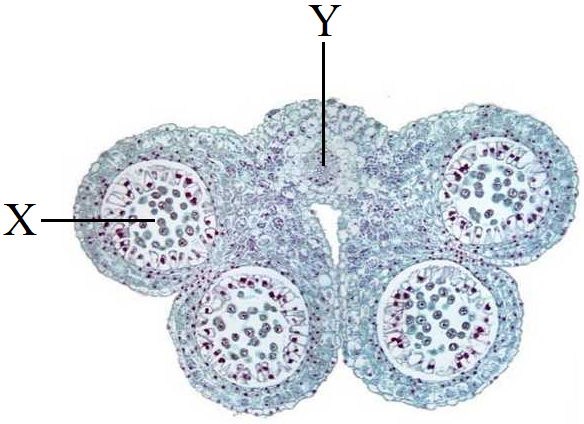
Many adaptations are found in flowers to achieve certain kind of pollination. The pollination achieved by insects is known as entomophily. The given diagram shows the cross-section of an anther of an insect pollinated flower.

  1. Which of the following is/ are the function(s) of structure Y?
  1. To carry waste products away from the anther.
  2. To supply oxygen to the cells of the anther.
  3. To transport food and mineral salts to the anther.
  4. To supply water to the anther.
  1. Conly.
  2. C and D only.
  3. A, B and D only.
  4. A, B, C and D.
  1. Which of the following most accurately describes the structures found in compartment X?
  1. They contain two haploid nuclei resulting from meiosis.
  2. They contain two haploid nuclei resulting from mitosis.
  3. They contain two haploid male gametes, resulting from mitosis.
  4. They contain a vegetative nucleus and pollen tube nucleus.
  1. Which of the following is a distinctive characteristic of insect-pollinated flower?
  1. All of them have nectar guides on their flowers.
  2. They produce sugary fruit.
  3. Their pollen grains tend to have rough surfaces.
  4. They produce abundant quantities of pollen to make up for pollen grains that might be removed by the wind.
  1. Which of the following are likely characteristics of the structures found in X and stamens of this plant?
S. No
Structure of X
Stamens
(a)
Abundant and light
Pendulous
(b)
Rough surfaces
Non-pendulous
(c)
Light and sticky
Pendulous
(d)
Coarse and sticky
Protrude outside the flower
  1. Spiny or sticky pollen grains and large, attractively coloured flowers are associated with:
  1. Hydrophily.
  2. Entomophily.
  3. Ornithophily.
  4. Anemophily.
A patient is suffering from ADA deficiency. Can he be cured? How?
Explain the methods for making host cell competent to insert the r DNA.
Read the following and answer any four questions from (i) to (v) given below:
Population is defined as the total number of individuals of a species present in a particular area at a given time. 'The scientific study of human population is called demography. The rapid increase in population over a relatively short period is called population explosion. Four basic processes are involved in increase or decrease in the population size. Population shows two types of growth; exponential and logistic.
  1. Which of the following factors are responsible for population explosion?
  1. Decrease in number of people of reproducible age.
  2. Decline in infant mortality rate.
  3. Increase in maternal mortality rate.
  4. Rapid decline in death rate.
  1. A and B
  2. B and C
  3. B and D
  4. A and D
  1. What is the shape of curve showing logistic growth?
  1. Sigmoid.
  2. J-shape.
  3. Linear.
  4. Hyperbola.
  1. What is immigration?
  1. Number of individuals of the population who left the habitat.
  2. Number of individuals that have come into the habitat.
  3. Number of individuals of a species per unit area at given time.
  4. Number of births per 1000 individuals.
  1. Equation of Verhulst-Pearl logistic growth is:
  1. $\frac{\text{dN}}{\text{dt}}=\text{rN}$
  2. $\frac{\text{dN}}{\text{dt}}=\frac{\text{K-N}}{\text{k}}$
  3. $\frac{\text{dN}}{\text{dt}}=\text{rN}\Big(\frac{\text{K-N}}{\text{k}}\Big)$
  4. $\frac{\text{dN}}{\text{dt}}=\text{rN}\Big(1-\frac{\text{K-N}}{\text{k}}\Big)\text{r}$
  1. Which of the following contributes to decrease in population?
  1. Fertility.
  2. Natality.
  3. Social mobility.
  4. Emigration.
Read the following and answer any four questions from (i) to (v) given below:

Regular change in temperature that occurs at specific intervals of time is called thennoperiodicity. It is of two types-diurnal and seasonal thermoperiodicity. Diumal periodicity refers to temperatures of day and night. It determines periods ofannual activity. In season periodicity different temperature prevails in different seasons of the year. 'Tiley favour different aspects of plant and animal life termed as phenology. For example in wheat, leaf growth requires a temperature of 10º-25ºC. Apple requires temperature below 7ºC for a period of 800 hrs before flowering and fruiting can occur. Low temperature is required for germination of some seeds as well as flowering in some plants. It also determines growth, reproduction, colour and morphology of animals. Both low and high temperature cause stress in organisms which is overcome by particular adaptations.

  1. Some plants require low temperature treatment for flowering. This phenomenon is known as:
  1. Photoperiodism.
  2. Vemalisation.
  3. Thermoperiodism.
  4. None of these.
  1. Animals found in arctic zones are called.
  1. microtherms
  2. Megatherms
  3. Mesotherms
  4. Hekistotherms
  1. Which of the following parts of wheat plant grows maximum in temperature around 10º-25ºC?
  1. Root
  2. Seeds
  3. Leaf
  4. Stem
  1. "Different temperatures prevail in different seasons of the year." It represents:
  1. Diurnal thermoperiodicity.
  2. Seasonal periodicity.
  3. Homeostasis.
  4. Thermoregulation.
  1. Assertion: Low and high temperature causes stress in organisms.

Reasons: Organisms show specific adaptations to overcome stressful condition.

  1. Both assertion and reason are true and reason is the correct explanation of assertion
  2. Both assertion and reason are true but reason is not the correct explanation of assertion.
  3. Assertion is true but reason is false.
  4. Both assertion and reason are false.
Read the following and answer any four questions from (i) to (v) given below:

In today's world, more than 25% of human population is suffering from hunger and malnutrition. Scientists have developed techniques where microbes are grown on industrial scale as a source of good protein which can be grown from waste water, animal manure and even sewage. Single cell proteins are such products. TI1e biomass or protein is extracted from pure or mixed cultures of algae, yeasts, fungi or bacteria. These are a very good source of food for human consumption.

  1. Why the name single cell protein is applied?
  1. It contains only one type of protein.
  2. It is obtained from unicellular edible microbes.
  3. It contains only one type of microorganism.
  4. All of these.
  1. Which of the following is considered under single cell protein?
  1. Algae.
  2. Fungi.
  3. Cyanobacteria.
  4. All of these.
  1. Microorganisms can be a useful food resource for increasing human population because:
  1. These are easy to harvest.
  2. These can grow in water system.
  3. They have a high rate of multiplication thus producing huge biomass.
  4. They have high level of nucleic acid.
  1. Single cell protein can be grown from:
  1. Waste water.
  2. Animal manure.
  3. Sewage.
  4. All of these.
  1. Assertion: Production of single cell protein reduces pollution.

Reason: Single cell protein can be grown from waste water and even sewage.
  1. Both assertion and reason are true and reason is the correct explanation of assertion.
  2. Both assertion and reason are true but reason is not the correct explanation of assertion.
  3. Assertion is true but reason is false.
  4. Both assertion and reason are false.
Read the following and answer any four questions from (i) to (v) given below:

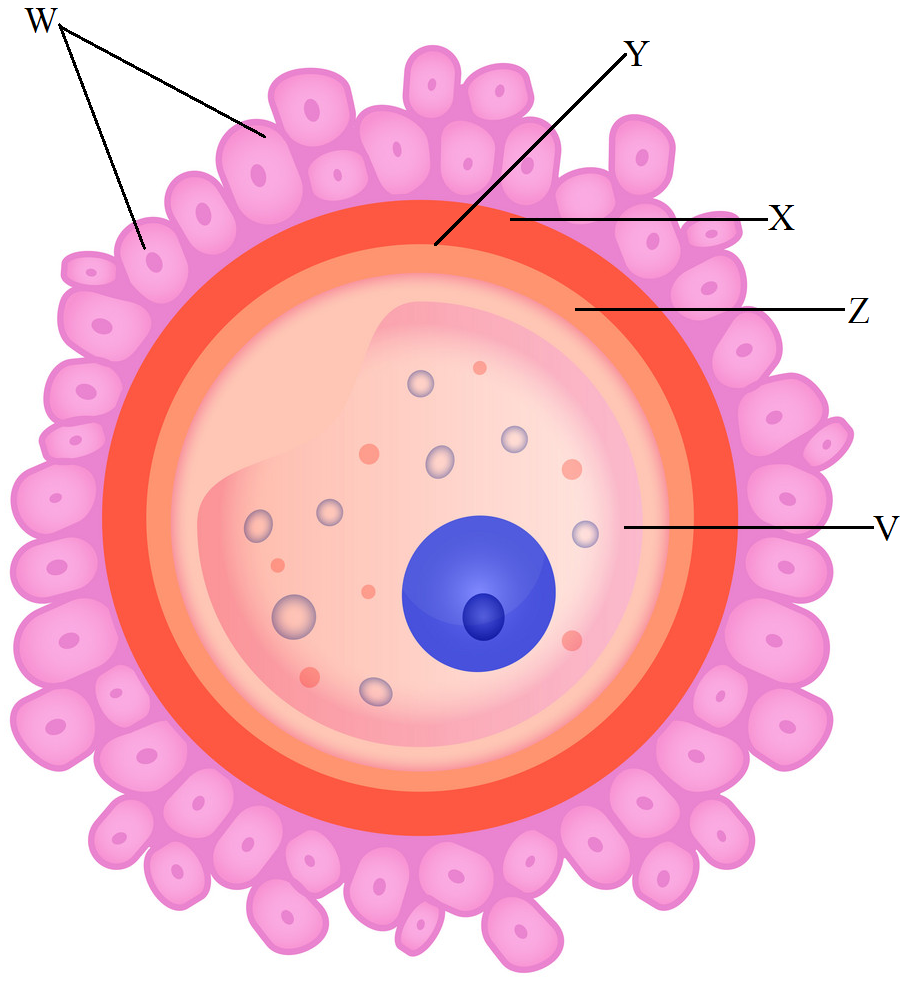
The mature ovum or a female gamete is spherical in shape. The human ovum is almost free of yolk and is said to be alecithal. Human ovum loses its ability to be fertilised about 24 hours after ovulation. Refer to the given structure of ovum and answer the following questions.

  1. Thick cellular layer formed of radially elongated follicular cells is:
  1. Zona pellucida.
  2. Plasma membrane.
  3. Perivitelline membrane.
  4. Corona radiata.
  1. In humans, at which stage does ovum get released from ovary?
  1. Secondary oocyte.
  2. Oogonium.
  3. Primary oocyte.
  4. First polar body.
  1. Cytoplasm of an ovum is enveloped by _____.
  1. Zona pellucida.
  2. Corona radiata.
  3. Cell membrane.
  4. Perivitelline space.
  1. Select the correct option:
S. No
V
W
X
(a)
Cytoplasm
Zona pellucida
Plasma membrane
(b)
Cortical granules
Corona radiata
Zona pellucida
(c)
Cortical granules
Plasma membrane
Corona radiata
(d)
Cytoplasm
Corona radiata
Zona pellucida
  1. Which of the following is not a characteristic of an ovum?
  1. Nucleus of an ovum has prominent nucleolus.
  2. Only one ovum formed from one oogonium.
  3. It lacks centrioles.
  4. It has very small amount of ooplasm.
Suggest some methods to assist infertile couples to have children.
Write a short note on transcription unit.### Explain : Transcription unit