Question
  1. When an AC source is connected to an ideal capacitor, show that the average power supplied by the source over a complete cycle is zero.
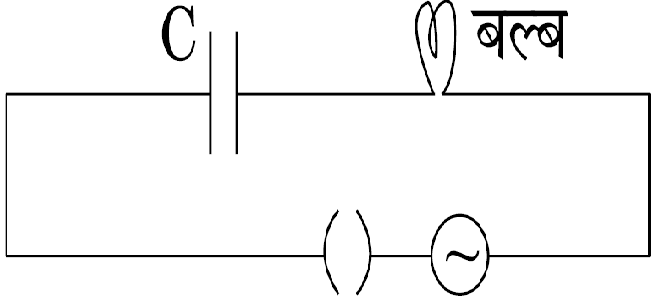
  2. A bulb is connected in series with a variable capacitor and an A.C. source as shown. What happens to the brightness of the bulb when the key is `the capacitor is gradually reduced?
Answer

  1. Let the applied voltage be
$\text{V}= \text{V}_{o}\sin\omega\text{t}$
The current through an ideal capacitor, would then be
$\text{I} = \text{I}_{o}\sin(\omega\text{t} + \frac{\pi}{2}) = \text{I}_{0}\cos\omega\text{t}$
$\therefore\text{P}_{inst} = \text{VI}$
$\therefore\text{P}_{AV} = \frac{1}{\text{T}}\int^{T}_{0}\text{VIdt}$
$\therefore\text{P}_{AV} = \frac{\text{V}_{0}\text{I}_{0}}{2}\langle\sin2\omega\text{t}\rangle$
$=0.$
  1. $\text{X}_{c} = \frac{1}{\omega\text{C}}$
$\therefore\text{X}_{c}$ increases as C decreases.Hence, with decreasing C, the brightness of the bulb would decrease.

Need a full question paper?

Generate a complete, print-ready paper with questions like this in minutes — across 16+ boards, with answer keys.

Start Generating Free

Similar questions

A simple microscope has a magnifying power of 3.0 when the image is formed at the near point (25cm) of a normal eye.
  1. What is its focal length?
  2. What will be its magnifying power if the image is formed at infinity?
Define resolving power of a microscope. Write its formula. How will it be affected when
(i) the wavelength of incident light decreases and
(ii) the aperture of the objective decreases ?
Explain principle, construction and working of optical fibre.
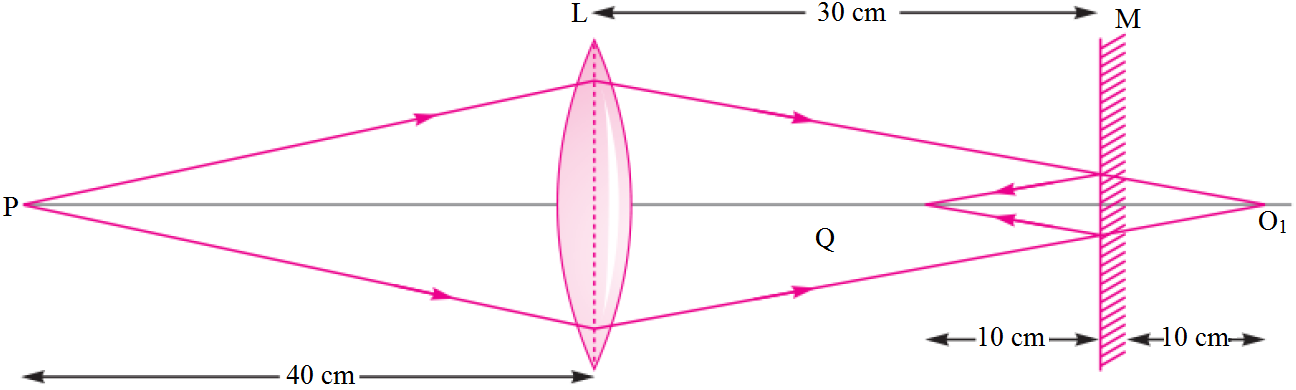
A convex lens, of focal length $20\ cm,$ has a point object placed on its principle axis at distance of $40\ cm$ from it. A plane mirror is placed $30\ cm$ behind the convex lens. Locate the position of image formed by this combination.
Find the range of frequency of light that is visible to an average human being $(400\ \text{nm}<\lambda<700\ \text{nm}).$
Two neutral particles are kept $1m$ apart. Suppose by some mechanism some charge is transferred from one particle to the other and the electric potential energy lost is completely converted into a photon. Calculate the longest and the next smaller wavelength of the photon possible.
How much energy is released in the following reaction?
$\text{ }^7\text{Li + p}\rightarrow\alpha+\alpha.$
Atomic mass of $^7Li = 7.0160u$ and that of $^4He = 4.0026u.$
A 12.3 eV electron beam is used to bombard gaseous hydrogen at room temperature. Upto which energy level the hydrogen atoms would be excited?
Calculate the wavelengths of the second member of Lyman series and second member of Balmer series.
A proton and an $\alpha$-particle move perpendicular to a magnetic field. Find the ratio of radii of the circular paths described by them when both (i) have equal momenta, and (ii) were accelerated through the same potential difference.
Get the electric field due to a uniformly charged thin spherical shell.