Question
Explain briefly the relationship between poverty and population and how one affects the other.

Answer

Poverty and population have been closely linked ever since the world faced changes due to the major revolutions. Poverty has its own effects on the population and vice versa. Poverty prevails because of illiteracy and traditional beliefs in the economically weaker strata. Since illiteracy and traditional beliefs prevail the people from this stratum, they regard children as gift of God and a sign of prosperity. They consider children to be helping hands in increasing the family income, hence they keep producing more children forgetting that their current situation would do no good for the children and they would add more to this already overburdened poverty strata. Hence, the population keeps on rising and so does poverty. As the population increases the quality of life goes down.

Need a full question paper?

Generate a complete, print-ready paper with questions like this in minutes — across 16+ boards, with answer keys.

Start Generating Free

Similar questions

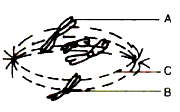
The fig given alongside shows a certain stage in a cell division in a cell with four chromosomes.

(i) Name the parts of the chromosome labeled A and B.
(ii) Name the structure C. what is its function?
(iii) Name the type of division . Give a reason.
(iv) Name the stage of division.
(v) Name the stages before and after the stage shown in diagram.
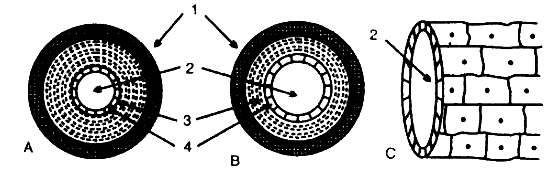
The figures given below are cross-sections of blood vessels.

(i) Identify the blood vessels A, B, and C.
(ii) Name the parts labeled 1-4.
(iii) Mention two structural differences between A and B.
(iv) Name the type of blood A that flows (a) through A, (b) through B.
(v) In which of the above vessels referred to in (iv) above does exchange of gases actually take place?
State two methods of contraception, one a barrier method and one which is not a barrier method. For each method named give two advantages and one disadvantage of the method.
Write short note on the following:
Guttation
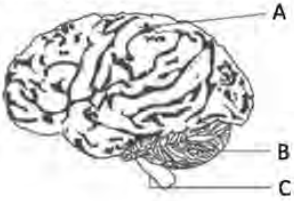
The diagram given below shows a section of the human brain.

Image

(i) Name the parts labelled $A, B$ and $C$.
(ii) Give the main function of each of the parts, $A, B$ and $C$.
(iii) Name the three protective membranes covering the brain.
Make a punnett square for finding out the proportion of different genotypes in the progeny of a genetic cross between.
red flower variety of pea (RR) with white flower variety of pea (rr)
List some adaptations found in desert plants to reduce transpiration.
Given below is the diagram of an experimental set up to study the process of transpiration in plants. Study the same and then answer the questions that follow:
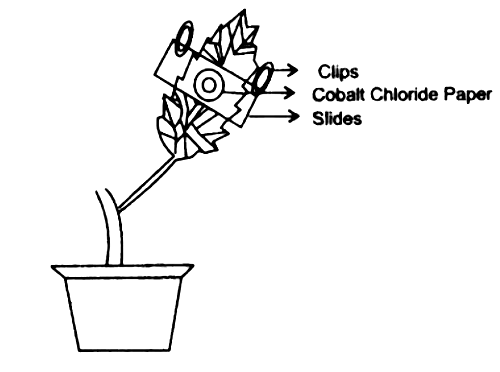
(i) What is the colour of dry cobalt chloride paper?
(ii) Is the experimental leaf a monocot or a dicot? Give a reason to support your answer.
(iii) Why axe glass slides placed over the dry cobalt chloride papers?
(iv) After about half an hour what change, if any, would you expect to find in the cobalt chloride paper placed on the dorsal and ventral sides of the leaf? Give a reason to support your answer.
(v) Define the term ‘transpiration’.
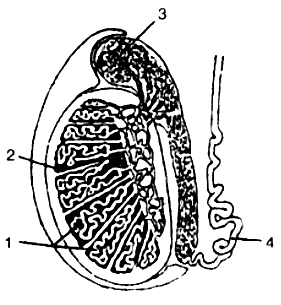
Given below is a diagram of the lateral section of the testis of a man. Study the same and answer the questions that follow:
(i) Label the parts numbered 1 to 4 of the diagram.
(ii) State the functions of the parts labeled 1 and 3.
(iii)What is the significance of the testes being located in the scrotal sac outside the abdomen?
(vi)What is the role played by the inguinal canal?
(v) What is semen?
What are the two kinds of diabetes? Mention their symptoms and the causes.