Question
i. Explain:
1. $\mathrm{CCl}_4$ doesn't hydrolyse unlike $\mathrm{SiCl}_4$.
2. Ga has a lower atomic radius compared to Al.
ii. Write balanced equations for:
a. Silicon dioxide is treated with hydrogen fluoride.
b. Boric acid is added to water.
iii. Diborane reacts with $\mathrm{NH}_3$ followed by heating.
Answer

  1.  
  1. It is because 'C' does not have d-orbitals.
  2. It is due to poor sheilding effect of d-electrons present in Ga as a result of which effective nuclear charge increases.
  1.  
  1. $\text{SiO}_2\ +\ 6\text{HF}\ \xrightarrow{\ \ \ \ \ \ \ \ }\ \text{H}_2\text{SiF}_6\ +\ 2\text{H}_2\text{O}$
  2. $\text{H}_3\text{BO}_3\text{}\ +\ \text{H}_2\text{O}\ \xrightarrow{\ \ \ \ \ \ }[\text{B(OH})_4]^{-}\ +\ \text{H}^+$
  1. $ 3\text{B}_2\text{H}_6\ +\ 6\text{NH}_3\ \xrightarrow{\ \ \ \Delta\ \ \ }\ 2\text{B}_3\text{N}_3\text{H}_6\ +\ 12\text{H}_2\\ ^\text{Diborane}\ \ \ \ \ ^\text{Ammonia}\ \ \ \ \ \ \ \ \ \ \ \ \ \ ^\text{Borazole}\ \ \ \ \ \ \ \ \ ^\text{Hydrogen}$

Need a full question paper?

Generate a complete, print-ready paper with questions like this in minutes — across 16+ boards, with answer keys.

Start Generating Free

Similar questions

S. No
Column I
Column II
1.
$Cl_2O$
+7
2.
$Cl_2O_7$
+4
3.
$ClO_2$
+1
4.
$Cl_2O_6$
+6
Explain the following: $CO_2$ is a gas whereas $SiO_2$ is a solid.
Balance the following equations in basic medium by ion-electron method and oxidation number methods and identify the oxidising agent and the reducing agent.$\text{P}_4(\text{s})+\text{OH}^{-}(\text{aq})\rightarrow\text{PH}_3(\text{g})+\text{HPO}_2^-(\text{aq})$
1. What is the relationship between the members of following pairs of structures? Are they structural or geometrical isomers or resonance contributors?
Image
2. A sample of 0.50 g of an organic compound was treated according to Kjeldahl's method. The ammonia evolved was absorbed in 50 mL of $0.5 M H _2 SO _4$. The residual acid required 60 mL of 0.5 M solution of NaOH for neutralisation. Find the percentage composition of nitrogen in the compound.
Calculate the atomic mass (average) of chlorine using the following data:
 
% Natural Abundance
Molar Mass
${ }^{35} \mathrm{Cl}$
75.77
34.9689
${ }^{37} \mathrm{Cl}$
24.23
36.9659
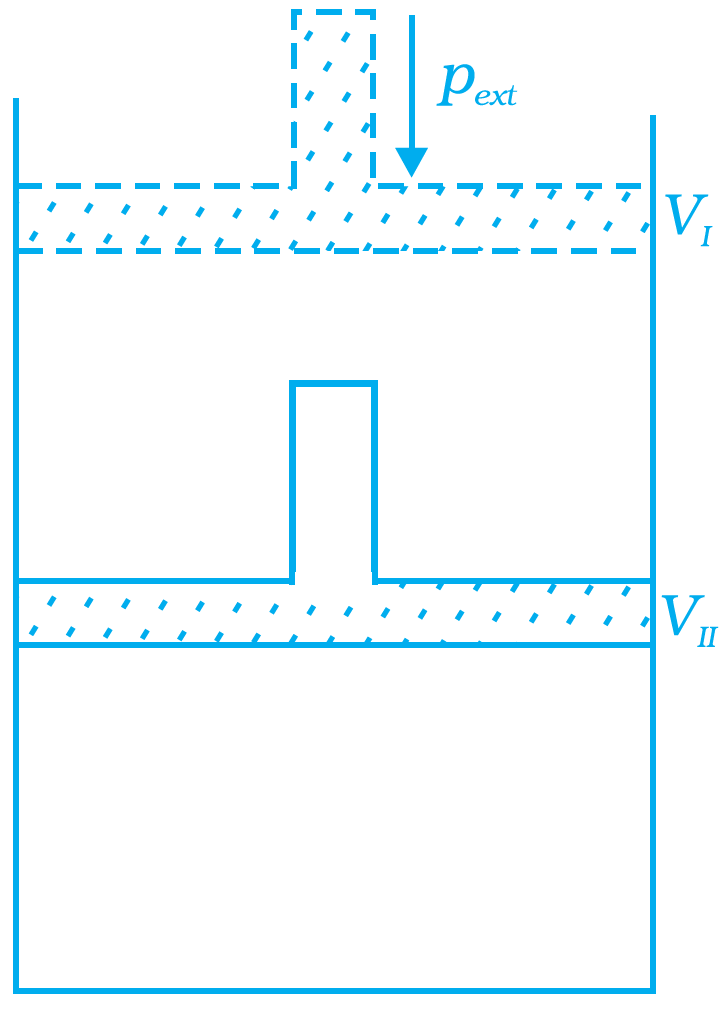
What will be the work done on an ideal gas enclosed in a cylinder, when it is compressed by a constant external pressure, $p_{ext}$​​​​​​​ in a single step as shown in Fig. Explain graphically.
What is the equilibrium concentration of each of the substances in the equilibrium when the initial concentration of ICl was 0.78M?
$2\text{ICI (g)}\rightleftharpoons\text{I}_2\text{ (g) + Cl}_2\text{ (g)};\text{ K}_{\text{c}}=0.14$
In terms of period and group where would you locate the element with $Z=114$?
Calculate the pH of 0.4g of NaOH dissolved in water to give 200ml of solution.
Consider the following species:
$N^{3–}, O^{2–}, F^–, Na^+, Mg^{2+}$ and $Al^{3+}$​​​​​​​
  1. What is common in them?
  2. Arrange them in the order of increasing ionic radii.