Question
Explain characteristics of electric charge.

Answer

►(1) There are two types of electric charge :
         (i) Positive charge.
         (ii) Negative charge.
   (2) Heterogeneous electric charges repel and homogeneous charge attracts each other.
   (3) Electric charge without mass does not exist.
   (4) Charge is an internal property of matter.

Need a full question paper?

Generate a complete, print-ready paper with questions like this in minutes — across 16+ boards, with answer keys.
Start Generating Free

Similar questions

Find the maximum Coulomb force that can act on the electron due to the nucleus in a hydrogen atom.
The wavelength of light in a medium is $\lambda=\frac{\lambda_0}{\mu},$ where $\lambda$ is the wavelength in vacuum. A beam of red light $(\lambda_0=720\text{nm})$ enters into water. The wavelength in water is $\lambda=\frac{\lambda_0}{\mu}=540\text{nm}.$ To a person under water does this light appear green?
Using lens maker’s formula, derive the thin lens formula $\frac{1}{\text{f}}=\frac{1}{\text{v}}-\frac{1}{\text{u}}$ for a biconvex lens.
Metallic (nonferromagnetic) and nonmetallic particles in a solid waste may be separated as follows. The waste is allowed to slide down an incline over permanent magnets. The metallic particles slow down as compared to the norunetallic ones and hence are separated. Discuss the role of eddy currents in the process.
  1. Write the necessary conditions for the phenomenon of total internal reflection to occur.
  2. Write the relation between the refractive index and critical angle for a given pair of optical media.
If three identical prisms are combined, is it possible to pass a beam that emerges undeviated? Undispersed?
Identify the electromagnetic waves whose wavelengths vary as
  1. 10–12 m < $\lambda$ < 10–8 m
  2. 10–3 m < $\lambda$ < 10–1 m
Write one use for each.
Briefly explain the discovery of neutrons.
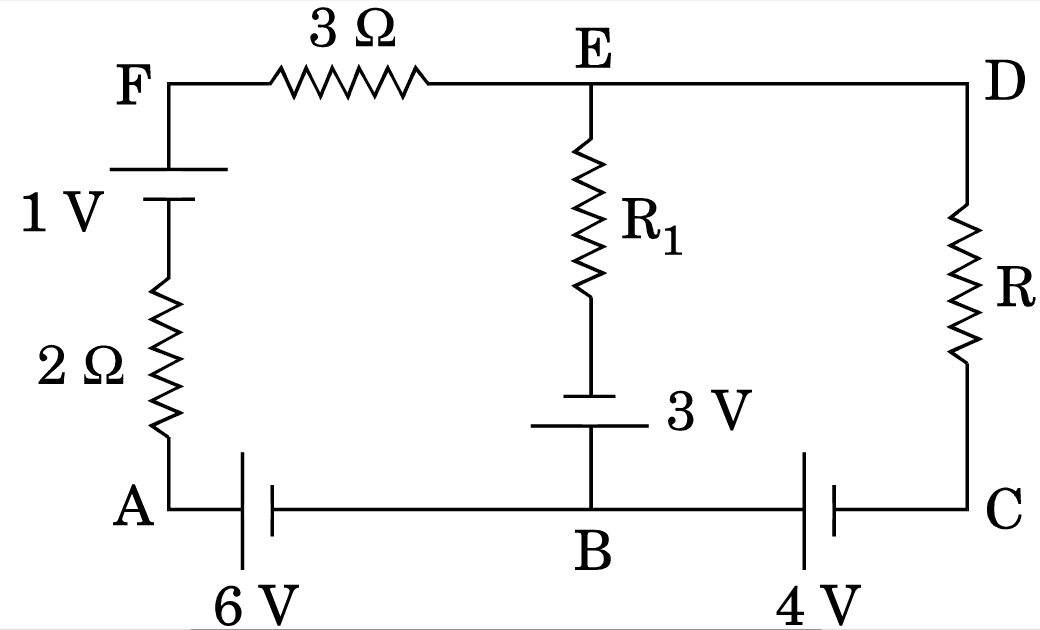
Use Kirchhoff ’s rules to determine the potential difference between the points A and D when no current flows in the arm BE of the electric network shown in the figure.

Light from Balmer series of hydrogen is able to eject photoelectrons from a metal. What can be the maximum work function of the metal?