Question
Explain clearly, with examples, the distinction between: magnitude of displacement (sometimes called distance) over an interval of time, and the total length of path covered by a particle over the same interval;

Answer

The magnitude of displacement over an interval of time is the shortest distance (which is a straight line) between the initial and final positions of the particle. The total path length of a particle is the actual path length covered by the particle in a given interval of time. For example, suppose a particle moves from point A to point B and then, comes back to a point, C taking a total time t, as shown below. Then, the magnitude of displacement of the particle = AC. Whereas, total path length = AB + BC It is also important to note that the magnitude of displacement can never be greater than the total path length. However, in some cases, both quantities are equal to each other.

Need a full question paper?

Generate a complete, print-ready paper with questions like this in minutes — across 16+ boards, with answer keys.
Start Generating Free

Similar questions

There are two displacement vectors, one of magnitude $3m$ and the other of $4m$. How would the two vectors be added so that the magnitude of the resultant vector be $(i)\  7m\  (ii)\  1m$ and $(iii)\  5m$?
A thin prism of crown glass $(\mu_\text{r}=1.515,\mu_\text{v}=1.525)$ and a thin prism of flint glass $(\mu_\text{r}=1.612,\mu_\text{v}=1.632)$ are placed in contact with each other. Their refracting angles are 5.0° each and are similarly directed. Calculate the angular dispersion produced by the combination.
A body of mass $2\ kg$ is initially at rest. A constant force of $5\ N$ acts on it for $10\ s.$ Calculate the average power of the force.
A steam engine delivers $5.4 \times 10^8 \mathrm{~J}$ of work per minute and services $3.6 \times 10^9 \mathrm{~J}$ of heat per minute from its boiler. What is the efficiency of the engine? How much heat is wasted per minute?
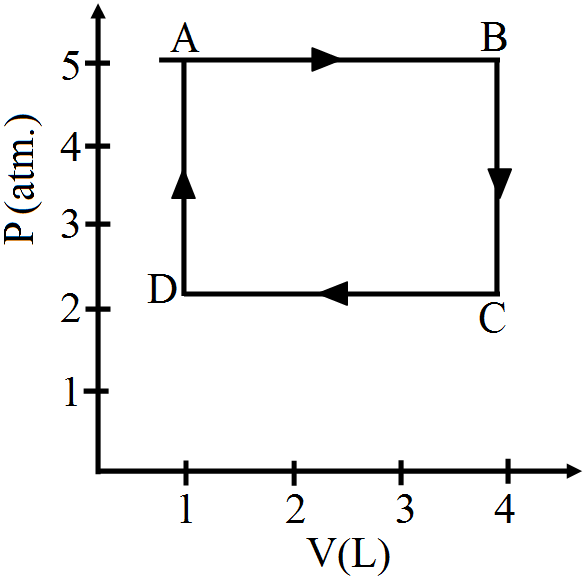
One mole of an ideal gas undergoes a cyclic change ABCD. From the given diagram, calculate the net work done in the process. $1$ atmosphere = $10^\circ dyne\ cm^{-2}$.
Derive an expression for the work done in an isothermal process.
Distinguish between a cyclic process and a non-cyclic process.
A body of mass ‘m' suspended from a spring executes S.H.M. Calculate the ratio of the kinetic energy and potential energy of the body when it is at half the amplitude far from the mean position.
A body is moving in a straight line along $x-$axis. Its distance from the origin is given by the equation $x = at^2 - bt^3$, where $x$ is in metre and $t$ is in second. Find :
  1. The average speed of the body in the interval $t = 0$ and $t = 2s$.
  2. its instantaneous speed at $t = 2s$.
The coefficient of apparent expansion of a liquid when determined using two different vessels A and B are $\gamma_1$ and $\gamma_2$ respectively. If the coefficient of linear expansion of vessel A is α, find the coefficient of linear expansion of vessel B.