Question
Explain clearly, with examples, the distinction between: magnitude of displacement (sometimes called distance) over an interval of time, and the total length of path covered by a particle over the same interval;

Answer

The magnitude of displacement over an interval of time is the shortest distance (which is a straight line) between the initial and final positions of the particle. The total path length of a particle is the actual path length covered by the particle in a given interval of time. For example, suppose a particle moves from point A to point B and then, comes back to a point, C taking a total time t, as shown below. Then, the magnitude of displacement of the particle = AC. Whereas, total path length = AB + BC It is also important to note that the magnitude of displacement can never be greater than the total path length. However, in some cases, both quantities are equal to each other.

Need a full question paper?

Generate a complete, print-ready paper with questions like this in minutes — across 16+ boards, with answer keys.
Start Generating Free

Similar questions

Three uniform spheres each having a mass M and radius a are kept in such a way that each touches the other two. Find the magnitude of the gravitational force on any of the spheres due to the other two.
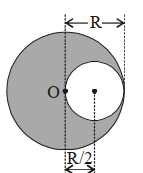
A sphere of radius $R$ has been cut out of $\left(\frac{R}{2}\right)$ solid sphere of radius $R$ as shown in the figure. Find the position of the center of mass of the remaining sphere.
Image
A particle is released from the top of an incline of height h. Does the kinetic energy of the particle at the bottom of the incline depend on the angle of incline? Do you need any more information to answer this question in Yes or No?
In science sometimes we observe certain phenomenon experimentally but are unable to give a logical equation or theory for that. Sometimes, it also happens that we have a scientific theory supported by mathematical formulation yet are unable to test it immediately. Cite one such example.
The speed of sound in air is 332m/s. Is it advisable to define the length 1m as the distance travelled by sound in $\frac{1}{332}\text{s}$?
A light ray, going through a prism with the angle of prism 60°, is found to deviate by 30°. What limit on the refractive index can be put from these data?
A woman starts from her home at 8.00 a.m., walks with a speed of 5km/ hr on a straight road upto her office 5km away stays at the office upto 4 p.m., and returns home by an auto with a speed of 25km/ hr. Choose suitable scales, and plot the x-t graph of her motion.
A cylindrical vessel of uniform cross-section contains liquid upto a height 'H'. At a depth $'\text{h}'=\frac{\text{H}}{2}$ below the free surface of the liquid there is an orifice. Using Bernoulli's theorem, find the velocity of efflux of liquid.
The flow rate of water is $0.58 L / mm$ from a tap of diameter of 1.30 cm . After some time, the flow rate is increased to $4 L / min$. Determine the nature of the flow for both the flow rates. The coefficient of viscosity of water is $10^{-3} Pa- s$ and the density of water is $10^3 kg / m ^3$.
The electric field associated with a monochromatic beam becomes zero $1.2 \times 10^{15}$ times per second. Find the maximum kinetic energy of the photoelectrons when this light falls on a metal surface whose work function is 2.0eV.