Question
Explain co-dominance in humans with the help of example.

Answer

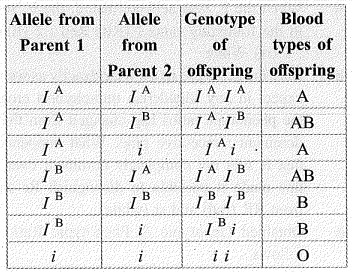
→ Co-dominance is a phenomenon in which two alleles express themselves independently when present together in an organism.
→ Example: ABO Blood Group
→ It is the inheritance in which both alleles of a gene are expressed in a hybrid. E.g. ABO blood grouping inhuman.
→ ABO blood groups are controlled by the gene I.
→ This gene controls the production of sugar polymers (antigens) that protrude from plasma membrane of RBC.
→ The gene I has three alleles IA, IB & i.
→ IA and IB produce a slightly different form of the sugar while allele i doesn't produce any sugar.Image
→ When I and I are present together, they both express their own types of sugars. This is due to co-dominance.
Need a full question paper?

Generate a complete, print-ready paper with questions like this in minutes — across 16+ boards, with answer keys.

Start Generating Free

Similar questions

Define ecological pyramids and describe with examples, pyramids of number and biomass.
Read the following and answer any four questions from (i) to (v) given below:
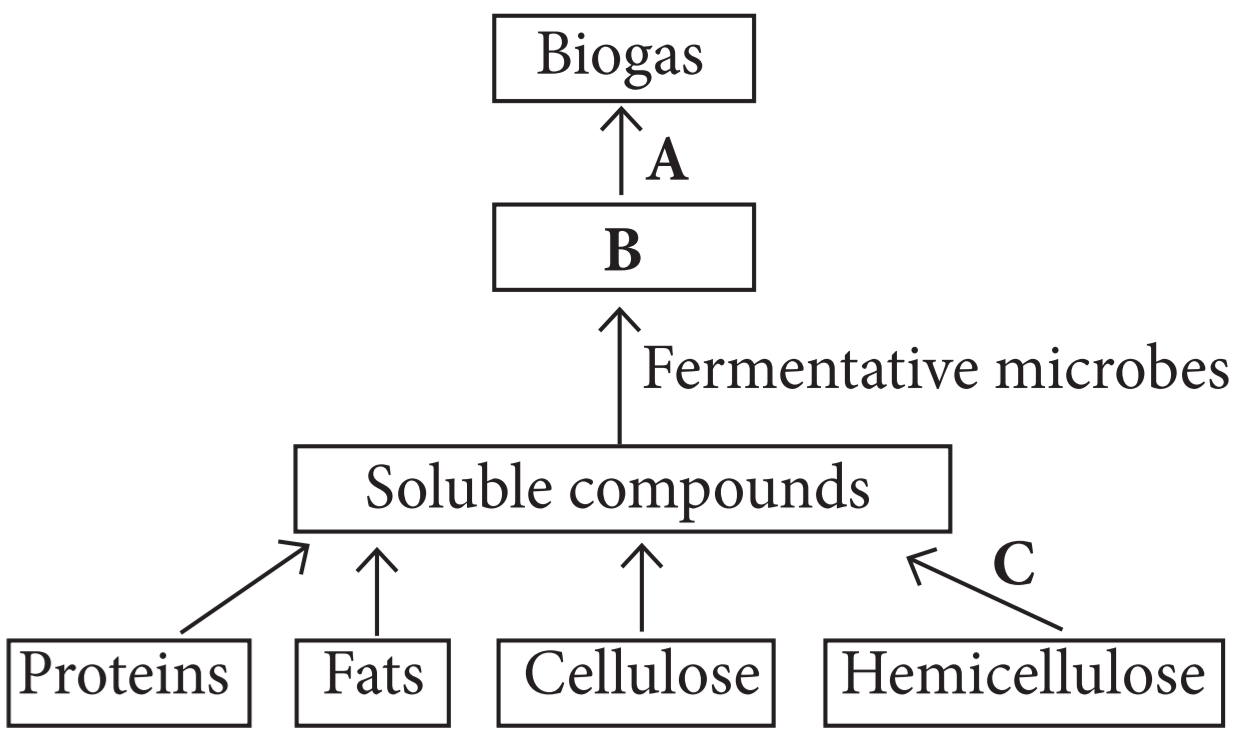
Villagers in a place near Chambur started planning to make power supply for agricultural purposes from cow dung. 'Tiley have started a biogas plant for the purpose. Study the flow chart for biogas production given below and answer the following questions.
  1. Biagas is composed of majorly:
  1. Methane, $\mathrm{CO}_2$ and $\mathrm{O}_2$
  2. $\mathrm{CO}_2, \mathrm{H}_2 \mathrm{~S}$ and H
  3. Methane, $\mathrm{CO}_2$
  4. $\mathrm{H}_2 \mathrm{~S}, \mathrm{H}$ and $\mathrm{O}_2$
  1. In the given flow chart, 'A' denotes:
  1. Aerobic bacteria.
  2. Methanogenic bacteria.
  3. Cellulose degrading bacteria.
  4. Yeast and protozoa.
  1. What is represented by 'B' in the flow chart?
  1. Carbohydrates.
  2. Protein polymers.
  3. Organic acids.
  4. Fat globules.
  1. 'C' in the given flow chart causes:
  1. Aerobic breakdown of complex organic compounds.
  2. Anaerobic digestion of complex organic compounds.
  3. Fermentation of organic compounds.
  4. Fermentation of monomers.
  1. If 'A' is not added in the procedure.
  1. Methane will not be formed.
  2. $\mathrm{CO}_2$ will not be formed.
  3. Organic compounds will not be converted to $\mathrm{H}_2 \mathrm{S}$
  4. $\mathrm{O}_2$ will not be formed.
Read the following and answer any four questions from (i) to (v) given below:
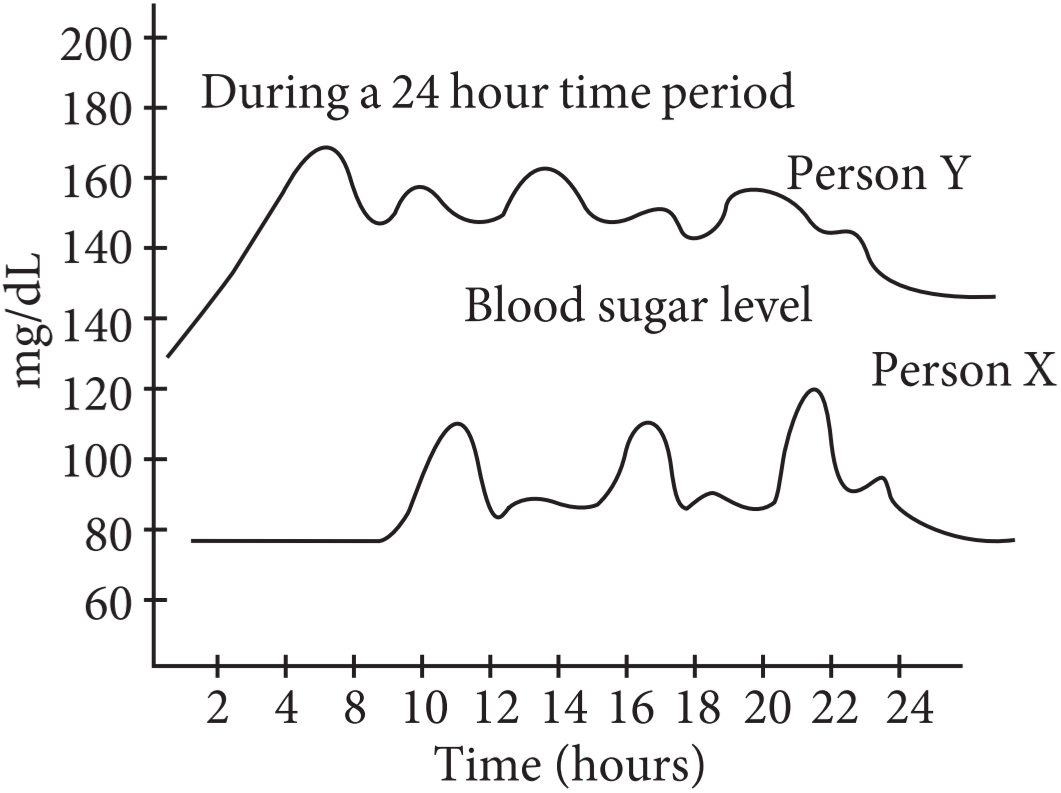
The given graphs show fluctuations in blood sugar of person X and Y during a 24 hour time period.

Based on the above information, answer the following questions.
  1. Which of the following holds true for person X?
  1. Person X is suffering from type I diabetes.
  2. Person X shows severe insulin deficiency and beta cell depletion.
  3. Person X is normal and shows good control of blood sugar level.
  4. Person X is subjected to excessive urination and abnormal thrust.
  1. The given graph indicates that person Y is suffering from.
  1. Diabetes
  2. Hypertension
  3. Atherosclerosis
  4. Rheumatic heart disease.
  1. Which of the following conditions are common in person Y?
  1. Excretion of glucose in urine and excessive urination.
  2. Polydipsia and mild beta cell depletion.
  3. Progressive erosion of articular cartilage at synovial joint.
  4. Both (a) and (b).
  1. A person suffering from diabetes mellitus becomes weak because.
  1. The cells are unable to utilise glucose and other carbohydrates for energy production.
  2. Degradation of fat increases production of toxic ketone bodies.
  3. Cells utilise proteins for obtaining energy
  4. All of these.
  1. Assertion: Type I diabetes involves failure of insulin to facilitate the movement of glucose into cells.
Reason: Type II diabetes is caused by failure of beta cells to produce adequate amount of insulin due to beta cell depletion.
  1. Both assertion and reason are true, and reason is the correct explanation of assertion.
  2. Both assertion and reason are true, but reason is not the correct explanation of assertion.
  3. Assertion is true, but reason is false.
  4. Both assertion and reason are false.
Explain different types of RNA along with process of transcription.
Explain innate immunity in detail
Draw a schematic diagram of typical anatropous ovule and describe structure of megasporangium in detail.###With a neat, labelled diagram, describe the parts of a typical angiosperm ovule.
Read the following text carefully and answer the questions that follow:
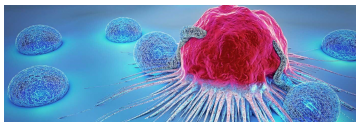
Cancer refers to any one of a large number of diseases characterized by the development of abnormal cells that divide uncontrollably and have the ability to infiltrate and destroy normal body tissue. Cancer often has the ability to spread throughout your body. Cancer is the second-leading cause of death in the world.
Image
i. How does a cancerous cell differ from a normal cell? (1)
ii. Benign tumor is less dangerous than malignant tumor. Why? (1)
iii. Describe causes of cancer. (2)
OR
Mention two methods of treatment of the disease. (2)
Read the following and answer any four questions from (i) to (v) given below:
Kangaroo rat seldom drinks water. It has thick coat to minimise evaporative desiccation. TI1e animal seldom comes out of its comparatively humid and cool burrow during the day time. 90% of its water requirement is met from metabolic water (water produced by respiratory breakdown of fats) while 10% is obtained from its food. Loss of water is minimised by producing nearly solid urine and faeces. As the animal faces acute water scarcity, it develops two types of adaptations : reducing water loss and ability to tolerate desert conditions.
  1. Kangaroo rat is a:
  1. Partial regulators
  2. Partial conformer
  3. Regulator
  4. Conformer
  1. Metabolic water refers to:
  1. Water required for metabolic activities.
  2. Water present in intercellular fluid.
  3. Water produced during oxidation of fat or carbohydrate.
  4. Water taken in, to promote metabolism.
  1. Desert animals minimise water loss by:
  1. Producing highly concentrated urine.
  2. Promoting maximum reabsorption of water in kidney tubules.
  3. Possessing one of the longest loop of Henle in kidney tubules.
  4. All of these.
  1. Assertion: Kangaroo rat can tolerate and thrive in wide temperature range and is known as stenothermal.
Reason: Kangaroo rats go into hibernation during winter to escape cold weather.
  1. Both assertion and reason are true and reason is the correct explanation of assertion.
  2. Both assertion and reason are true but reason is not the correct explanation of assertion.
  3. Assertion is true but reason is false.
  4. Both assertion and reason are false.
  1. The adaptations in an organism are meant for:
  1. Optimum primary production.
  2. Optimum life span.
  3. Optimum mobility.
  4. Optimum survival and reproduction.
For food related services, granting patent for transgenic organisms is becoming complicated. Explain with example.
Read the following and answer any four questions from (i) to (v) given below:
Cleavage is the series of rapid mitotic divisions in zygote and forms blastula. The 2, 4, 8, 16 daughter cells are called blastomeres. Embryo with 64 blastomeres is known as blastocyst and has blastocoel cavity. Blastocyst gets implanted in uterine wall and leads to pregnancy.
  1. Solid mass of cells with 16 blastomeres is called:
  1. Morula.
  2. Blastula.
  3. Gastrula.
  4. Zygote.
  1. At which stage of embryonic development, trophoectoderm develops?
  1. Zygote.
  2. Morula.
  3. Blastula.
  4. Gastrula.
  1. Site of implantation is:
  1. Endometrium of uterus.
  2. Cervix.
  3. Uterine fundus.
  4. Infundibulum of oviduct.
  1. Correct sequence of various structures formed during embryonic development is:
  1. Morula → Embryo → Gastrula → Blastula.
  2. Zygote → Embryo → Morula → Blastula.
  3. Blastula → Morula → Gastrula → Embryo.
  4. Zygote → Morula → Blastula → Gastrula.
  1. Assertion: Side of blastocyst with inner cell mass is called animal pole.
Reason: Inner cell mass gives rise to embryo.
  1. Both assertion and reason are true, and reason is the correct explanation of assertion.
  2. Both assertion and reason are true, but reason is not the correct explanation of assertion.
  3. Assertion is true, but reason is false.
  4. Both assertion and reason are false.