Questions

Case study (4 Marks)

Take a timed test

9 questions · self-marked practice — reveal the answer and mark yourself.

Question 14 Marks
Explain the inheritance of one gene by Punnett Square ?
Answer
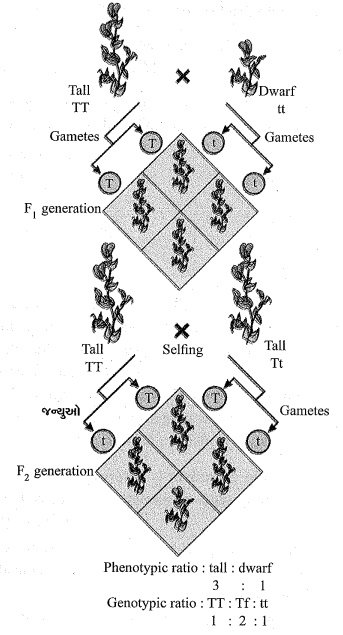
$\rightarrow$ Punnett Squre:
$\rightarrow$ The production of gametes by the parents, the formation of the zygotes, the $F,$ and $F_2$ plants can be understood from a diagram called Punnett Square $($By Reginald $C.$ Punnett).
$\rightarrow$ It is a graphical representation to calculate the probability of all possible genotypes of offspring in a genetic cross.
$\rightarrow$ The Punnett Square shows,
$TT$ $\rightarrow$ Tall $($Male$)$ $(♂)$
$tt$ $\rightarrow$ Dwarf $($Female$)$ $(♀)$
Produced Gametes $(T, t)$
$Tt\rightarrow$ $F$ Progeny $($self$-$pollinated$)$
$\rightarrow$ The $F_1$ plant of the genotype $Tt$ when self$-$ pollinated, produces gametes of the genotype $T$ and $t$ in equal proportion.
$\rightarrow$ When fertilisation takes place, the pollen grains of genotype $T$ have a $50$ per cent chance to pollinate eggs of the genotype $T,$ as well as of genotype $t.$
$\rightarrow$ Also pollen grains of genotype $t$ have a $50$ per cent chance of pollinating eggs of genotype $T,$ as well as of genotype $t.$ As a result of random fertilisation, the resultant zygotes can be of the genotypes $TT, Tt$ or $ tt.$
$\rightarrow$ From the Punnett square it is easily seen that $1/4^{th}$ of the random fertilisations lead to $TT, 1/2$ lead to $Tt $ and $1/4^{th}$ to $tt.$
$\rightarrow$ Though the $F_1$ have a genotype of $Tt,$ but the phenotypic character seen is 'tail'.
$\rightarrow$ At $F_2$, $3/4$ of the plants are tall, where some of them are $TT$ while others are $Tt.$
$\rightarrow$ Externally it is not possible to distinguish between the plants with the genotypes $TT$ and $Tt.$ Hence, within the genotypic pair $Tt$ only
one character $' \ T\ '$ tall is expressed.
$\rightarrow$ Hence the character $T$ or 'tall' is said to dominate over the other allele or 'dwarf character.
$\rightarrow$ It is thus due to this dominance of one character over the other that all the $F_1$ are tall $($though the genotype is $Tt)$ and in the $F_2$ $3/4$ of the plants are tall $($though genotypically $1/2$ are $Tt$ and only $1/4th$ are $TT).$
Genotypic ratio $3 : 1 ($Tall: Dwarf$)$
Phenotypic ratio $1:2:1 \ (TT: Tt: tt)$
$\rightarrow$ The $ 1/4 1/2 1/4$ ratio of $TT \ Tt: tt$ is mathematically condensable to the form of the binomial expression $(ax + by)^2,$ that has the gametes bearing genes $T$ or $t$ in equal frequency of $1/2.$ The expression is expanded as given below:
$\rightarrow$ $(1/2T + 1/2t)^2= (1/2T + 1/2t) \times (1/2T + 1/2t)$
$= 1/4 \ TT + 1/2 \ Tt + 1/4 \ tt$
$\rightarrow$ Mendel self$-$pollinated the $F_2$ plants and found that dwarf $F_2$ plants continued to generate dwarf plants in $F_3$ and $F_4$ generations. He concluded that the genotype of the dwarfs was homozygous $- tt.$ Image
View full question & answer
Question 24 Marks
Describe Sex Determination in honey bee with diagram.
Answer
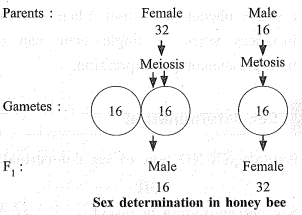
→ The sex determination in honey bee is based on the number of sets of chromosomes an individual receives.
→ An offspring formed from the union of a sperm and an egg develops as a female (queen or worker), and an unfertilised egg develops as a male (drone) by means of parthenogenesis.
→ This means that the males have half the number of chromosomes than that of a female.
→ The females are diploid having 32 chromosomes and males are haploid. i.e. having 16 chromosomes.
→ This is known as haplodiploid sex-determination system and has special characteristic features such as males produce sperms by mitosis they do not have father and thus cannot have sons, but have grandfather and can have grandsons.
Image
View full question & answer
Question 34 Marks
Explain incomplete dominance in dog flower (snapdragon or Antirrhinum sp.) with the help of a chart.###During monohybrid experiment, in F 2 generation, the ratio of phenotype & genotype remains same - explain by giving suitable example (chart is necessary).
Answer
→ When experiments on peas were repeated using other traits in other plants, it was found that sometimes the F, had a phenotype that did not resemble either of the two parents and was in between the two.
→ The inheritance of flower colour in the dog flower (snapdragon or Antirrhinum sp.) is a good example to understand incomplete dominance.
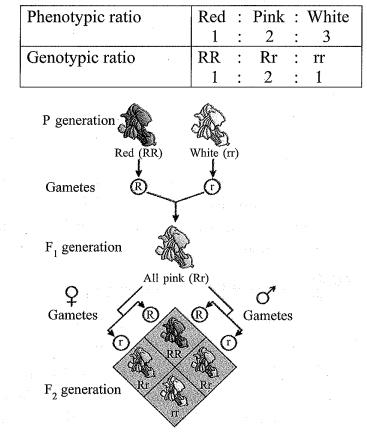
→ In a cross between true-breeding red-flowered (RR) and true breeding white-flowered plants (rr). the F₁ (Rr) was pink.
→ When the F₁ was self-pollinated, the F₂ resulted in the following ratio 1 (RR) Red: 2 (Rr) Pink : 1 (rr) White.
→Here the genotype ratios were exactly as we would expect in any Mendelian monohybrid cross, but the phenotype ratios had changed from the 3:1 dominant: recessive ratio. What happened was that R was not completely dominant over r and this made it possible to distinguish Rr as pink from RR (red) and rr (white).
→ Obtained Genotypic & Phenotypic Ratio is as
follows:
Image
View full question & answer
Question 44 Marks
Explain co-dominance in humans with the help of example.
Answer
→ Co-dominance is a phenomenon in which two alleles express themselves independently when present together in an organism.
→ Example: ABO Blood Group
→ It is the inheritance in which both alleles of a gene are expressed in a hybrid. E.g. ABO blood grouping inhuman.
→ ABO blood groups are controlled by the gene I.
→ This gene controls the production of sugar polymers (antigens) that protrude from plasma membrane of RBC.
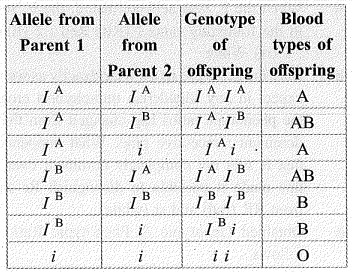
→ The gene I has three alleles IA, IB & i.
→ IA and IB produce a slightly different form of the sugar while allele i doesn't produce any sugar.Image
→ When I and I are present together, they both express their own types of sugars. This is due to co-dominance.
View full question & answer
Question 54 Marks
Explain any two X-linked recessive disorder?
Answer
X-Linked recessive disorder:
→ (i) colourblindness, (ii) Haemophilia.
→ (i) Colour Blindness:
→ It is a sex-linked recessive disorder due to defect in either red or green cone of eye resulting in failure do discriminate between red and green colour.
→ This defect is due to mutation in certain genes present in the X-chromosomes.
→ It occurs in about 8 per cent of males and only about 0.4 per cent of females.
→ This is because the genes that lead to red-green colour blindness are on the X-chromosomes. Males have only one X-chromosomes and females have two.
→ The son of a woman who carries the gene has a 50 per cent chance of being colour blind.
→ The mother is not herself colour blind because the gene is recessive. That means that its effect is suppressed by her matching dominant normal
gene.
→ A daughter will not normally be colour blind, unless her mother is a carrier and her father is colour blind.
→ (ii) Haemophilia:
→ This sex linked recessive disease, which shows its transmission from unaffected carrier female to some of the male progeny has been widely studied.
→ In this disease, a single protein that is a part of the cascade of proteins involved in the clotting of blood is affected.
→ Due to this, in an affected individual a simple cut will result in non-stop bleeding.
→ The heterozygous female (carrier) haemophilia may transmit the disease to sons.
→ The possibility of a female becoming a haemophilic is extremely rare because mother of such a female has to be at least a carrier and the father should be haemophilic (unviable in the later stage of life.)
→ The family pedigree of Queen Victoria shows a number of haemophilic descendents as she was a carrier of the disease.
View full question & answer
Question 64 Marks
Explain: Chromosomal Theory of Inheritance.###Briefly mention the contribution of T.H. Morgan in genetics.
Answer
→ Proposed by Walter Sutton & Theodore Boveri.
→ They said that pairing & separation of a pair of chromosomes lead to segregation of a pair of factors they carried.
→ Sutton united chromosomal segregation with Mendelian principles and called it the chromosomal theory of inheritance. It states that:
(a) Chromosomes are vehicles of heredity.
(b) Two identical chromosomes form a homologous pair.
(c) Homologous pair segregates during gamete formation.
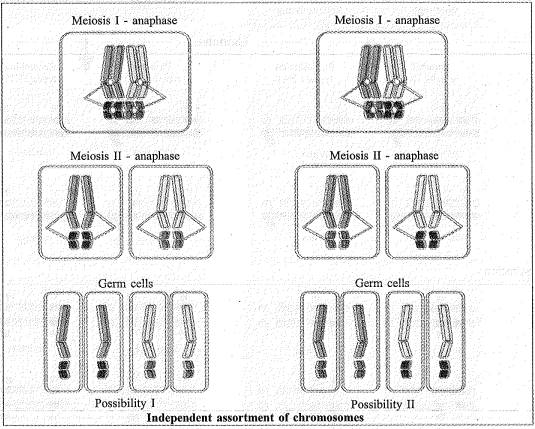
(d) Independent pairs segregate independently of each other. Genes (factors) are present on chromosomes. Hence genes and chromosomes show similar behaviours.
Image
Image
→ Thomas Hunt Morgan proved chromosomal theory of inheritance using fruit flies (Drosophila melanogaster).
It is the suitable material for genetic study because:
→ They can grow on simple synthetic medium.
→ Short generation time (life cycle: 12-14 days).
→ Breeding can be done throughout the year.
→ Hundreds of progenies per mating.
→ Male and female flies are easily distinguishable e.g. Male is smaller than female.
→ It has many types of hereditary variations that can be seen with low power microscopes.
View full question & answer
Question 74 Marks
Differentiate between Monohybrid & Dihybrid Cross.
Answer
Monohybrid cross Dihybrid cross
1Monohybrid cross is a genetic cross between two homozygous individuals to obtain progenies with a single contrasting character1Dihybrid corss is a cross between two pure plants to obtain progenies with two contrasting characters.
2Phenotypic ratio is 3: 1 in the F₂ generation.2Phenotypic ratio is 9:3:3:1 in the F₂ generation.
3It produces a genotypic ratio of 1:2:1 in F₂ generation.3It produces a genotypic ratio of 1:2:2:4:2: 1:2:1 in F₂ generation.
4A single pair of gene is involved.4Two pair of gene is involved.
View full question & answer
Question 84 Marks
What is chromosomal disorder? Explain any two aneuploidy with characters in humans.###Mention any two autosomal genetic disorders with their symptoms.
Answer
→Chromosomal disorder is caused due to absence or excess or abnormal arrangement of one or more chromosomes. It is of 2 types: (i) Aneuploidy (ii) Euploidy
→ (i) Aneuploidy
→ Failure of segregation of chromatids during cell division cycle results in the gain or loss of a chromosomes, is called aneuploidy.
(i) Down's syndrome: It is the presence of an additional copy of chromosome number 21 (trisomy of 21).
→ Total 47 Chromosome Present
→ Features:
→ They are short statured with small round head.
→ Broad flat face.
→ Furrowed big tongue and partially open mouth.
→ Retarded physical, psychomotor & mental development.
(ii) Klinefelter's Syndrome: It is the presence of an additional copy of X-chromosome in male (trisomy).
→ Features:
→ Overall masculine development. However, the fetninine developtnent is also expressed. e.g. Development of breast (Gynaecomastia).
→ Sterile.
→ Mentally retarded.
View full question & answer
Question 94 Marks
Explain Linkage & Recombination.
Answer
→ The crosses were similar to the dihybrid crosses carried out by Mendel in peas.
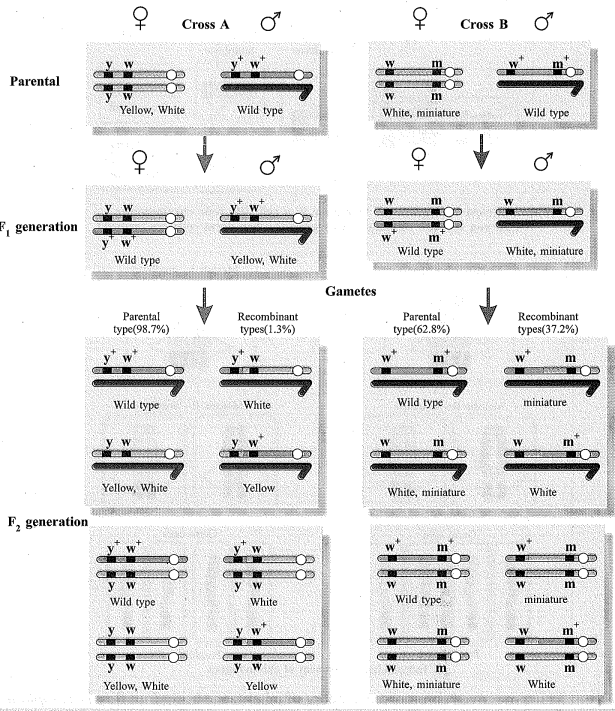
→ For example Morgan hybridised yellow-bodied, white-eyed females to brown-bodied, red-eyed males and intercrossed their F1 progeny.
→ He observed that the two genes did not segregate independently of each other and the F2 ratio deviated very significantly from the 9:3:3:1 ratio (expected when the two genes are independent).
→ Morgan and his group knew that the genes were located on the X chromosome and saw quickly that when the two genes in a dihybrid cross were situated on the same chromosome, the proportion of parental gene combinations were much higher than the non-parental type.
→ Morgan attributed this due to the physical association or linkage of the two genes and coined the term linkage to describe this physical association of genes on a chromosome and the term recombination to describe the generation of non-parental gene combinations.
→ Morgan and his group also found that even when genes were grouped on the same chromosome, some genes were very tightly linked (showed very low recombination (Cross A) while others were loosely linked (showed higher recombination) (Cross B)
→ For example he found that the genes white and yellow were very tightly linked and showed only 1.3 percent recombination while white and miniature wing showed 37.2 percent recombination.
→ His student Alfred Sturtevant used the frequency of recombination between gene pairs on the same chromosome as a measure of the distance between genes and 'mapped' their position on the chromosome.
Image
View full question & answer