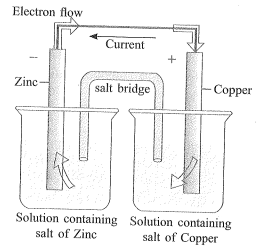
→ We can construct innumerable number of galvanic cells based on the pattern of Daniell cell by taking combination of different half-cells
→ Each half-cell consists of a metallic electrode dipped into an electrolyte. The two half-cells are connected by a mettalic wire through a voltmeter and a switch externally.
→ The electrolytes of the two half-cells are connected internally through a salt bridge as shown in Fig.
→Sometimes, both the electrodes dip in the same elecrtolyte solution and in such cases we don't require a salt bridge.
→At the interface of each electrode and electrolyte, metal ions from the solution tend to deposit on the metal electrode, to make it positively charged.
→ At the same time, metal atoms of the electrode have a tendency to go into the solution as ions leaving behind electrons at the electrode, there by trying to make it negatively charged.
→ At equilibrium, there is a separation of charges occurs, and depending on the tendencies of the two opposing reactions, the electrode may become positively or negatively charged with respect to the solution.
→ A potential difference develops between the electrode and the electrolyte is called as electrode potential.
→ When the concentrations of all the species involved in a half-cell in unity then the electrode potential is known as standard electrode potential.
→ In a galvanic cell, the half-cell in which oxidation takes place is called anode and it hasti a negative potential with respect to the solution.
→ The other half-cell in which reduction takes place is called cathode and it has positive potential with respect to the solution.
→ Thus, there exists a potential difference between the two electrodes and as soon as the switch is in the on position the electrons flow from negative electrode to positive electrode. The direction of current flow is opposite to that of electron flow.