Question
Explain controlled thermonuclear fusion.

Answer

The natural thermonuclear fusion process in a star is a replicated in a thermonuclear fusion device.
In controlled fusion reactors, the aim is to generate steady power by heating the nuclear fuel to a temperature in the range of $10^8 K$. At these temperature the fuel is a mixture of positive ions and electrons (plasma).
The challenge is to confine this plasma, since no container can stand such a high temperature. Several countries around the world including India are developing techniques in this connection. If successful, fusion reactors will hopefully supply almost unlimited power to humanity.

Need a full question paper?

Generate a complete, print-ready paper with questions like this in minutes — across 16+ boards, with answer keys.
Start Generating Free

Similar questions

Two conducting spheres of radii $R_1$ and $R_2$ are kept widely separated from each other. What are their individual capacitances? If the spheres are connected by a metal wire, what will be the capacitance of the combination? Think in terms of series-parallel connections.
What is a filter circuit? Explain its functioning.
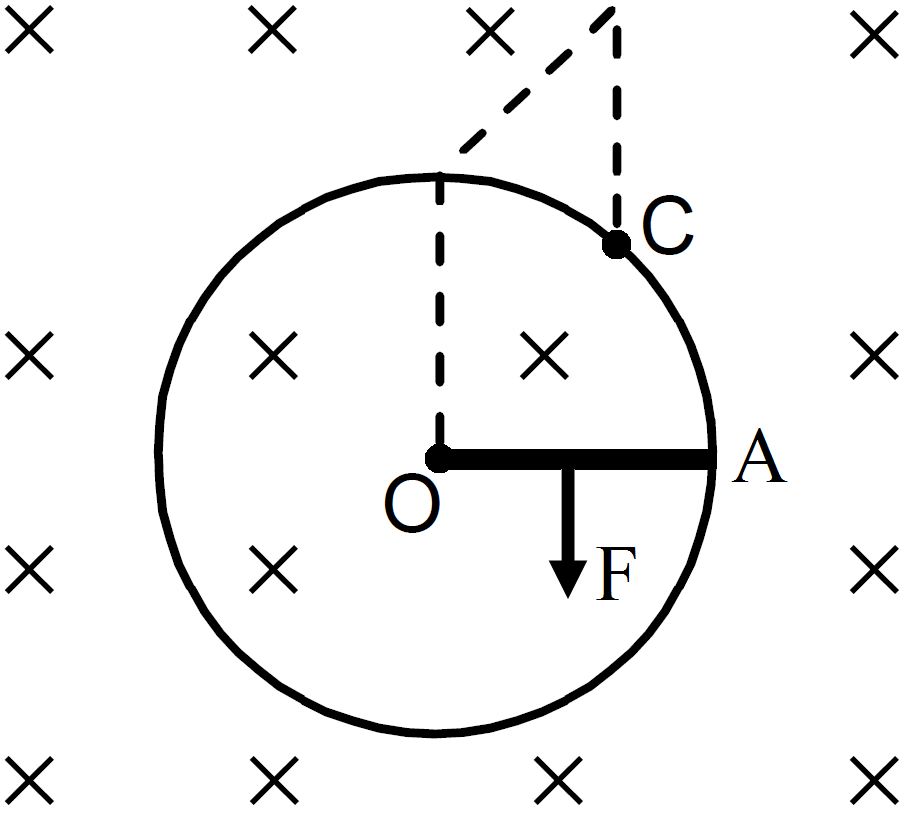
Figure shows a conducting circular loop of radius a placed in a uniform, perpendicular magnetic field B. A thick metal rod OA is pivoted at the centre O. The other end of the rod touches the loop at A. The centre O and a fixed point C on the loop are connected by a wire OC of resistance R. A force is applied at the middle point of the rod OA perpendicularly, so that the rod rotates clockwise at a uniform angular velocity $\omega.$ Find the force.
Plot a graph showing the variation of coulomb force (F) versus$\bigg(\frac{1}{\text{r}^{2}}\bigg)$; where r is the distance between the two charges of each pair of charges: (1 μC, 2 μC) and (2 μC, – 3 μC). Interpret the graphs obtained.
How magnetic field lines are drawn? Write their four characteristics.
Explain the proof of validity of Einstein's equation of photoelectric effect.
What are the effects on the depletion layer when the diode is connected in forward bias and reverse bias condition?
Obtain the equation of magnification of combination of lenses.
A short bar magnet of magnetic moment $m = 0.32\ JT^{-1}$ is placed in a uniform magnetic field of 0.15 T. If the bar is free to rotate in the plane of the field, which orientation would correspond to its (a) stable, and (b) unstable equilibrium? What is the potential energy of the magnet in each case?
Two beams, one of red light and the other of blue light, of the same intensity are incident on a metallic surface to emit photoelectrons. Which one of the two beams emits electrons of greater kinetic energy?