Question
Explain current formed in solid conductors in presence of external electric field.

Answer

Image

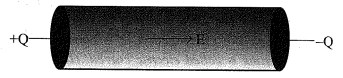
A cylindrical conductor of radius R is shown in the figure, Two thin insulating discs (or dielectric discs) of same radius are placed at the ends of this cylinder. The charges on these discs are $+Q$ and - Q respectively.
An electric field will be created and it is directed from the positive charge $+Q$ towards the negative charge $-Q$.
Due to this electric field, the electrons will be accelerated towards + Q . Such motion continues until the electron neutralizes the charge + Q . This will constitute an electric current.
When this disc is neutralized by the electrons, electrons stop moving. As a result, no current flows. Hence in the considered situation, there will be a current for a short peroid.
Now we can imagine a mechanism where the ends of the cylinder are supplied with fresh charges to make up for any charges neutralized by electrons moving inside the conductor.
In that case, there will be a steady electric field in the conductor. This will result in a continuous current rather than a current for a short period of time.
Electric cells or batteries can maintain a steady electric field that results in a steady current inside the conductor.

Need a full question paper?

Generate a complete, print-ready paper with questions like this in minutes — across 16+ boards, with answer keys.
Start Generating Free

Similar questions

Write any two characteristics of nuclear force.
Find the greatest length of an organ pipe open at both ends that will have its fundamental frequency in the normal hearing range (20Hz-20,000Hz). Speed of sound in air = 340m/s.
An infinite line charge produces a field of $9 \times 10^4 N/C$ at a distance of $2 \ cm.$ Calculate the linear charge density.
The force with which the earth attracts an object is called the weight of the object. Calculate the weight of the moon from the following data: The universal constant of gravitation $G = 6.67 \times 10^{-11}N-m^2/kg^2$, mass of the moon $= 7.36 \times 10^{22}kg$, mass of the earth $= 6 \times 10^{24}kg$ and the distance between the earth and the moon $= 3.8 \times 10^5\ km.$
The distance between the cathode (filament) and the target in an X-ray tube is 1.5m. If the cutoff wavelength is 30pm, find the electric field between the cathode and the target.
The yellow colour has a greater luminous efficiency as compared to the other colours. Can we increase the illuminating power of a white light source by putting a yellow plastic paper around this source?
Obtain expression for induced emf in any one coil due to electric currents flowing at same time in two coils placed near each other.
A convex lens of focal length $f_1$ is kept in contact with a concave lens of focal length $f_2.$ Find the focal length of the combination.
Draw the ray diagram of an astronomical telescope showing image formation in the normal adjustment position. Write the expression for its magnifying power.
A short bar magnet of magnetic moment $m = 0.32 JT^{–1} $ is placed in a uniform magnetic field of $0.15 T$. If the bar is free to rotate in the plane of the field, which orientation would correspond to its $(a)$ stable, and $(b)$ unstable equilibrium? What is the potential energy of the magnet in each case?