Question
Crystal structure of oxides of transition metals often show defects. Given reason. (2)

Answer

The actual oxide structures, generally show departures from a regular arrays due in part to distortions caused by packing of ions of different size and to ligand field effects.

Need a full question paper?

Generate a complete, print-ready paper with questions like this in minutes — across 16+ boards, with answer keys.
Start Generating Free

Similar questions

Explain the addition of HX and halogens to alkenes.
Read the following text carefully and answer the questions that follow:
The solutions which boil at a constant temperature like a pure liquid and possess the same composition in liquid, as well as vapour state are called azeotropes. The components of azeotropes cannot be separated by fractional distillation. Only non-ideal solutions form azeotropes. Solutions with negative deviation form maximum boiling azeotrope and the solutions with positive deviation form minimum boiling azeotrope. The boiling point of azeotrope is never equal to the boiling points of any of the components of the azeotrope.
i. The azeotropic solutions of two miscible liquids show what type of deviation from Raoult's law? 
ii. The azeotropic mixture of water & HCI boils at 108.5°C. What type of deviation is shown by the solution?
Does this solution behave as ideal or non-ideal? 
iii. Do ideal solutions form azeotropes?
Which mechanisms helps in the transportation of water in a plant?
The d-block of the periodic table contains the elements of the groups 3 to 12 and are known as transition elements. In general, the electronic configuration of these elements is $(n-1) d^{1-10} n s^{1-2}$. The d-orbitals of the penultimate energy level in their atoms receive electrons giving rise to the three rows of the transition metals i.e. 3d, 4d and 5d series. However, $Zn , Cd$ and Hg are not regarded as transition elements. Transition elements exhibit certain characteristic properties like variable oxidation stables, complex formation, formation of coloured ions, alloys, catalytic activity etc. Transition metals are hard (except $Zn , Cd$ and Hg ) and have a high melting point.
i. Why are $Zn , Cd$ and Hg non-transition elements?
ii. Which transition metal of 3d series does not show variable oxidation state?
iii. Why do transition metals and their compounds show catalytic activity?
OR
iii. Why are melting points of transition metals high?
Explain Raoult's Law for volatile solute and Volatile solvent and derive formula for total vapour pressure with graph.
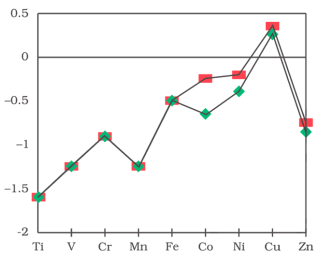
The unique behaviour of $Cu ,$ having a positive $E ^{\circ}$ accounts for its inability to liberate $H _2$ from acids. Only oxidising acids (nitric and hot concentrated sulphuric) react with $Cu ,$ the acids being reduced. The stability of the half$-$filled  sub$-$shell in $Mn ^{2+}$ and the completely filled $d ^{10}$ configuration in $Zn ^{2+}$ are related to their $E ^{\circ}$ values, whereas $E ^{\circ}$ for $Ni$ is related to the highest negative $\Delta_{h y d} H ^{\circ}$. An examination of the $E_{\left(M^{3+} / M^{2+}\right)}^o$ values the low value for $Sc$ reflects the stability of $Sc ^{3+}$ which has a noble gas configuration. The comparatively high value for $Mn$ shows that $Mn ^{2+}\left( d ^5\right)$ is particularly stable, whereas a comparatively low value for $Fe$ shows the extra stability of $Fe ^{3+}\left( d ^5\right)$. The comparatively low value for $V$ is related to the stability of $V ^{2+} ($half$-$filled $t _{2 g}$ level$).$
Image
$i.$ Why $Zn$ has high value for $M^{3+}/M^{2+}$ Standard Electrode Potentials?
$ii.$ Transition metals, despite high $E^\circ$ oxidation, are poor reducing agents. Justify.
$iii.$ Why is $Cr^{2+}$ reducing and $Mn^{3+}$ oxidising when both $Cr$ and $Mn$ have $d^4$ configuration?
$OR$
$iii.$ Why $Cu^{2+}$ is more stable than $Cu^+$ ?
Derive the formula for determining activation energy from Arrhenius equation using rate constant at different temperatures. And also explain how activation energy can be determined using graph.
Derive integrated rate equation for first order reaction and also explain how than rate constant can be determine with help of graph.
Write the reaction of phenol with the following :
(i) With $PCl _5$
(ii) With $NH _3$
(iii) Hinsberg reagent
(iv) Hydrogen.
Explain how the molecularity of a complex reaction determined? And give the points showing difference between molecularity of a reaction and order of a reaction.