Question
Explain different types of RNA along with process of transcription.

Answer

→ Type of RNA In bacteria, there are three major types of RNAs:
(i) mRNA (messenger RNA),
(ii) tRNA (transfer RNA), and
(iii) rRNA (ribosomal RNA).
→ All three RNAs are needed to synthesise a protein in a cell.
→ The mRNA provides the template, tRNA brings aminoacids and reads the genetic code, and rRNAs play structural and catalytic role during translation.
→ There is a single DNA-dependent RNA polymerase that catalyses transcription of all types of RNA in bacteria.
Process of Transciption
→ RNA polymerase binds to promoter and initiates transcription (Initiation).
It uses nucleoside triphosphates as substrate and polymerises in a template depended fashion following the rule of complementarity.
→ It somehow also facilitates opening of the helix and continues elongation.
→ Only a short stretch of RNA remains bound to the enzyme.
→ Once the polymerases reaches the terminator region, the nascent RNA falls off, so also the RNA polymerase. This results in termination of transcription.
→ An intriguing question is that how is the RNA polymerases able to catalyse all the three steps, which are initiation, elongation and termination.
→ The RNA polymerase is only capable of catalysing the process of elongation. It associates transiently with initiation-factor (σ) and termination-factor (p) to initiate and terminate the transcription, respectively.
→ Association with these factors alter the specificity of the RNA polymerase to either initiate or terminate.
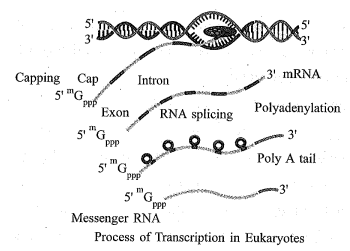
Image
→ In bacteria, since the mRNA does not require any processing to become active, and also since transcription and translation take place in the same compartment (there is no separation of cytosol and nucleus in bacteria), many times the translation can begin much before the mRNA is fully transcribed.
→ Consequently, the transcription and translation can be coupled in bacteria.
Need a full question paper?

Generate a complete, print-ready paper with questions like this in minutes — across 16+ boards, with answer keys.

Start Generating Free

Similar questions

The size of a population for any species is not a static parameter. Explain.###Explain population growth###Explain in brief - population growth.
Explain innate immunity in detail
Read the following and answer any four questions from (i) to (v) given below:
A 23 year old Sahil has been diagnosed with an infection of reproductive tract caused by bacteria. He complains about burning sensation during urination, pus-containing discharge and pain around genitalia. This infection has incubation period of 2-5 days but can be cured.
  1. From which disease is Sahil suffering?
  1. Chlamydiasis.
  2. Herpes.
  3. Gonorrhoea.
  4. Syphilis.
  1. Which among the following reproductive tract infections is transmitted by bacteria?
  1. Trichomoniasis.
  2. Chancroid.
  3. Genital warts.
  4. Both (a) and (b).
  1. Which mode of treatment would be useful for Sahil?
  1. Cryosurgery.
  2. Use of Podophyllum preparation.
  3. Use of antibiotic ampicillin.
  4. It cannot be treated.
  1. What technique was used to diagnose Sahil's disease?
  1. Gram staining of discharge and culture.
  2. ELISA Test.
  3. Antibody detection.
  4. Antigen test.
  1. Find the odd one out.
  1. Treponema pallidum.
  2. Neisseria gonorrhoeae.
  3. Haernophilus ducreyi.
  4. Trichomonas vaginalis.
How interesingly Gene is amplified by using PCR? Explain with diagram.
Read the following and answer any four questions from (i) to (v) given below:
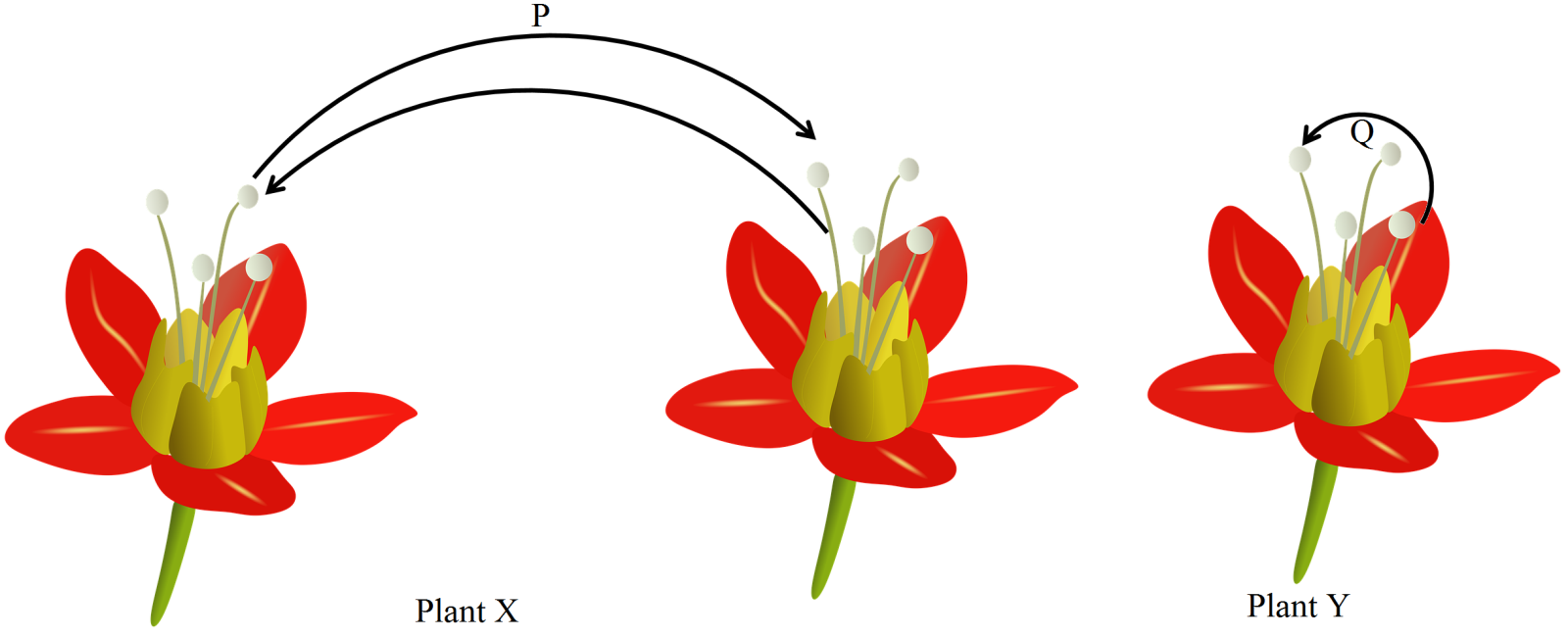
In angiosperms, the pollen grains are being transferred from the anther to the stigma and is termed pollination. This phenomenon was first discovered by Camerarius (1694) in the end of seventeenth century. Pollen grains are immobile. They cannot reach the stigma by themselves. An external agent is required for this. The pollination is mainly of two types-self pollination and cross pollination. The diagram given below shows two plants of the same species showing different types of pollination.

  1. What is transferred between the plants in the process indicated by arrow P?
  1. Ova.
  2. Pollen.
  3. Nutrients.
  4. Seeds.
  1. Which of the following statements is correct regarding processes P, Q and R?
  1. Processes P, Q and R introduce genetic variability in the offspring of sexually reproducing plants X and Y.
  2. Wind serves as agent for process Q if plants X and Y belong to Genus Salvia.
  3. Flowers of plants X and Y need to produce odour and nectar for completion of processes P and Q if they are entomophilous.
  4. If plants X and Y belong to Genus Cannabis, then their flowers need to produce sticky and heavy pollens in very small amount for accomplishment of process Q.
  1. Identify the processes P, Q and R.
S. No
P
Q
R
(a)
Geitonogamy
Xenogamy
Autogamy
(b)
Allogamy
Chasmogamy
Cleistogamy
(c)
Autogamy
Geitonogamy
Xenogamy
(d)
Geitonogamy
Allogamy
Autogamy
  1. In Catliarantl1us, the growth of style brings the stigma in contact of ripe anthers present on the mouth of corolla tube. This is an example of:
  1. Homogamy.
  2. Cleistogamy.
  3. Geitonogamy.
  4. Xenogamy.
  1. Which of the given processes represents a type of pollination that would result in greater adaptability of the particular species to potential environmental changes?
  1. P.
  2. Q.
  3. R.
  4. All of these.
Read the following and answer any four questions from 9(i) to 9(v) given below:

Bioreactors are considered as vessels in which raw materials are biologically converted into specific products by microbes, plant and animal cells or their enzymes. They are used for large scale production as they provide optimum growth conditions such as temperature, pH, substrate, vitamins, oxygen and salts for obtaining desired product. Most commonly used bioreactors are of stirring type which include simple stirred tank bioreactor and sparged stirred-tank bioreactor.

  1. Bioreactor are useful in:
  1. Amplifying a gene.
  2. Isolation of genetic material.
  3. Processing large volume of culture.
  4. Infecting DNA in a cell.
  1. Which of the following is essential to obtain desired product in a bioreactor?
  1. Size of the bioreactor.
  2. Sterile condition.
  3. Quantity of the raw material.
  4. All of these.
  1. Assertion: The stirred-tank is well suited for large scale production of microorganisms under aseptic conditions.

Reason: In sparged stirred tank bioreactor, surface area for oxygen transfer is increased.

  1. Both assertion and reason are true and reason is the correct explanation of assertion.
  2. Both assertion and reason are true but reason is not the correct explanation of assertion.
  3. Assertion is true but reason is false.
  4. Both assertion and reason are false.
  1. Growth condition that could affect the quality of obtained product in a bioreactor are:
  1. Temperature and pH only.
  2. pH and oxygen supply only.
  3. Temperature and oxygen supply only.
  4. Temperature, pH and oxygen supply.
  1. Vessels in which raw materials are biologically converted into specific products are.
  1. Bioreactors.
  2. Fermentors.
  3. Gene guns.
  4. Both (a) and (b).
Read the following and answer any four questions from (i) to (v) given below:

Over population causes number of family problems. Strategies like birth control methods help to control population explosion. Natural methods of birth control do not involve medications or devices to prevent pregnancy, but rather rely on behavioural practices and/ or making observations about menstrual cycle.

  1. Which method helps in contraception by temporary absence of sex?
  1. Coitus interruptus.
  2. Withdrawal method.
  3. Rhythm method.
  4. Lactational amenorrhea method.
  1. Assertion: The effectiveness of coitus interruptus method is limited.

Reason: Some sperms may pass into vagina before ejaculation.

  1. Both assertion and reason are true, and reason is the correct explanation of assertion.
  2. Both assertion and reason are true, but reason is not the correct explanation of assertion.
  3. Assertion is true, but reason is false.
  4. Both assertion and reason are false.
  1. Why is lactational amenorrhea effective for about 4-5 months after parturition?
  1. Ovulation occurs on about the 14th day of menstruation.
  2. Ovulation does not occur during intense lactation.
  3. This method inhibits mobility of sperms.
  4. Both (b) and (c).
  1. Which fact is not the basis of periodic absence method of birth control?
  1. Ovum remains alive for about 1-2 days.
  2. Ovulation occurs on about 14th day of menstruation.
  3. Sperms survive for about 3 days.
  4. Alteration in uterine endometrium.
  1. On which days of menstrual cycle should coitus be avoided to prevent fertilisation?
  1. 10-17
  2. 6-13
  3. 1-5
  4. 15-28
Read the following and answer any four questions from (i) to (v) given below:

Kangaroo rat seldom drinks water. It has thick coat to minimise evaporative desiccation. TI1e animal seldom comes out of its comparatively humid and cool burrow during the day time. 90% of its water requirement is met from metabolic water (water produced by respiratory breakdown of fats) while 10% is obtained from its food. Loss of water is minimised by producing nearly solid urine and faeces. As the animal faces acute water scarcity, it develops two types of adaptations : reducing water loss and ability to tolerate desert conditions.

  1. Kangaroo rat is a:
  1. Partial regulators
  2. Partial conformer
  3. Regulator
  4. Conformer
  1. Metabolic water refers to:
  1. Water required for metabolic activities.
  2. Water present in intercellular fluid.
  3. Water produced during oxidation of fat or carbohydrate.
  4. Water taken in, to promote metabolism.
  1. Desert animals minimise water loss by:
  1. Producing highly concentrated urine.
  2. Promoting maximum reabsorption of water in kidney tubules.
  3. Possessing one of the longest loop of Henle in kidney tubules.
  4. All of these.
  1. Assertion: Kangaroo rat can tolerate and thrive in wide temperature range and is known as stenothermal.

Reason: Kangaroo rats go into hibernation during winter to escape cold weather.

  1. Both assertion and reason are true and reason is the correct explanation of assertion.
  2. Both assertion and reason are true but reason is not the correct explanation of assertion.
  3. Assertion is true but reason is false.
  4. Both assertion and reason are false.
  1. The adaptations in an organism are meant for:
  1. Optimum primary production.
  2. Optimum life span.
  3. Optimum mobility.
  4. Optimum survival and reproduction.
Write a short note on embryo development.###With a labeled diagram discuss stages in embryo development in a dicot.
Draw a schematic diagram of typical anatropous ovule and describe structure of megasporangium in detail.###With a neat, labelled diagram, describe the parts of a typical angiosperm ovule.