Question
Explain innate immunity in detail

Answer

Innate immunity is non-specific immunity, which is present at the time of birth.
1) Physical barrier :
Our skin is the main physical barrier that prevents the entry of microorganisms.
Mucous membrane lining the respiratory tract, gastrointestinal tract and urinary tract also helps to prevent germs from entering the body.
2) Physiological barrier:
Acid in the stomach, saliva in the mouth, tears in the eyes etc. inhibit the growth of pathogens.
3) Cellular Barrier :
Some white blood cells [WBCs] in our body, such as polymorphonuclear leukocytes and natural killer cells, a type of lymphoid cell in the blood, can feed on and destroy microbes.
(4)Cytokine barrier:
Virus-infected cells secrete proteins called interferons, which protect other uninfected cells from virus infection.

Need a full question paper?

Generate a complete, print-ready paper with questions like this in minutes — across 16+ boards, with answer keys.
Start Generating Free

Similar questions

Read the following and answer any four questions from (i) to (v) given below:

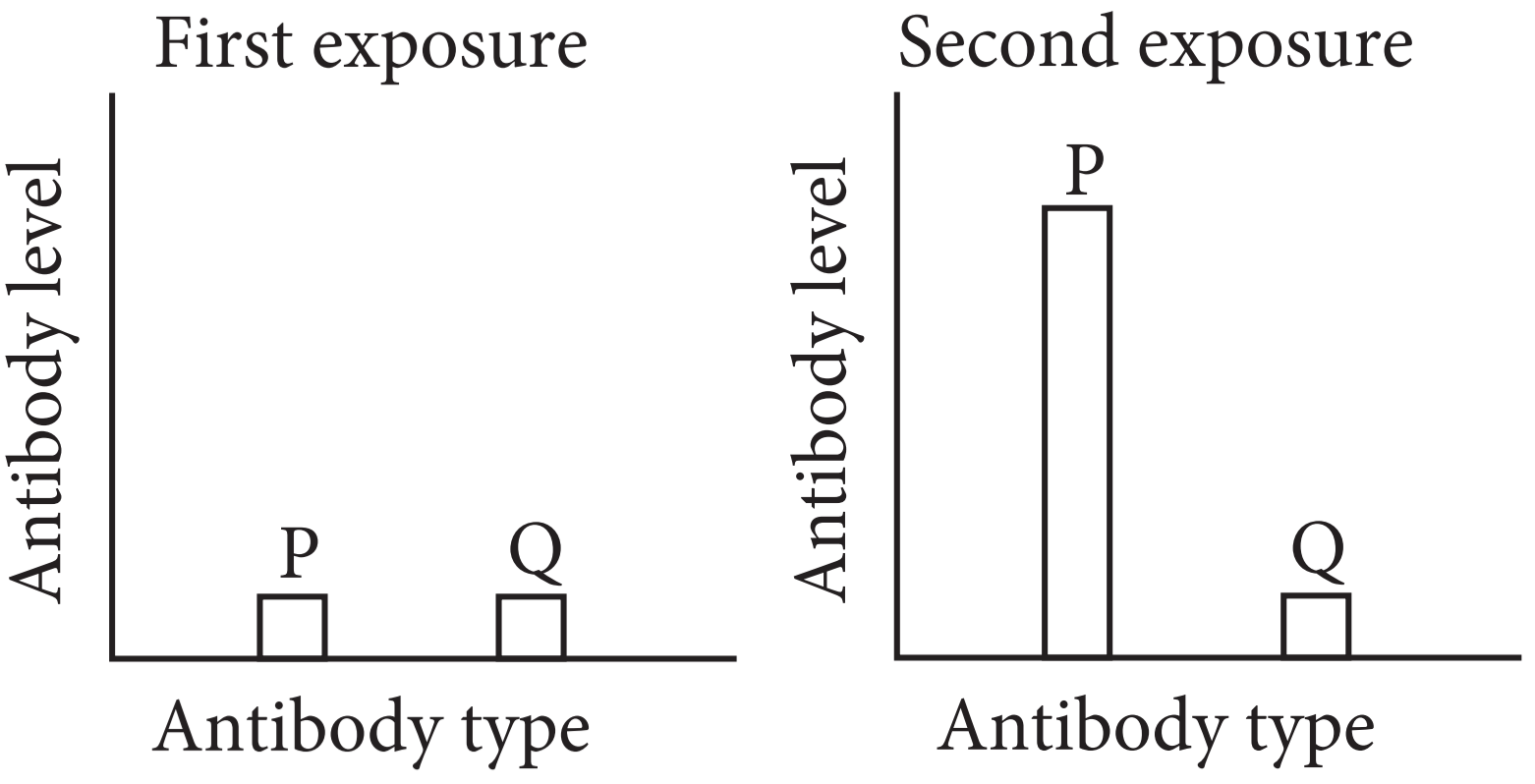
In a study to test a new vaccine against a viral disease, mouse model testing is done. In this process, mice are vaccinated and their blood samples were tested. Mice developed mild disease symptom. After few days those mice were again infected with the virus. This time they do not show any disease symptoms. Their blood samples were tested. Two graphs show antibody concentration for the first and second infection in mice blood.

Based on the above information, answer the following questions.

  1. P and Qin the given graphs indicate.
  1. IgM and IgG respectively.
  2. IgG and IgM respectively
  3. IgG and IgM respectively
  4. IgM and IgA respectively.
  1. Which form of pathogen is used in vaccination?
  1. Activated and strong pathogenic antigen.
  2. Inactivated and weakened pathogenic antigen.
  3. Hyperactive and strong pathogen.
  4. Preformed antibodies.
  1. Which of the following is incorrect for P?
  1. It is the most abundant class of lg.
  2. It is found in blood, lymph, and intestine.
  3. It is unable to cross the placental barrier.
  4. It is a monomer.
  1. How does vaccination work?
  1. The immune system produces antibodies which stay in the blood.
  2. Memory lymphocytes remain in the body to fight off any future infection with the same pathogen.
  3. The dead pathogen stays in the body and constantly stimulates the immune system.
  4. All of these.
  1. Assertion: Mice do not show any disease symptoms during second exposure to the pathogenic virus.

Reason: The antibody production is accelerated and more intense during secondary immune response.
  1. Both assertion and reason are true, and reason is the correct explanation of assertion.
  2. Both assertion and reason are true, but reason is not the correct explanation of assertion.
  3. Assertion is true, but reason is false.
  4. Both assertion and reason are false.
Draw a schematic diagram of typical anatropous ovule and describe structure of megasporangium in detail.###With a neat, labelled diagram, describe the parts of a typical angiosperm ovule.
Read the following text carefully and answer the questions that follow:
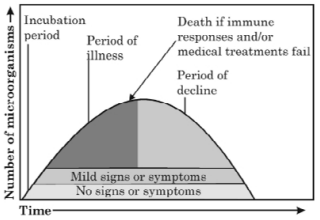
When a microorganism invades a host, a definite sequence of events usually occur leading to infection and disease, causing suffering to the host. This process is called pathogenesis. Once a microorganism overcomes the defense system of the host, development of the disease follows a certain sequence of events as shown in the graph. Study the graph given below for the sequence of events leading to appearance of a disease and answer the questions that follow:
Image
i. In which period, according to the graph there are maximum chances of a person transmitting a disease/infection and why? (1)
ii. Study the graph and write what is an incubation period. Name a sexually transmitted disease that can be easily transmitted during this period. Name the specific type of lymphocytes that are attacked by the pathogen of this disease. (1)
iii. Draw a schematic labelled diagram of an antibody. (2)
OR
In which period, the number of immune cells forming antibodies will be the highest in a person suffering from pneumonia?
Name the immune cells that produce antibodies. (2)
Read the following and answer any four questions from (i) to (v) given below:

Medical termination of pregnancy is termination of pregnancy before the fetus become viable. To reduce the incidence of illegal abortion and consequent maternal mortality, MTP Amendment Act, 2017 was enacted by the government of India. About 40-50 million MTPs are done in a year all over the world.

  1. Abortion can be safely done for about ______ weeks of pregnancy.
  1. 4
  2. 12
  3. 8-10
  4. 15-18
  1. How is MTP helpful in decreasing human population?
  1. By aborting normal female fetus.
  2. By aborting normal female fetus.
  3. By getting rid of unwanted pregnancies.
  4. None of these.
  1. Select an incorrect statement for MTP.
  1. Second trimester abortions are more risky than first trimester.
  2. It is being misused to abort normal female fetus.
  3. It helps to get rid of unwanted pregnancies.
  4. Child detected with congenital heart disease cannot be aborted.
  1. MTP was legalised by Government of India in:
  1. 1971
  2. 1982
  3. 1973
  4. 1991
  1. Assertion: MTPs are safe during first trimester of pregnancy.

Reason: After first trimester, fetus become intimately associated with the maternal tissues.
  1. Both assertion and reason are true, and reason is the correct explanation of assertion.
  2. Both assertion and reason are true, but reason is not the correct explanation of assertion.
  3. Assertion is true, but reason is false.
  4. Both assertion and reason are false.
Explain the inheritance of one gene by Punnett Square ?
Read the following text carefully and answer the questions that follow:
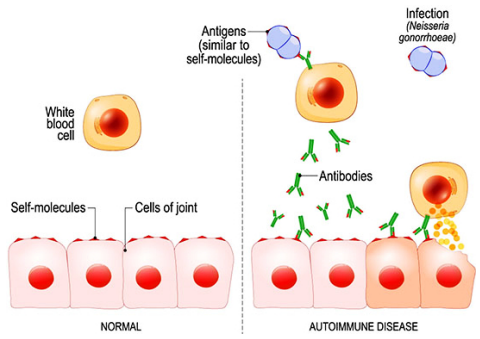
A healthy immune system defends the body against disease and infection. But if the immune system malfunctions, it mistakenly attacks healthy cells, tissues, and organs. Called autoimmune disease, these attacks can affect any part of the body, weakening bodily function and even turning life-threatening.
Image
i. Why are autoimmune diseases called degenerative diseases? (1)
ii. Name the autoimmune disease of body muscles. (1)
iii. Which types of immunity is provided by T-lymphocytes? (2)
OR
Which immune cells form humoral immune system? (2)
Explain population attributes.
Nematode specific genes were introduced into the tobacco host plant using a vector:
  1. pBR 322.
  2. Plasmid.
  3. Bacteriophage.
  4. Agrobacterium.
Read the following and answer any four questions from (i) to (v) given below:

In today's world, more than 25% of human population is suffering from hunger and malnutrition. Scientists have developed techniques where microbes are grown on industrial scale as a source of good protein which can be grown from waste water, animal manure and even sewage. Single cell proteins are such products. TI1e biomass or protein is extracted from pure or mixed cultures of algae, yeasts, fungi or bacteria. These are a very good source of food for human consumption.

  1. Why the name single cell protein is applied?
  1. It contains only one type of protein.
  2. It is obtained from unicellular edible microbes.
  3. It contains only one type of microorganism.
  4. All of these.
  1. Which of the following is considered under single cell protein?
  1. Algae.
  2. Fungi.
  3. Cyanobacteria.
  4. All of these.
  1. Microorganisms can be a useful food resource for increasing human population because:
  1. These are easy to harvest.
  2. These can grow in water system.
  3. They have a high rate of multiplication thus producing huge biomass.
  4. They have high level of nucleic acid.
  1. Single cell protein can be grown from:
  1. Waste water.
  2. Animal manure.
  3. Sewage.
  4. All of these.
  1. Assertion: Production of single cell protein reduces pollution.

Reason: Single cell protein can be grown from waste water and even sewage.

  1. Both assertion and reason are true and reason is the correct explanation of assertion.
  2. Both assertion and reason are true but reason is not the correct explanation of assertion.
  3. Assertion is true but reason is false.
  4. Both assertion and reason are false.
Read the following and answer any four questions from 9(i) to 9(v) given below:

Bioreactors are considered as vessels in which raw materials are biologically converted into specific products by microbes, plant and animal cells or their enzymes. They are used for large scale production as they provide optimum growth conditions such as temperature, pH, substrate, vitamins, oxygen and salts for obtaining desired product. Most commonly used bioreactors are of stirring type which include simple stirred tank bioreactor and sparged stirred-tank bioreactor.

  1. Bioreactor are useful in:
  1. Amplifying a gene.
  2. Isolation of genetic material.
  3. Processing large volume of culture.
  4. Infecting DNA in a cell.
  1. Which of the following is essential to obtain desired product in a bioreactor?
  1. Size of the bioreactor.
  2. Sterile condition.
  3. Quantity of the raw material.
  4. All of these.
  1. Assertion: The stirred-tank is well suited for large scale production of microorganisms under aseptic conditions.

Reason: In sparged stirred tank bioreactor, surface area for oxygen transfer is increased.

  1. Both assertion and reason are true and reason is the correct explanation of assertion.
  2. Both assertion and reason are true but reason is not the correct explanation of assertion.
  3. Assertion is true but reason is false.
  4. Both assertion and reason are false.
  1. Growth condition that could affect the quality of obtained product in a bioreactor are:
  1. Temperature and pH only.
  2. pH and oxygen supply only.
  3. Temperature and oxygen supply only.
  4. Temperature, pH and oxygen supply.
  1. Vessels in which raw materials are biologically converted into specific products are.
  1. Bioreactors.
  2. Fermentors.
  3. Gene guns.
  4. Both (a) and (b).