Question
Explain Doppler effect in sound. Obtain an expression for apparent frequency of sound when source and listener are approaching each other.
Answer

Whenever there is a relative motion between a source of sound and listener, the apparent frequency of sound heard by listener is different from actual frequency of sound emitted by the source.
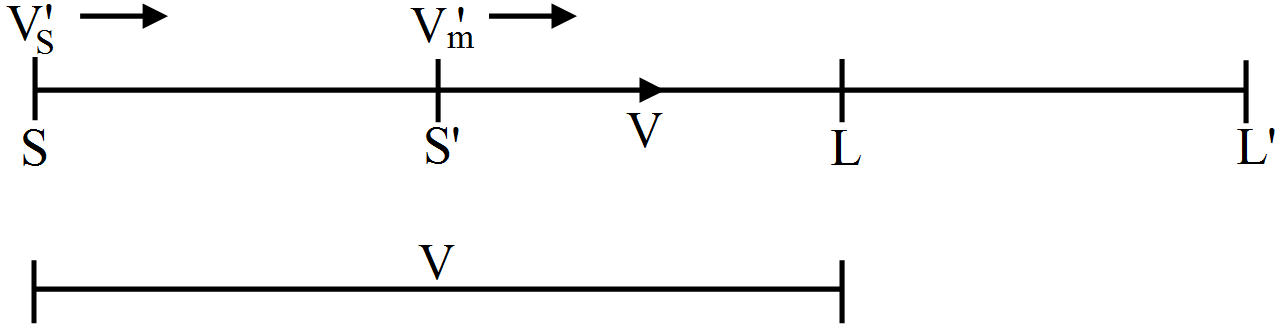
Let S be a source of sound and L, the listener of sound, both initially at rest. Let v be the actual frequency of sound emitted by the source and $\lambda$ be the actual wavelength of sound emitted. If v is velocity of sound in still medium, then
$\lambda=\frac{v}{\text{v}}$
Let the distance between source and listener be V, so that v waves from the source reach listener in 1 second.
Vm = Velocity of medium, Vs = Velocity of source,
VL = Velocity of listener

Resultant velocity of sound along SL = (V + Vm)
SS' = Distance moved by source in 1 sec. = Vs along SL
$\therefore$ Relative velocity of sound w.r.t. source SS' = Vs' = [(V + Vm) - Vs]
As the frequency remains unchanged.
$\therefore$ V waves emitted in one second occupy the distance [(V + Vm) - Vs] apparent wavelength $\lambda'=\frac{[(\text{V}+\text{V}_\text{m})-\text{V}_\text{s}]}{\text{V}}$
Assuming both listener and source are moving in same direction, i.e. toward right.
LL' = VL’ relative velocity of sound wave w.r.t. listener (V + Vm) - VL
Apparent frequency of sound waves heard by listener is
$\text{v}'=\frac{(\text{V}+\text{V}_\text{m})-\text{V}_\text{L}}{\lambda'}$
$\text{v}'=\frac{[(\text{V}+\text{V}_\text{m})-\text{V}_\text{L}]\text{v}}{(\text{V}+\text{V}_\text{m})-\text{V}_\text{s}}$
When both approach each other, i.e. listener move towards the source:
Vs = Positive, VL = Negative.
$\text{v}'=\frac{\text{V}-(-\text{V}_\text{L})}{\text{V}-\text{v}_\text{s}}\text{v}=\Big(\frac{\text{V}+\text{V}_\text{L}}{\text{V}-\text{V}_\text{s}}\Big)\text{v}$
Apparent frequency (v') is greater than actual frequency (v).

Need a full question paper?

Generate a complete, print-ready paper with questions like this in minutes — across 16+ boards, with answer keys.
Start Generating Free

Similar questions

 An inductor-coil of inductance 20mH having resistance $10\Omega$ is joined to an ideal battery of emf 5.0V. Find the rate of chenge of the induced emf at:
  1. t = 0
  2. t = 10ms
  3. t = 1.0s. 
Show that for a projectile the angle between the velocity and the x-axis as a function of time is given by,
$\theta(\text{t})=\tan^{-1}\Big(\frac{\text{u}_\text{oy}-\text{gt}}{\text{u}_\text{ox}}\Big)$
Figure. shows a large closed cylindrical tank containing water. Initially the air trapped above the water surface has a height h0 and pressure 2p0 where p0 is the atmospheric pressure. There is a hole in the wall of the tank at a depth h1 below the top from which water comes out. A long vertical tube is connected as shown.
  1. Find the height h2 of the water in the long tube above the top initially.
  2. Find the speed with which water comes out of the hole.
  3. Find the height of the water in the long tube above the top when the water stops coming out of the hole.

A sitar wire is replaced by another wire of same length and material but of three times the earlier radius. If the tension in the wire remains the same, by what factor will the frequency change?
An object is moving along x-axis in such a way that its displacement is given by

x = 30 + 20t2

where x is in metres and t is in seconds.
  1. Find the velocity and acceleration.
  2. What are the initial position and the velocity of the object?
A long wire carries a current of 4.00A. Find the energy stored in the magnetic field inside a volume ot 1.00mm at a distance of 10.0cm from the wire.
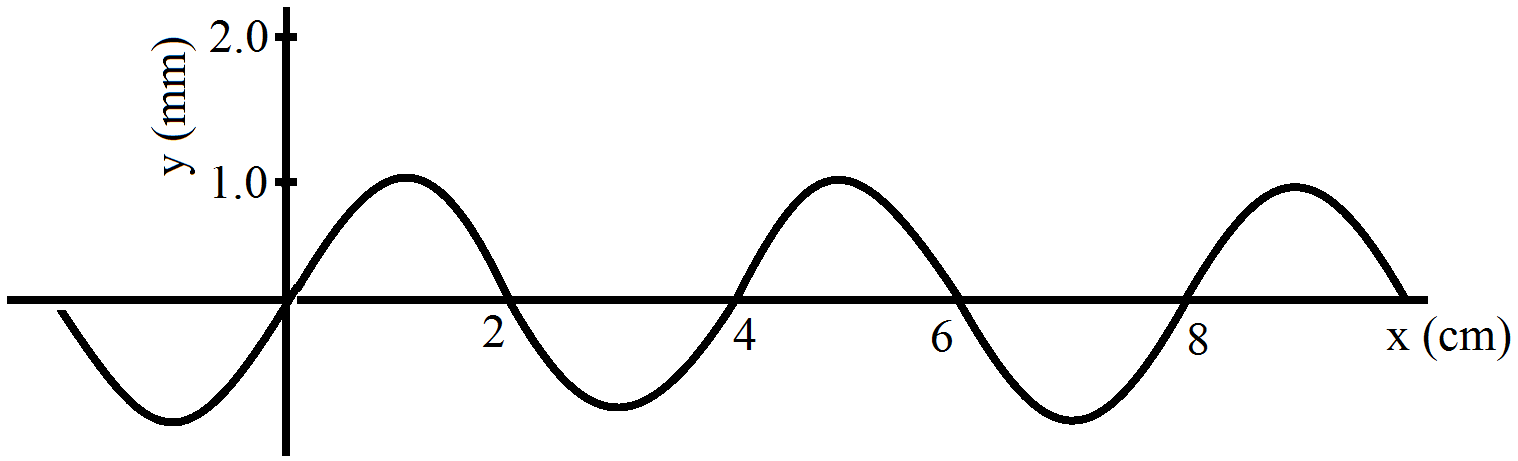
Figure shows a plot of the transverse displacements of the particles of a string at t = 0 through which a travelling wave is passing in the positive x-direction. The wave speed is 20cm/s. Find-

  1. The amplitude
  2. The wavelength
  3. The wave number
  4. The frequency of the wave.

A charge Q is placed at the centre of an uncharged, hollow metallic sphere of radius a:
  1. Find the surface charge density on the inner surface and on the outer surface.
  2. If a charge q is put on the sphere, what would be the surface charge densities on the inner and the outer surfaces?
  3. Find the electric field inside the sphere at a distance x from the centre in the situations (a) and (b).
A simple pendulum of time period 1s and length l is hung from a fixed support at O, such that the bob is at adistance H vertically above A on the ground The amplitude is $\theta$ The string snaps at $\theta=\frac{\theta_0}{2}$ Find the time taken by the bob to hit the ground. Also find distance from A where bob hits the ground. Assume θ to be small so that $\sin\theta_0\ \text{and}\ \cos\theta_0=1.$

Figure, shows two adiabatic vessels, each containing a mass m of water at different temperatures. The ends of a metal rod of length L, area of cross section A and thermal conductivity K, are inserted in the water as shown in the figure. Find the time taken for the difference between the temperatures in the vessels to become half of the original value. The specific heat capacity of water is s. Neglect the heat capacity of the rod and the container and any loss of heat to the atmosphere.