Questions

5 Marks Questions

Take a timed test

24 questions · self-marked practice — reveal the answer and mark yourself.
Question 15 Marks
By defining electric dipole and dipole moment, find the necessary formula for the field intensity at any point located on the neutral (equatorial plane) of the dipole.
Answer
SELF
View full question & answer
Question 25 Marks
Write the statement of Gauss's law for electrostatics. Draw a diagram and derive an expression for the electric field due to a uniformly charged infinite plane sheet at a point near it.In the given figure, write the value of electric flux emerging from the surface :

Image
Answer
SELF
View full question & answer
Question 35 Marks
Prove that due to a charged layer of infinite expansion, the value of the electric field at any point near it does not depend on the area of the surface and the distance from the layer . i.e., the electric field remains uniform at points near the layer.###Write Gauss'law.By applying this rule,find the value of the electric field due to a uniformly charged infinite plane sheet at any point near the sheet.
Answer
Carl Friedrich Gauss propounded a law to describe the relationship between the electric flux passing through a closed surface and the charge present in it, which is called Gauss's law.
According to this rule, "The value of the total electric flux $\phi$ associated with any closed imaginary surface located in an electric field is $(1 / \epsilon)$ times the charges.
$\Sigma q_i=(q)$ bound to that surface the volume."
This is total electric flux $\phi=\oint \overrightarrow{ E } \cdot \vec{d} s=\frac{\sum q_1}{\epsilon}=\frac{q}{\epsilon}$
Or, in vacuum $\phi=\frac{q}{\epsilon_0}$
Here the electronegativity of vacuum is $\epsilon_0$.
Electric field intensity due to a uniformly charged infinite plane sheet :
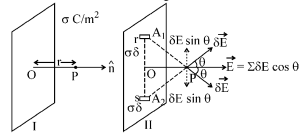
Suppose the charge per unit area (charge surface density) on a charged dielectric or dielectric plate of infinite extension is $\sigma$. It is shown in Fig.
Image
There is a point P at a perpendicular distance $r$ in front of the layer at which the intensity of the electric field due to the charged layer is to be determined. The direction of the electric field on the surface of the layer or at points adjacent to the surface is always perpendicular to the surface because if the electric field is not perpendicular to the surface, then due to the component of the electric field in the tangential direction to the surface, there will be a continuous force on the charges, due to which the charges will continuously move, which is not possible in the stable state of the charged layer.
Image
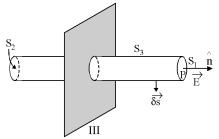
To find the resultant electric field $\vec{E}$ at point $P$, we assume a cylindrical Gaussian surface of length $2 r$ as per III. Amount of charge inside a cylindrical Gaussian surface
$ q=\sigma S $
The definition of electric flux is the value of flux emerging from a Gaussian surface.
$ \sigma=\int_{S} \overrightarrow{E} \delta \overrightarrow{S}=\int_{S} E \delta S \cos \theta $
Where $\theta$ is the angle between the vector area $\delta \overrightarrow{ S }$ and the electric field $\vec{E}$. This cylindrical Gaussian surface is divided into three parts :
(i) The end surface $S _1$ of one side the layer, on which the electric field is perpendicular to the surface $\theta=0$ or $\cos \theta=1$.
(ii) The end surface $S _2$ on the surface side of the layer on which the electric field is perpendicular to the surface $\theta=$ 0 or $\cos \theta=1$.
(iii) Cylindrical surface $S_3$ on which the electric field is along the surface
$ \theta=90^{\circ} \quad \therefore \cos 90^{\circ}=0 $
From equation (2)
$=\int_{S_1} E \delta \cos \theta+\int_{ S _2} E \delta s \cos \theta+\int_{ S _3} E \delta s \cos \theta$
$=\int_{s_1} E \delta s+\int_{ s _2} E \delta s +0$
$\phi= ES + ES$
$\phi=2 ES$
because the total area of each end surface is A.
From Gauss's Law $\phi=\left(\frac{1}{\epsilon_0}\right) \times$ bounded charge
$2 ES =\frac{1}{\epsilon_0} \times \sigma S$ [from equation (1)]
or $\quad E =\frac{\sigma}{2 \epsilon_0}$
View full question & answer
Question 45 Marks
What is Gauss theorem? With its help, obtain an expression for the electric field intensity at any point near a uniformly charged linear conductor of infinite length.###Make the necessary diagram and with the help of Gauss law, calculate the electric field intensity at any point due to a charged wire of infinite length. Plot the change in intensity with distance.###Define Gauss' law. With its help, find the value of electric field intensity at a distance from a uniformly charged linear conductor of infinite extension. Make the necessary diagram and also make a graph of the change of electric field with distance.
Answer
SELF
View full question & answer
Question 55 Marks
What is meant by electric field lines? Give examples of electric field lines due to different charge distributions and also write their characteristics.
Answer
SELF
View full question & answer
Question 75 Marks
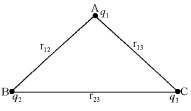
Write the definition of electrostatic at any point. Also write its S.I. units. As shown in the figure, three points charges $q_1$, $q _2$ and $q _3$ are placed at points $A, B$ and $C$ respectively. Drive an expression for the electrostatic potential energy of this system.

Image
Answer
Electrostatic Potential : "Electric potential at any point inside the electric field is equal to the ratio of the work W done in bringing a test positive charge from infinity to that point without acceleration and the value of the test charge $q_0$." The unit of electric potential in SI system is Volt. If charge $q_1$ is brought from infinity to $\vec{r}_1$, no work is done. Therefore $W _1=0$.
Work done in bringing charge $q _2$ from infinity to $\overrightarrow{r_2}$,
$ W_{12}=q_2, V_1=\frac{1}{4 \pi \varepsilon_0} \frac{q_1 q_2}{r_{12}} $
where the potential at distance $r_{12}$ is $V _1$.
Now charges $q_1$ and $q_2$ produce potential at the distance $\vec{r}_3$
$ V_3=\frac{1}{4 \pi \varepsilon_0} \cdot \frac{q_1}{r_{13}}+\frac{1}{4 \pi \varepsilon_0} \cdot \frac{q_2}{r_{23}} $
Work done in bringing the charge $q_{13}$ from infinity to $\overrightarrow{r_3}$,
$W ^{\prime}= W _{13}+ W _{23}=q_3 V_3$
$=q_3\left[\frac{1}{4 \pi \varepsilon_0} \cdot \frac{q_1}{r_{13}}+\frac{1}{4 \pi \varepsilon_0} \cdot \frac{q_2}{r_{23}}\right]$
$=\frac{1}{4 \pi \varepsilon_0} \frac{q_1 q_3}{r_{13}}+\frac{1}{4 \pi \varepsilon_0} \frac{q_2 q_3}{r_{23}}$
Therefore, the value of electrostatic potential energy of this system is
$U = W _{12}+ W ^{\prime}$
$=\frac{1}{4 \pi \varepsilon_0} \frac{q_1 q_2}{r_{12}}+\frac{1}{4 \pi \varepsilon_0} \frac{q_1 q_3}{r_{13}}+\frac{1}{4 \pi \varepsilon_0} \frac{q_2 q_3}{r_{23}}$
$=\frac{1}{4 \pi \varepsilon_0}\left(\frac{q_1 q_2}{r_{12}}+\frac{q_1 q_3}{r_{13}}+\frac{q_2 q_3}{r_{23}}\right)$
View full question & answer
Question 85 Marks
The uniform surface charge density of a thin spherical shell of radius $R$ is $\sigma$. Calculate the intensity of the electric field due it, in the following circumstances : $\square$(i) Elecric field outside the shell(ii) Electric field inside the shell.
Answer
SELF
View full question & answer
Question 95 Marks
Establish expressions for the force and torque on an electric dipole located in a uniform electric field. Find the value of torque for each case.
Answer
SELF
View full question & answer
Question 105 Marks
Write Gauss' law in electrostatics. With the help of a suitable example and a diagram, show that the outward flux due to point charge ' $q$ ' in a closed surface in vaccum does not depend on the size and shape of the surface and its magnitude is $\frac{q}{\epsilon_0}$.
Answer
SELF
View full question & answer
Question 115 Marks
Derive the electric field generated due to the dipole at any point located on the equatorial plane of the electric dipole. Draw the necessary diagram.
Answer
SELF
View full question & answer
Question 125 Marks
Define electric flux. Find the expression for the electric field intensity due to the electric dipole at its axial point. Draw a diagram.
Answer
SELF
View full question & answer
Question 135 Marks
What is meant by electric field intensity? Write its units and dimensional formula. Find the expression for the electric field intensity at a point due to a point charge. Draw a graph between electric field intensity E and distance r.
Answer
SELF
View full question & answer
Question 155 Marks
Propound Coulomb's law. On the basis of this rule, write the definition of Coulomb, the unit of charge. If there is a medium between the charges then how will the electric force change with the medium?
Answer
SELF
View full question & answer
Question 175 Marks
Write the properties of charge. What is meant by charge conservation? Explain with example. What do you understand by charge quantization?
Answer
SELF
View full question & answer
Question 195 Marks
Explain electric charge. Verify by experiment that there is repulsion between like charges and attraction between unlike charges.
Answer
SELF
View full question & answer
Question 205 Marks
Write the definition of electric flux.Obtain the expression for the electric field intensity at any point due to a uniformly charged straight wire of infinite extension using Gauss'law. Draw the necessary diagram.
Answer
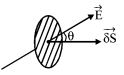
The number of lines of electric force perpendicularly penetrating a surface located in an electric field expresses the magnitude of electric flux associated with that surface.
Image
"In the electric field, the electric flux emanating from a surface with area fraction $\Delta \overrightarrow{ S }$ is equal to the scalar product of the area fraction $\Delta \vec{S}$ and the electric field intensity $\vec{E}$ on $it ^{\prime \prime}$, i.e.
$ \Delta \phi=\overrightarrow{E} \cdot \overrightarrow{\Delta s}=E \Delta s \cos \theta $
(i) If $\theta=0^{\circ}$ then $\cos \theta=1$
$ \Delta \phi=E \Delta s \text { (maximum value) } $
(ii) If $\theta=90^{\circ}$ then $\cos 90^{\circ}=0$
$ \Delta \phi=0 \text { (minimum value) } $
It is a scalar quantity, $\because \Delta \phi=\overrightarrow{ E } \cdot \overrightarrow{\Delta s}$
$\therefore$ Its unit is $N \times m ^2 / C$ or Vm .
Electric Field Intensity due to an Infinite length of uniformly charged wire :
Image
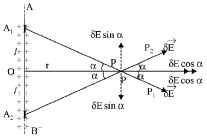
Let $A B$ be a part of an infinitely long linear charged wire whose value on unit length is $\lambda$. The value of the electric field intensity at a point $P$ due to this infinite linear charge is to be found. Let the perpendicular distance of this point from the infinite linear charge distribution be $OP =r$. We observe the electric field produced at point due to two short lengths of wire $A _1 A_2$ located at a symmetrical distance from point O .
Since the distance of $A_1$ and $A_2$ from point $P$ is same, magnitude of $\overrightarrow{ E }$ will be same but its directions will be along $A _1 P$ and $A _2 P$ respectively. They make equal angles with the OP line. By applying these electric fields in the OP and its perpendicular direction, we find that the perpendicular components cancel each other out while the components in the OP direction add up. Similarly, if the entire length of the wire is divided into minority pairs, then the electric field due to each minority pair is only in the OP direction. That is, due to the entire linear charge, the electric field at point P is in the direction perpendicular to the wire
Image
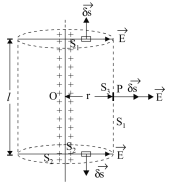
Calculation of electric field : According to the figure, there is a wire of infinite length whose linear charge density is $\lambda$. Let us imagine a cylidrical Gaussian surface of length l. The value of charge in this Gaussian surface will be $\lambda_1$ and the point $P$ will be on its curved surface. This Gaussian page can be divided into three parts:
(i) Upper circular surface $S _{ I }$
(ii) Lower circular surface $S _2$
(iii) $C$ ylindrical surface $S _3$
According to Gauss' law, the total emerging flux from all three surfaces is :
$ \phi=\oint \overrightarrow{E} \cdot \vec{d} S=\int_{S_1} \overrightarrow{E} \cdot d \overrightarrow{S}+\int_{S_2} \overrightarrow{E} \cdot d \overrightarrow{S}+\int_{S_1} \overrightarrow{E} \cdot d \overrightarrow{S}=\frac{\lambda l}{\epsilon_0} $
The electric field $\vec{E}$ is on the circular surface $S_1$ and $S _2$ and the direction of $\delta \overrightarrow{ S }$ is perpendicular to each other, whereas on the cylindrical surface $S _3$ the direction of $\delta \overrightarrow{ S }$ and $\vec{E}$ is same. The cylindrical surface is at the same distance from the charged wire, i.e. the value of the electric field at all its points is also the same
$\int_{ S _1} E \cdot d S \cos 90^{\circ}+\int_{ S _2} E \cdot d S \cos 90^{\circ}+\int_{ S _3} E \cdot d S \cos 90^{\circ}=\frac{\lambda l}{\epsilon_0}$
or $\quad \phi=0+0+\int_{ S _3} E \cdot d S= F \int d S$
For cylindrical surface
$\therefore \quad \int d S=2 \pi r l$
$\therefore \quad E \times 2 \pi r l=\frac{\lambda l}{\epsilon_{ o }}$
or $\quad E =\frac{\lambda}{2 \pi r \epsilon_{ o }}=\frac{1}{4 \pi \epsilon_{ o }} \times \frac{2 \lambda}{ r }$
or $\quad E =\frac{1}{4 \pi \epsilon_{ o }} \frac{2 \lambda}{ r }$
Therefore $E =\frac{\lambda}{2 \pi \epsilon_o r}$
The electric field $\overrightarrow{ E }$ at any point in vector form is expressed as
$ \overrightarrow{E}=\frac{\lambda}{2 \pi \epsilon_o r} \hat{n} $
Image
Here $\hat{n}$ is the radial unit vector in the plane passing normal to any point on the wire, when $\lambda$ is posirtive, $\vec{E}$ is outward and when it is negative, it is inward.
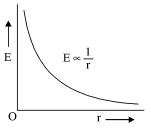
or $ E \propto \frac{1}{r} $
That is, the electric field at a point is inversely proportional to its distance from the wire, which can be shown in the figure. The same formula is also true for a linear charge of finite length but for that the value $r$ is very small in relation to the length.
View full question & answer
Question 215 Marks
Two point charges $q_A=3 \mu C$and $q _{ B }=$$-3 \mu C$ are located 20 cm apart in vacuum.
(a) What is the electric field at the midpoint O of the line AB joining the two charges?
(b) If a negative test charge of magnitude $1.5 \times$$10^{-9} C$ is placed at this point, what is the force experi-enced by the test charge?
Answer
Given:
$q_{ A }=3 \mu C =3 \times 10^{-6} C$
$q_{ B }=-3 \mu C =-3 \times 10^{-6} C$
and $\quad 2 a=20 cm=0.02 m$
$a=10 cm=0.01 m$
Image
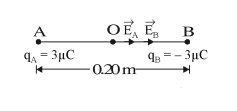
(a) Electric field at point O due to charges placed on A and B ,
$\overrightarrow{ E }=\overrightarrow{ E }_{ A }+\overrightarrow{ E }_{ B }$
$|\overrightarrow{ E }|=\frac{1}{4 \pi \in_o} \frac{q}{(0.10)^2}+\frac{1}{4 \pi \in_o} \frac{q}{(0.10)^2}$
$=\frac{1}{4 \pi \in_{ o }} \frac{2 \times 3 \times 10^{-6}}{(.10)^2}$
$=\frac{9 \times 10^9 \times 6 \times 10^{-6}}{10^{-2}}$
$=54 \times 10^5=5.4 \times 10^6 NC ^{-1}$
The direction of the electric field is from A to B.
(b) Force on a negative test charge of magnitude
$1.5 \times 10^{-9} C$,
$F =q_0$ is given by E
$=-1.5 \times 10^{-9} \times 5.4 \times 10^6$
$=-8.1 \times 10^{-3} N$, sign along OA
shows that the force $F$ is along the opposite direction to the field E .
View full question & answer
Question 225 Marks
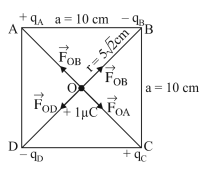
Four point charges $q_{ A }=2 \mu C$,$q_{ B }=-5 \mu C , q_{ C }=2 \mu C$ and $q_{ D }=-5 \mu C$ are located at the of a square ABCD of side 10 cm. Wht is the force on a charge of $1 \mu C$ placed at the centre of the square?
Image
Answer
Considered O centre and ABCD is a square of side 10 cm each. There is a charge of 1 µC at the centre O.
Now clearly $\quad OA = OB = OC = OD$
$AC =\sqrt{(10)^2+(10)^2}$
$\begin{array}{l}=\sqrt{100+100}=\sqrt{200} \\
=10 \sqrt{2}\end{array}$
$AO =\frac{ AC }{2}=\frac{10 \sqrt{2}}{2}=5 \sqrt{2}$
$\therefore \quad AO = OC = OB = OD$
$=5 \sqrt{2} cm=5 \sqrt{2} \times 10^{-2} m$
Given: $\quad q_{ A }=2 \mu C =2 \times 10^{-6} C$
$q_{ B }=-5 \mu C =-5 \times 10^{-6} C$
$q_{ C }=2 \mu C =2 \times 10^{-6} C$
$q_{ D }=-5 \mu C =-5 \times 10^{-} C$
Due to charge of force $q=1 \mu C =1 \times 10^{-6} C , q_{ A }$
By formula $F_1=\frac{1}{4 \pi \in_0}=\frac{\left|q_1 q_2\right|}{r^2}$
Since qA = qCequal and opposite forces will act on the charge of 1mu*C due to charges qA and qC i.e. their mag-nitudes are along OC and OA respectively.
$F _1= F _3=\frac{1}{4 \pi \in_0} \times \frac{q_{ A } \times 1 \mu C }{( AO )^2}$
$=\frac{9 \times 10^9 \times 2 \times 10^{-6} \times 1 \times 10^{-6}}{\left(5 \sqrt{2} \times 10^{-2}\right)^2}$
$=\frac{18 \times 10^{-3}}{25 \times 2 \times 10^{-4}}=\frac{180}{50}=3.6 N$
$\therefore \quad \overrightarrow{ F }_1=-\overrightarrow{ F }_3$
Similarly $F_4=F_2$, charge of $1 \mu$ c experiences equal but opposite forces due to charges $q_{ B }$ and $q_{ D }$
Similarly $\quad \vec{F}_2=-\vec{F}_4$
Similarly all four charges, the net force on $1 \mu c$ will be zero .
i.e. $\quad \overrightarrow{ F }=\overrightarrow{ F _1}+\overrightarrow{ F _2}+\overrightarrow{ F _3}+\overrightarrow{ F _4}=0 N$
There force will be zero.
View full question & answer
Question 235 Marks
Check that the ratio $ke ^2 / Gm _{ e } m _{ p }$, is dimen-sionless. Look up a Table of Physical Constants and determine the value of this ratio. What does the ratio signify?
Answer
Dimention of $e^2= C ^2$
Dimension of $k=\left[ MLT ^{-2}\right] \times\left[ L ^2\right] \times\left[ A ^{-2} T^{-2}\right]$
$=\left[ ML ^3 T^{-4} A^{-2}\right]$
Dimension of $G =\left[ M ^{-1} L^3 T^{-2}\right]$ and
Dimension of $m_e=[ M ]$
$\therefore$ Dimension of $\frac{k e^2}{ G m_e m_p}$
$=\frac{\left[ ML ^3 T^{-4} A^{-2}\right]\left[ A ^2 T^2\right]}{\left[ M ^{-1} L^3 T^{-2}\right][ M ][ M ]}$
$=\left[ M ^{2-2} L^{3-3} T^{-2+2} A^0\right]$
$=\left[ M ^0 L^0 T^0 A^0\right]$
$\therefore \frac{k e^2}{ G m_e m_p}$ is dimensionless quantity
$e=1.6 \times 10^{-19} C , K =9 \times 10^9 Nm ^2 C ^{-2}$
$G =6.67 \times 10^{-11} Nm ^2 kg^{-2}$
$m_e=9.1 \times 10^{-31} kg$ and
On using $\quad m_p=1.66 \times 10^{-27} kg$
Therefore ,
$\begin{aligned} \frac{k e^2}{ G m_e m_p} & =\frac{\left(9 \times 10^9\right) \times\left(1.6 \times 10^{-19}\right)^2}{6.67 \times 10^{-11} \times 9.1 \times 10^{-31} \times 1.66 \times 10^{-27}} \\ & =\frac{9 \times 2.56 \times 10^{-38+9}}{6.67 \times 9.1 \times 1.66 \times 10^{-11-31-27}} \\ & =\frac{9 \times 2.56 \times 10^{-29}}{6.67 \times 9.1 \times 1.66 \times 10^{-69}} \\ & =\frac{9 \times 2.56 \times 10^{-29+69}}{6.67 \times 9.1 \times 1.66} \\ & =\frac{9 \times 2.56 \times 10^{40}}{6.67 \times 9.1 \times 1.66}=\frac{90 \times 2.56 \times 10^{39}}{6.67 \times 9.1 \times 1.66} \\ & =2.29 \times 10^{39}\end{aligned}$
This ratio shows that the electric force between the proton and electron, when located at the same distance is 1039 times stronger than the gravitational force between them.
View full question & answer
Question 245 Marks
A polythene piece rubbed with wool is found to have a negative charge of $3 \times 10^{-7} C$.
(a) Estimate the number of electrons transferred (from which substance to which substance).
(b) Is there a transfer of mass from wool to polythene?
Answer
(a) Here the value of total transferred charge
$=3 \times 10^{-7} C$
Charge on one electron $=1.6 \times 10^{-19} C$
n = Number of transferred electrons = ?
Since the piece of polythene has a negative charge when rubbed with wool, the electrons are transferred from the wool to the piece of polythene.
From q = ne
$n=\frac{q}{e}=\frac{3 \times 10^{-7} C }{1.6 \times 10^{-19} C }$
$=1.875 \times 10^{12}$
$\simeq$ $\ 2 \times 10^{12}$electrons
(b) Yes, there is also transfer of mass from wool to polyethylene, because electrons, which are material particles, are displaced from wool to polyethylene. We know that the mass of the electrons is very less. Therefore the transfer of mass is negligible.
Total mass transferred to polyethylene = m x n
$=9.1 \times 10^{-31} kg \times 1.875 \times 10^{12}$
$=1.71 \times 10^{ -18} kg$
$\simeq$ $2 \times 10^{-18} kg$
View full question & answer