CURRENT ELECTRICITY — Physics STD 12 Science — Question
Gujarat BoardEnglish MediumSTD 12 SciencePhysicsCURRENT ELECTRICITY3 Marks
Question
Explain electrical energy and power.
✓
Answer
$\rightarrow$
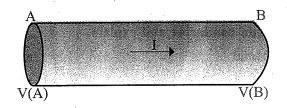
$\rightarrow$ As shown in figure, consider a conductor with end points $A$ and $B$ . In this conductor, current I is flowing from $A$ to $B $.
$\rightarrow$ The potential at $A$ and $B$ are $V ( A )$ and $V ( B )$ respectively.
Since current is flowing from $A$ to $B, V(A)>V(B)$.
$\rightarrow$ The potential difference across $A B$
$V = V ( A )- V ( B )>0$
$\rightarrow$ In time interval $\Delta t$, an amount of charge $\Delta Q = I \Delta t$ flows from $A$ to $B $.
$\rightarrow$ The potential energy of the charge at $A$ is $\Delta Q . V ( A )$ and at $B$ is $\Delta Q . V ( B )$.
$\rightarrow$ Thus, change in potential energy.
$\Delta U =\text { final potential energy }- \text { initial potential }$
$\text { energy }$
$\therefore \Delta U=\Delta Q V(B)-\Delta Q V(A)$
$\therefore \Delta U=\Delta Q(V(B)-V(A))$
$\therefore \Delta U=\Delta Q(-V) \quad\left(\because \text { from eq }{ }^{ n }(1)\right)$
$\therefore \Delta U=-\Delta Q . V$
$\therefore \Delta U =- IV \Delta t<0$
$\rightarrow$ According to law of conservation of energy,
$\Delta K +\Delta U =0$
$\therefore \Delta K=-\Delta U$
$\therefore \Delta K =-(- IV \Delta t) \quad\left(\because \text { from eq }^{ n }(2)\right)$
$\therefore \Delta K = IV \Delta t \text { (positive) }$
$\rightarrow$ Thus, from this equation it can be seen that a charge moving freely under the effect of an electric field acquires kinetic energy, it means kinetic energy increases.
$\rightarrow$ But in reality, the charges in the conductor move with constant drift velocity,
i.e. they gain no energy on an average.
$\rightarrow$ This is because of the collisions with ions and atoms during the motion.
During collisions, the energy gained by the charges is shared with the atoms,
So the atoms vibrate more energetically, i.e. the conductor heats up.
$\rightarrow$ Thus, kinetic energy of charge is converted in to heat energy.
$\rightarrow$ Amount of energy dissipated as heat in the conductor during the time interval $\Delta t$ is
$\Delta W = VI \Delta t$
$\rightarrow$ The energy dissipated per unit time is the dissipated power $P$ .
$\therefore P =\frac{\Delta W }{\Delta t}$
$\therefore P =\frac{ VI \Delta t}{\Delta t}$
$\therefore P = VI$
$\rightarrow$ Using ohm's law $V = IR$
$\therefore P = I ^2 R$
$\rightarrow$ and also $P =\frac{ V ^2}{ R }$ can be derived.
$\rightarrow$ The SI unit of electrical power is $W ($watt$)$ OR $ J/s$
$\rightarrow$ Equations $(5), (6)$ and $(7) $ show dissipated power in conductor. $($power loss or ohmic loss$)$
$\rightarrow$ For example, when power is supplied to the coil of an electric bulb, this power is converted into heat and light.
Need a full question paper?
Generate a complete, print-ready paper with questions like this in minutes — across 16+ boards, with answer keys.