Maharashtra BoardEnglish MediumSTD 12 SciencePhysicsAC Circuits4 Marks
Question
Explain the terme sharpness of resonance and $Q$ factor (quality factor).
✓
Answer
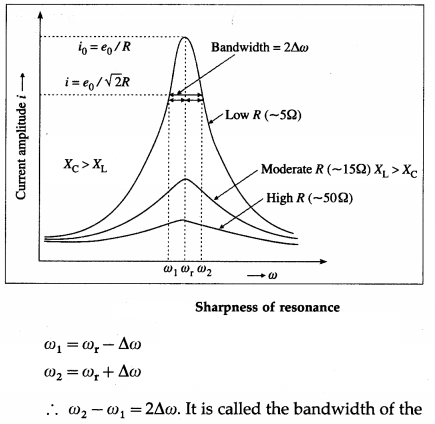
In a series LCR Ac circuit, the amplitude of the current, i.e., the peak value of the current, is $i_0=\frac{e_0}{\sqrt{R^2+\left(\omega L-\frac{1}{\omega C}\right)^2}}$ If the angular frequency, $n$ changed. at resonance. $\omega_{ r } L =\frac{1}{\omega_{ r } C}$ giving $\omega_{ r }=\frac{1}{\sqrt{L C}}$ For $\omega$ different from $\omega_r$ the amplitude of $i$ is less than the maximum value of $i_0$. which is $\frac{e_0}{R}$. Contider the value of $\omega$ for which io $=\frac{\left(i_0\right)_{\max }}{\sqrt{2}}$ $=\frac{e_0}{R \sqrt{2}}$ that the power dissipated by the circuit is half the maximum power. This $\omega$ is called the half power angular frequency. There are two such values of $w$ on either side of $\omega_r$ as shown in below fiqure. circuit. $\frac{\omega_r}{2 \Delta \omega}$ is a measure of the sharpness of resonance If $It$ is high, resonance is sharp; if it is low, resonance is not sharp. The sharpness of resonance Is measured by a coefficient called the quality or $Q$ fader of the cicuit. The $Q$ factor of a series $L C R$ resonant circuit is defined as the ratio of the resonant angular frequency to the diference in two angular frequencies taken on both sides of the angular resonant 'frequency such that at each angular frequency the current amplitude becomes $\frac{1}{\sqrt{2}}$ times the value at resonant frequency. $ \therefore Q =\frac{\omega_{ r }}{\omega_2-\omega_1}=\frac{\omega_{ r }}{2 \Delta \omega}=\frac{\text { resonant frequency }}{\text { bandwidth }} $ Q-factor is a dimensionless quantity. The larger the Q-factor, the smaller is the bandwidth i.e. the sharper is the peak in the current It means the series resonant circuit is more selective in this case. from figure shows that the lower angular frequency side of the resonance curve is dominated by the capacitive reactance, the higher angular frequency side is dominated by the inductive reactance and resonance occurs in the middle. This follows from the formulae, $X_L=\omega L$ and $X_C=\frac{1}{\omega C}$. The higher the $\omega$, the greater is $X_L$ and smaller is $X_C \cdot A t \omega=\omega_r X_L=$ $X_c$.
Need a full question paper?
Generate a complete, print-ready paper with questions like this in minutes — across 16+ boards, with answer keys.