Question
Explain electricity conduction in intrinsic semi-conductors.

Answer

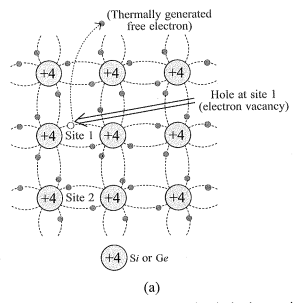
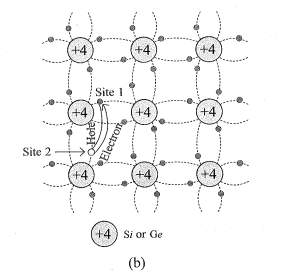
→As shown in Fig. (a), Suppose there is a hole at site-1. The movement of holes can be visualised as shown in the Fig (b).
→An electron from the covalent bond at site-2, may jump to the vacant site-1. (hole)
Image
→Thus, after such a jump, the hole is at site-2 and the site-1 has now an electron. Therefore, apparently, the hole has moved from site-1 to site-2. (So, the directions of motion of a hole and an electron are opposite).
Image
→Note that the electron originally set free (Fig. a) is not involved in the process of hole motion.
→The free electron moves completely independently as conduction electron and gives rise to an electron current, I under an applied electric field.
→Remember that the motion of hole is only a convenient way of describing the actual motion of bound electrons, whenever there is an empty bond anywhere in the crystal.
→Under the action of an electric field, these holes move towards negative potential giving the hole current, $I _h$.
→The total current, I is thus the sum of electron current $I _e$ and the hole current $I _h$ :
$\therefore I = I _e+ I _h$                                            .......(1)
→Apart from the process of generation of conduction electrons and holes, a simultaneous process of recombination occurs in which these electrons recombine with holes.
→At equilibrium, the rate of generation is equal to the rate of recombination of charge carries. The recombination occurs due to an electron colliding with a hole.

Need a full question paper?

Generate a complete, print-ready paper with questions like this in minutes — across 16+ boards, with answer keys.
Start Generating Free

Similar questions

When two surfaces are polished, the friction coefficient between them decreases. But the friction coefficient increases and becomes very large if the surfaces are made highly smooth. Explain.
Define self-inductance of a coil. Show that magnetic energy required to build up the current I in a coil of self inductance L is given by $\frac{1}{2}\text{LI}^{2}.$
A simple microscope is rated 5 for a normal relaxed eye. What will be its magnifying power for a relaxed farsighted eye whose near point is 40cm?
Find the flux of the electric field through a spherical surface of radius R due to a charge of $10^{-7}C$ at the centre and another equal charge at a point 2R away from the centre.
Consider two particles A and B having equal charges and placed at some distance. The particle A is slightly displaced towards B. Does the force on B increase as soon as the particle A is displaced? Does the force on the particle A increase as soon as it is displaced?
A person looking at a person wearing a shirt with a pattern comprising vertical and horizontal lines is able to see the vertical lines more distinctly than the horizontal ones. What is this defect due to? How is such a defect of vision corrected?
What are $V-1$ characteristics of a $p-n$ junction?
According to the classical electromagnetic theory, calculate the initial frequency of the light emitted by the electron revolving around a proton in hydrogen atom.
Derive R=2f for spherical mirror.
(Where, R= radius of curvature and f = focal length)###Obtain relation between radius of curvature and focal length of spherical mirror.
A small block B is placed on another block A of mass 5kg and length 20cm. Initially the block B is near the right end of block A. A constant horizontal force of 10N is applied to the block A. All the surfaces are assumed frictionless. Find the time elapsed before the block B separates from A.