Question
Explain electrolysis of concentration aqueous solution of $\text{NaCl}$

Answer

$\rightarrow $ During the electrolysis of aqueous sodium chloride solution, the products are $NaOH , Cl _2$ and $H _2$.
$\rightarrow $ In this case besides $Na ^{+}$and $Cl ^{-}$ions we also have $H ^{+}$and $OH ^{-}$ions along with the solvent molecules, $H _2 O$.
$\rightarrow $ At the cathode there is competition between the following reduction reactions :
$Na ^{+}( aq )+ e ^{-} \rightarrow Na ( s ) E _{\text {(cell) }}^{\ominus}=-2.71 V$
$H ^{+}( aq )+ e ^{-} \rightarrow \frac{1}{2} H _2(g) E _{\text {(cell) }}^{\ominus}=0.00 V$
\rightarrow The reaction with higher value of $E ^{\ominus}$ is preferred and, therefore the reaction at the cathode during electrolysis is :
$H ^{+}( aq )+ e ^{-} \rightarrow \frac{1}{2} H _2(g)...(1)$
but $H ^{+}( aq )$ is produced by the dissociation of $H _2 O$ i.e.,
$H _2 O (l) \rightarrow H ^{+}( aq )+ OH ^{-}( aq )...(2)$
Therefore, the net reaction at the cathode may be written as the sum of $(1)$ and $(2)$ and we have
$H _2 O ( l )+ e ^{-} \rightarrow \frac{1}{2} H _2(g)+ OH ^{-}$
At the anode the following oxidation reactions are possible :
$Cl ^{-}( aq ) \rightarrow \frac{1}{2} Cl _2(g)+ e ^{-} E _{\text {(cell) }}^{\ominus}=1.36 V \ldots \ldots . .(3)$
$2 H _2 O ( l ) \rightarrow O _2(g)+4 H ^{+}( aq )+4 e ^{-} E _{\text {(cell) }}^{\ominus}=1.23 V$
\rightarrow The reaction at anode with lower value of $E ^{\ominus}$ is preferred and therefore, water should get oxidised in preference to $Cl ^{-}$(aq). However, on account of over potential of oxygen, reaction $(3)$ is preferred. Thus, the net reactions may be summarised as:
$NaCl ( aq ) \xrightarrow{ H _2 O } Na ^{+}( aq )+ Cl ^{-}( aq )$
Cathode : $H _2 O (l)+ e ^{-} \rightarrow \frac{1}{2} H _2(g)+ OH ^{-}( aq )$
Anode : $Cl ^{-}( aq ) \rightarrow \frac{1}{2} Cl _2(g)+ e ^{-}$
Net reaction :
$NaCl ( aq )+ H _2 O ( l ) \rightarrow Na ^{+}( aq )+ OH ^{-}( aq )+\frac{1}{2} H _2(g)+\frac{1}{2} Cl _2(g)$

Need a full question paper?

Generate a complete, print-ready paper with questions like this in minutes — across 16+ boards, with answer keys.
Start Generating Free

Similar questions

State briefly the principles which serve as basis for the following operations in metallurgy:
  1. Froth floatation process.
  2. Zone refining.
  3. Refining by liquation.

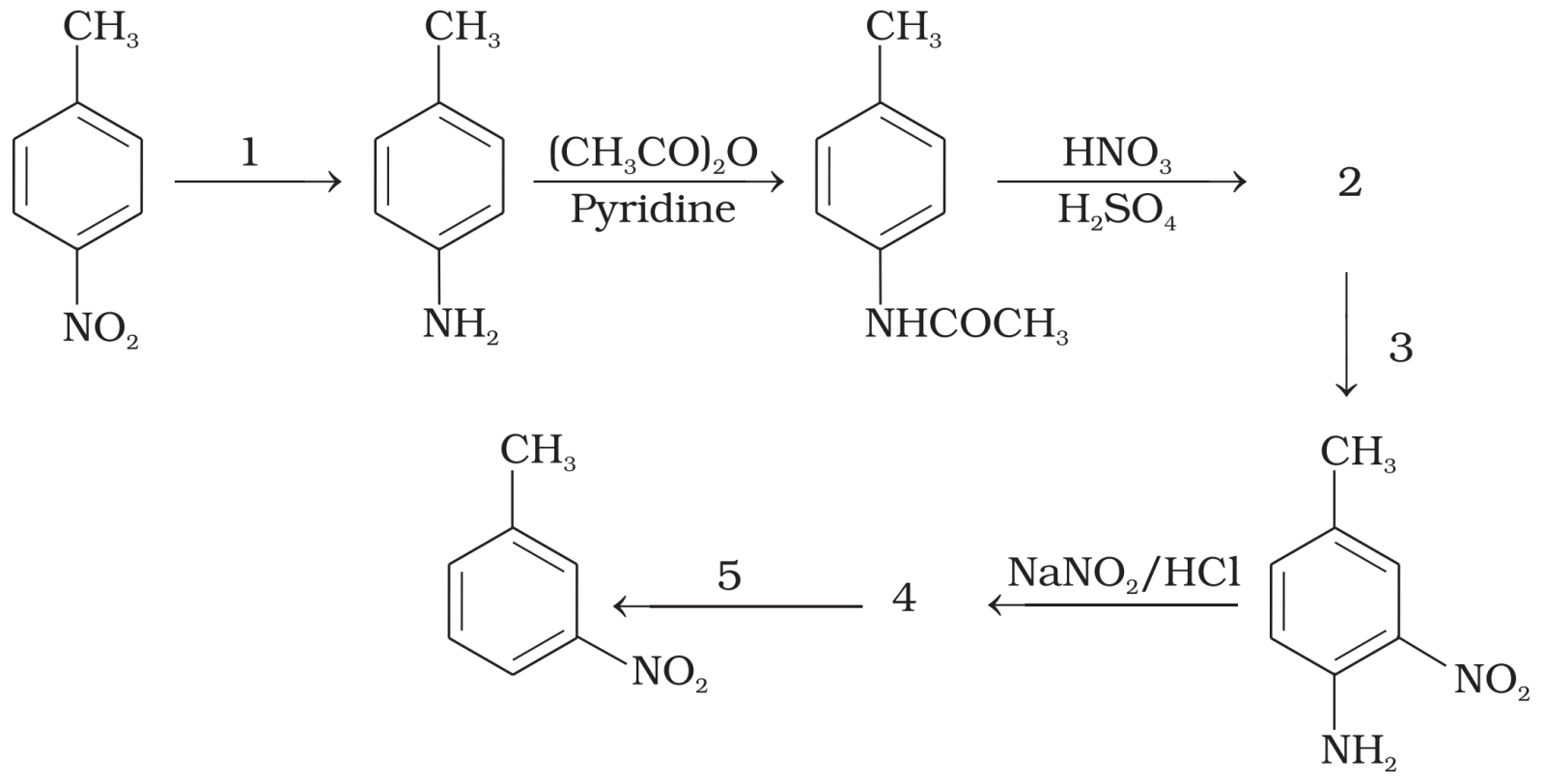
Predict the reagent or the product in the following reaction sequence.
Describe a method for refining nickel.
A colourless inorganic salt A decomposes at about $250^\circ C$ to give only two products $B$ and $C$ leaving no residue. The oxide $C$ is a liquid at room temperature and is neutral to litmus paper while $B$ is neutral oxide. White phosphorus burns in excess of $B$ to produce strong dehydrating agent. Give balanced equations for above processes.
Iron has a body centred cubic unit cell with a cell edge of 286.65 pm. The density of iron is $7.87\ g\ cm^{–3}.$ Use this information to calculate Avogadro’s number $($At mass of $Fe = 56\ g\ mol^{–1}).$
Vapour pressure of water at $20^o\ C$ is $17.5\ mm$ Hg. Calculate the vapour pressure of water at $20^o\ C$ when $15\ g$ of glucose $($Molar mass $=180\ g\ mol^{-1})$ is dissolved in $150\ g$ of water.
A current of $1.50A$ was passed through an electrolytic cell containing $AgNO_3$ solution with inert electrodes. The weight of Ag deposited was $1.50g$. How long did the current flow?
What happens when
  1. Ethyl chloride is treated with NaI in the presence of acetone,
  2. Chlorobenzene is treated with Na metal in the presence of dry ether,
  3. Methyl chloride is treated with $KNO_2$?
Write chemical equations in support of your answer.
Account for the following:
  1. $PCl_5$ is more covalent than $PCl_3.$
  2. Iron on reaction with HCl forms $FeCl_2$ and not $FeCl_3$
  3. The two $O-O$ bond lengths in the ozone molecule are equal.
. Match the type of packing given in Column I with the items given in Column II.
 
Column I
 
Column II
(i)
Square close packing in two dimensions
(a)
Triangular voids.
(ii)
Hexagonal close packing in two dimensions
(b)
Pattern of spheres is repeated in every fourth layer.
(iii)
Hexagonal close packing in three dimensions
(c)
Coordination number 4.
(iv)
Cubic close packing in three dimensions
(d)
Pattern of sphere is repeated in alternate layers.