Question
Explain electrostatic potential.

Answer

The work done in taking the test charge from one point to the other point in the electric field created by an electric charge distribution is stored in the form of potential energy and is proportional to charge $q$.
If this work is divided by $q$, then the resulting quantity does not depend on $q$. In this way, work done per unit charge is the characteristic of electric field, which can be defined as static electric potential.
The work done by external force in taking unit positive charge from $R$ to P ,
$\frac{ W _{ RP }}{q}=\frac{ U _{ P }- U _{ R }}{q}= V _{ P }- V _{ R }=\Delta V$ Where, $V _{ P }$ and $V _{ R }$ are electrostatic potential at points $P$ and $R$ respectively.
There is no importance of absolute value of electric potential. It is only the difference of electric potential between two points, which is important.
If electric potential at infinite distance is taken zero then,
"Work done in bringing unit positive charge from infinity to the given point in the electric field, against the electric field is called electro static potential (V) at that point".
OR
→"In the region of static electric field, electric potential at any point, means work done by external force in bringing unit positive charge from infinity to that point, without acceleration."
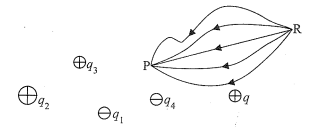
The work done in taking the test charge $q$ in the given electric field, does not depend on path. It depends only on the initial position and final position.

Image

As shown in the fig., in the resultant (net) electric field of electric charges $q_1, q_2, q_3$, $q_4$, the work done in taking the test charge $q$ from point R to P , on different paths, is found same which indicates that the work done is independent of path.

Need a full question paper?

Generate a complete, print-ready paper with questions like this in minutes — across 16+ boards, with answer keys.
Start Generating Free

Similar questions

If $\vec{\text{A}},\vec{\text{B}},\vec{\text{C}}$ are mutually perpendicular, show that $\vec{\text{C}}\times(\vec{\text{A}}\times\vec{\text{B}})=0.$ Is the converse true?
A toroid has a core $($non$-$ferromagnetic$)$ of inner radius $25 \ cm$ and outer radius $26 \ cm,$ around which $3500$ turns of a wire are wound. If the current in the wire is $11 A,$ what is the magnetic field,
  1. Outside the toroid,
  2. Inside the core of the toroid and,
  3. In the empty space surrounded by the toroid.
Explain the following giving reasons :
(i) When monochromatic light is incident and surface separating two media, the reflected and refracted light both have the same frequency as the incident frequency.
(ii) When light travels from a rarer medium to a denser medium, the speed decreases. Does this decrease in speed imply a reduction in the energy carried by the wave?
(iii) In the wave picture of light intensity of light is determined by the square of the amplitude of the curve. What determines the intensity in the photon picture of light ?
  1. Draw a schematic diagram of a reflecting telescope.
  2. State the advantages of reflecting telescope over refracting telescope.
A small pin fixed on a table top is viewed from above a distance of 50 cm. By what distance would the pin appear to be raised if it is viewed from the same point through a 15 cm thick glass slab held parallel to the table? Refractive index of glass = 1.5. Does the answer depend on the location of the slab?
A long, cylindrical tube of inner and outer radii a and b carries a current i distributed uniformly over its cross section. Find the magnitude of the magnetic field at a point (a) just inside the tube (b) just outside the tube.
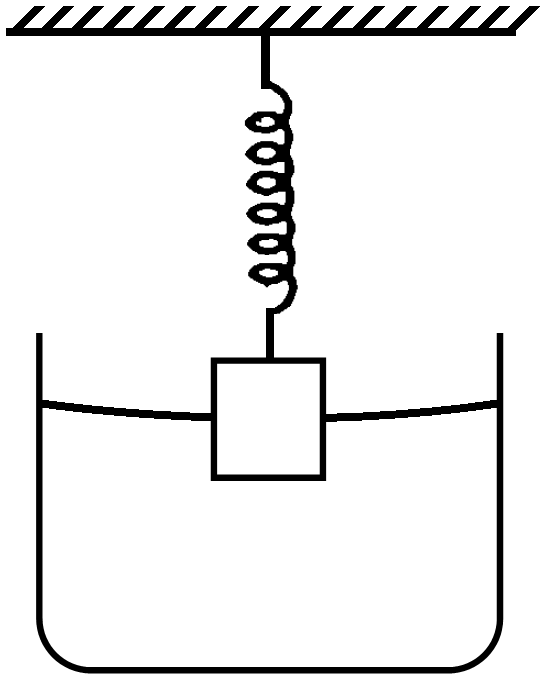
A cylindrical object of outer diameter $10\ cm,$ height $20\ cm$ and density $8000\ kg/m^3$ is supported by a vertical spring and is half dipped in water as shown in.
  1. Find the elongation of the spring in equilibrium condition.
  2. If the object is slightly depressed and released, find the time period of resulting oscillations of the object. The spring constant $= 500N/m.$
A river 400m wide is flowing at a rate of 2.0m/s. A boat is sailing at a velocity of 10m/s with respect to the water, in a direction perpendicular to the river.
  1. Find the time taken by the boat to reach the opposite bank.
  2. How far from the point directly opposite to the starting point does the boat reach the opposite bank?
Using $\text{B}=\mu_0\text{H},$ find the ratio $\frac{\text{E}_0}{\text{H}_0}$ for a plane electromagnetic wave propagating through vacuum. Show that it has the dimensions of electric resistance. This ratio is a universal constant called the impedance of free space.
A closely wound solenoid of 2000 turns and area of cross-section$1.6 \times 10^{-4} m^2$, carrying a current of 4.0 A, is suspended through its centre allowing it to turn in a horizontal plane.
(a) What is the magnetic moment associated with the solenoid?
(b) What is the force and torque on the solenoid if a uniform horizontal magnetic field of$7.5 \times 10^{-2} T$ is set up at an angle of $30^{\circ}$ with the axis of the solenoid?