Respiration In Plants — BIOLOGY STD 11 Science — Question
Gujarat BoardEnglish MediumSTD 11 ScienceBIOLOGYRespiration In Plants5 Marks
Question
Explain ETS.
✓
Answer
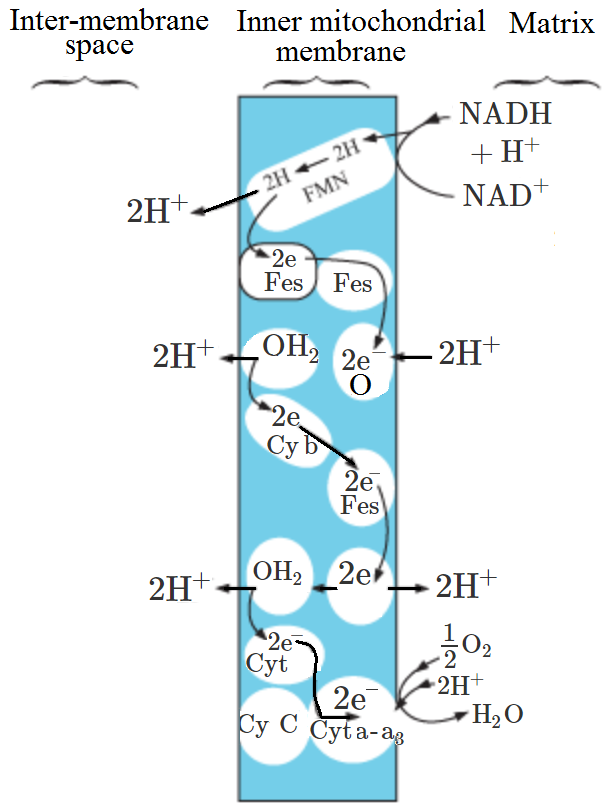
ETS or electron transport system is located in the inner mitochondrial membrane. It helps in releasing and utilizing the energy stored in $\mathrm{NADH}+\mathrm{H}^{+}$and $\mathrm{FADH}_2, \mathrm{NADH}+\mathrm{H}^{+}$, which is formed during glycolysis and citric acid cycle, gets oxidized by NADH dehydrogenase (complex I). The electrons so generated get transferred to ubiquinone through FMN. In a similar manner, FADH 2 (complex II) generated during citric acid cycle gets transferred to ubiquinone. The electrons from ubiquinone are received by cytochrome $\mathrm{bc}_1$ (complex III) and further get transferred to cytochrome c. The cytochrome c acts as a mobile carrier between complex III and cytochrome c oxidase complex, containing cytochrome- a and $\mathrm{a}_3$, along with copper centers (complex IV). During the transfer of electrons from each complex, the process is accompanied by the production of ATP from ADP and inorganic phosphate by the action ATP synthase (complex $\mathbf{V}$ ). The amount of ATP produced depends on the molecule, which has been oxidized. 2 ATP molecules are produced by the oxidation of one molecule of NADH. One molecule of FADH ${ }_2$, on oxidation, gives 3 ATP molecules.
Need a full question paper?
Generate a complete, print-ready paper with questions like this in minutes — across 16+ boards, with answer keys.