Maharashtra BoardEnglish MediumSTD 12 ScienceChemistrySolid State4 Marks
Question
Explain extrinsic semiconductor and doping.
✓
Answer
$(1)$ A semiconductor obtained by doping intrinsic semiconductor with elements of third group and fifth group is called extrinsic semiconductor.
$(2)$ This extrinsic semiconductor has higher electrical conductivity than pure intrinsic semiconductor.
$(3)$ There ate two types of extrinsic semiconductors:
$(A) \ n-$type semiconductors:
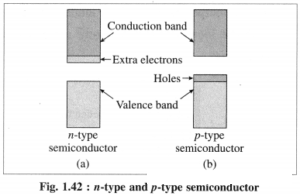
$(i) \ n-$type semiconductor contains increased number of electrons in the conduction band.
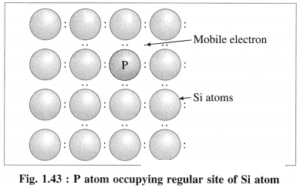
$(ii)$ When $Si$ semiconductor is doped with $15^{th}$ group element phosphorus, $P,$ the new atoms occupy some vacant sites in the lattice in place of $Si$ atoms.
$(iii) \ P$ has five valence electrons, out of which four are involved in covalent bonding with neigh$-$bouring $Si$ atoms while one electrons remains free and delocalised.
$(iv)$ These free electrons increase the electrical conductivity of the semiconductor.
$(v)$ The semiconductors with extra non$-$bonding free electrons are called $n-$type semiconductors.
$(B) \ p-$type semiconductor :
$(i) \ p-$type semiconductor is obtained by doping a pure semiconductor by an element of $13^{th}$ group like $B.$
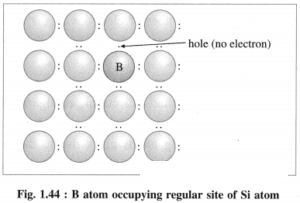
$(ii) \ 13^{th}$ group element has less number of valence electrons. When pure $Si$ is doped with $B$ atoms, these atoms occupy $Si$ lattice points.
$(iii)$ Boron $(_5B)$ has only $3$ valence electrons which form covalent bonds with the neighbouring $Si$ atoms, while one bond has shortage of one electron.
$(iv)$ This creates a vacancy or a hole, hence the electron from neighbouring $Si$ atom jumps into this hole creating a vacancy in itself. This process continues, i.e., positive holes move in one direction while
electrons moves in opposite direction.
$(v)$ Due to electron deficient positions, this semiconductor is called $p-$type semiconductor.
$(vi)$ When $p-$type semiconductor is connected to the external source of electricity, electrons from
neighbouring silicon atoms jump into the holes so that electrons move towards positive electrode and holes migrate towards negative electrode.
$(vii)$ Hence electrical conduction in $p-$type semiconductor is due to electrons and holes.
Need a full question paper?
Generate a complete, print-ready paper with questions like this in minutes — across 16+ boards, with answer keys.