Question
Explain fertilization and development in pheretima.

Answer

Fertilization and Development in Pheretima:
  • A mutual exchange of sperm occurs between two worms during mating. One worm has to find another worm and they mate juxtaposing opposite gonadal openings exchanging packets of sperms called spermatophores.
  • Mature sperm and egg cells and nutritive fluid are deposited in cocoons produced by the gland cells of clitellum. Fertilisation and development occur within the cocoons which are deposited in soil.
  • The cocoon holds the worm embryos. After about 3 weeks, each cocoon produces two to twenty baby worms with an average of four.
  • Earthworms development is direct, i.e., there is no larva formed.

Need a full question paper?

Generate a complete, print-ready paper with questions like this in minutes — across 16+ boards, with answer keys.

Start Generating Free

Similar questions

Explain the mass flow hypothesis of transport in phloem.
In a plant, tranalocation in xylem is unidirectional while in phloem it is bidirectional. Explain.
Give the factors that govern the size of the cell.
Complete the following table by filling the blanks marked (A-F) below.
Essential element
Macro or Micro/ Region of requirement
Function
Dificiency
Boron
Micro/ apical leaves and seeds
Elongation of pollen tube
____ (A) ____
____ (B) ____
Micro/ whole plant
Involved in OXi-red reactions
Development of necrotic spots
Phosphorus
____ (C) ____
____ (D) ____
Structed plants
Magnesium
Macro/ growing areas of root and stems
____ (E) ____
____ (F) ____
Explain the difference between cilia and flagella. Draw a diagram and describe their internal structure.
Explain, why a pair of homologous chromosomes is genetically different, but a pair of sister chromatids is genetically identical before crossing over in meiosis.
Give a detail description of plastids with the help of suitable diagram.
Write in detail on the exchange of gases
Akshita who is a biology tutor was teaching photosystems to the students at her place. While explaining the topic light reaction said that, "Two of the three products of light reaction, ATP and NADPH are used to drive the reactions in the biosynthetic/dark phase." It has been verified by the fact that immediately after light becomes unavailable, the biosynthetic phase continues for some time and then stops; if light becomes available again, the process continues. Her brother, student of class XI was also listening the same and was remembering that he had listened the same from his biology teacher also. He interupped her sister and asked her to re-explain the whole process for the better understanding.
  1. What are the products of light reaction?
  2. Can we say that calling the biosynthetic phase, dark reaction is a misnomer? Justify.
  3. Name the first stable product of photosynthesis.
  4. What value you learn from this phenomenon if applied in daily life?
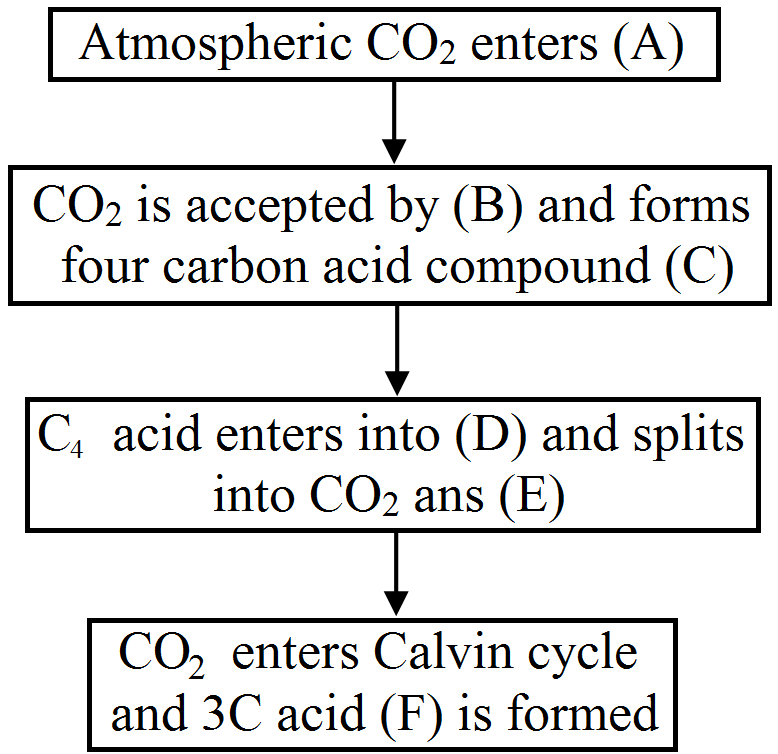
Fill in the blanks at (A), (B), (C), (D), (E) and (F) and complete the pathway/ Hatch-Slack pathway: