Question
Explain geometrical isomerism in octahedral Complex.

Answer

$\rightarrow$ This type of isomerism arises in heteroleptic complexes due to different possible geometric arrangements of the ligands.
$\rightarrow$ Important examples of these behaviour are found with coordination numbers $4$ and $6.$
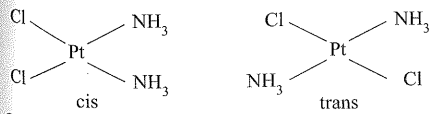
$\rightarrow$ In a square planar complex of formula $\ce{[MX_2L_2]} (X$ and $L$ are unidentate$),$ the two ligands $X$ may be arranged adjacent to each other in a cis isomer, or opposite to each other in a trans isomer.
Image
Geometrical isomers $($cis and trans$)$ of $\ce{Pt[(NH_3)_2Cl_2]}$
$\rightarrow$ Other square planar complex of the type $\text{MABXL} ($where $\text{A, B, X, L}$ are unidentates$)$ shows three isomers$-$two cis and one trans.
$\rightarrow$ Such isomerism is not possible for a tetrahedral geometry.
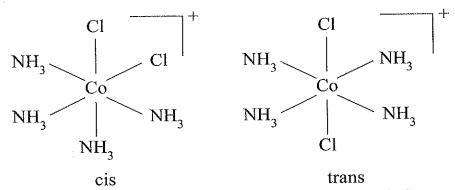
$\rightarrow$ In octahedral complexes of formula $\ce{[MX_2L_4]}$ in which the two ligands $X$ may be oriented cis or trans to each other
Image
Geometrical isomers $($cis and trans$)$ of $\ce{[Co(NH_3)_4Cl_2]^+}$
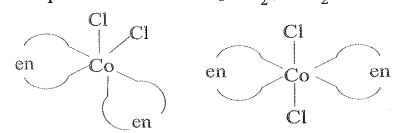
$\rightarrow$ This type of isomerism also arises when didentate ligands $L-L [e.g., en ]$ are present in complexes of formula $\ce{[MX_2(L-L)_2]}$​​​​​​​
Image
Geometrical isomers $($cis and trans$)$ of $\ce{[CoCl_2(en)_2]}$
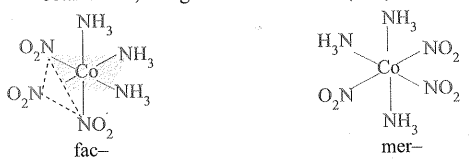
$\rightarrow$ Another type of geometrical isomerism occurs in octahedral coordination entities of the type $\ce{[Co(NH_3)_3(NO_2)_3].}$
$\rightarrow$ If three donor atoms of the same ligands occupy adjacent positions at the corners of an octahedral face, it forms the facial $($fac$)$ isomer.
$\rightarrow$ When the positions are around the meridian of the octahedron, we get the meridional $($mer$)$ isomer.​​​​​​​
Image
The facial $($fac$)$ and meridional $($mer$)$ isomers of $\ce{[Co(NH_3)_3(NO_2)_3]}$

Need a full question paper?

Generate a complete, print-ready paper with questions like this in minutes — across 16+ boards, with answer keys.

Start Generating Free

Similar questions

Give equations for the following reactions :
(i) Oxidation of propan-1-ol with alkaline $KMnO _4$ solution.
(ii) Bromine in presence of $C S _{ 2 }$ with phenol.
(iii) Dilute nitric acid with phenol.
Indicate the steps in the preparation of :
(i) $K _2 Cr _2 O _7$ from chromite ore
(ii) $KMnO _4$ from pyrolusite ore.
What is boiling point? What is elevation of boiling point? Explain Molal elevation constant and derive It's formula.
Write down reaction of halogens with metals. ### Give Fittig, Wurtz - Fittig and Grignard reaction of haloarene.
What is the difference between Schottky and Frenkel defect ?
Read the following text carefully and answer the questions that follow:
Many chemical and biological processes depend on osmosis, the selective passage of solvent molecules through the porous membrane from a dilute solution to a more concentrated one. The osmotic pressure $\pi$ depends on molar concentration of the solution ($\pi$ = CRT). If two solutions are of equal solute concentration and, hence, have the same osmotic pressure, they are said to be isotonic. If two solutions are of unequal osmotic pressures, the more concentrated solution is said to be hypertonic and the more diluted solution is described as hypotonic. Osmosis is the major mechanism, for transporting water upward in the plants. Transpiration is the leaves supports the transport mechanism of water. The osmotic pressure of seawater is about 30 atm; this is the pressure that must be applied to the seawater (separated from pure water using a semi-permeable membrane) to get drinking water.
i. What will happen if a plant cell kept in a hypertonic solution? 
ii. Blood cells are isotonic with 0.9% sodium chloride solution. What happens if we place blood cells in a solution containing in 1.2% sodium chloride solution?
iii. What happens when the external pressure applied becomes more than the osmotic pressure of solution?
Read the following text carefully and answer the questions that follow:
The transition metals when exposed to oxygen at low and intermediate temperatures form thin, protective oxide films of up to some thousands of Angstroms in thickness. Transition metal oxides lie between the extremes of ionic and covalent binary compounds formed by elements from the left or right side of the periodic table. They range from metallic to semiconducting and deviate by both large and small degrees from stoichiometry. Since delectron bonding levels are involved, the cations-exist in various valence states and hence give rise to a large number of oxides. The crystal structures are often classified by considering a cubic or hexagonal close-packed lattice of one set of ions with the other set of ions filling the octahedral or tetrahedral interstices. The actual oxide structures, however, generally show departures from such regular arrays due in part to distortions caused by packing of ions of different size and to ligand field effects. These distortions depend not only on the number of d-electrons but also on the valence and the position of the transition metal in a period or group.
i. Why does copper, which is in first series of transition metal exhibits +1 oxidation state most frequently? (1)
ii. The lowest oxide of transition metal is basic. Why? (1)
iii. The variability in oxidation states of d-block different from that of the p-block elements. Explain. (2)
Write a note on collision theory of chemical reaction. ### What is meant by collision theory? Explain.
Write the test by which following are distinguished:
(i) Ethanol and Acetaldehyde
(ii) Phenol and carboxylic acid
(iii) Aldehyde and Ketone
(iv) Formic and Acetic acid
Read the following text carefully and answer the questions that follow$:$
Aariv Sharma is very fond of a special drink made by his grandmother using different fruits available in their hometown. It has an outstanding taste and also provide great health benefits of natural fruits. He thought of utilizing his grandmother recipe to create a new product in the beverage market that provide health benefits and also contain fizziness of various soft drinks available in the market.
i. How he can add fizz to the special drink made by his grandmother? $(1)$
ii. What is the law stated in the chapter that can help Aariv to make his drink fizzy? $(1)$
iii. What precautions he should take while bottling so that his product does not lose fizz during storage and handling across long distances? $(2)$