Question
Explain Hertz experiment for communication of electromagnetic waves. Draw labelled diagram of apparatus used in the experiment.
$(or)$
Explain Hertz experiment related with electromagnetic waves and also explain experiments of Jagdish Chandra Basu and Marconi.
$(or)$
Critically evaluate Hertz experiment of production and communication of electromagnetic waves.
Answer

SELF

Need a full question paper?

Generate a complete, print-ready paper with questions like this in minutes — across 16+ boards, with answer keys.

Start Generating Free

Similar questions

A particle of mass m is kept on the top of a smooth sphere of radius R. It is given a sharp impulse which imparts it a horizontal speed v.
  1. Find the normal force between the sphere and the particle just after the impulse.
  2. What should be the minimum value of v for which the particle does not slip on the sphere?
  3. Assuming the velocity v to be half the minimum calculated in part.
  4. Find the angle made by the radius through the particle with the vertical when it leaves the sphere.
The difference in the frequencies of series limit of Lyman series and Balmer series is equal to the frequency of the first line of the Lyman series. Explain.
  1. A point object is placed on the principal axis of a convex spherical surface of radius of curvature R, which separates the two media of refractive indices $n_1$ and $n_2(n_2 > n_1)$. Draw the ray diagram and deduce the relation between the object distance (u), image distance (v) and the radius of curvature (R) for refraction to take place at the convex spherical surface from rarer to denser medium.
  2. A converging lens has a focal length of 20 cm in air. It is made of a material of refractive index 1.6. If it is immersed in a liquid of refractive index 1.3, find its new focal length.
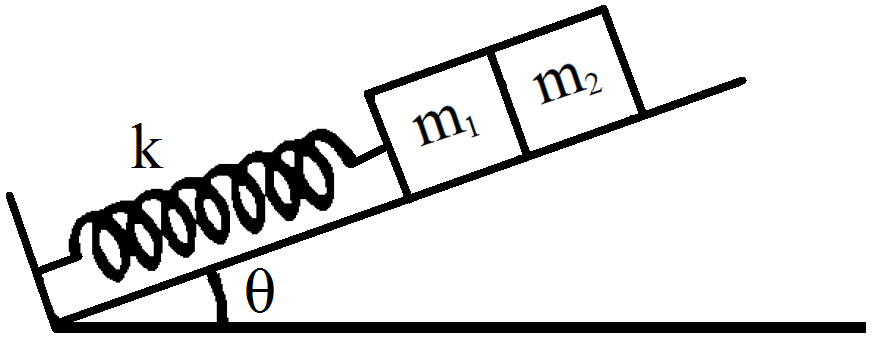
The block of mass $m_1$ shown in figure is fastened to the spring and the block of mass $m_2$ is placed against it.
  1. Find the compression of the spring in the equilibrium position.
  2. The blocks are pushed a further distance $\big(\frac{2}{\text{k}}\big)(\text{m}_1+\text{m}_2)\text{g}\sin\theta$ sine against the spring and released. Find the position where the two blocks separate.
  3. What is the common speed of blocks at the time of separation?
Two charged particles placed at a separation of 20cm exert 20N of Coulomb force on each other. What will be the force if the separation is increased to 25cm?
A hemispherical portion of the surface of a solid glass sphere $(\mu=1.5)$ of radius r is silvered to make the inner side reflecting. An object is placed on the axis of the hemisphere at a distance 3r from the centre of the sphere. The light from the object is refracted at the unsilvered part, then reflected from the silvered part and again refracted at the unsilvered part. Locate the final image formed.
Can static friction do nonzero work on an object? If yes, give an example. If no, give reason.
A metal block of heat capacity $80J^\circ C^{-1} $ placed in a room at 20°C is heated electrically. The heater is switched off when the temperature reaches 30°C. The temperature of the block rises at the rate of $2^\circ Cs^{-1}$ just after the heater is switched on and falls at the rate of $0.2^\circ Cs^{-1}$ just after the heater is switched off. Assume Newton's law of cooling to hold.
  1. Find the power of the heater.
  2. Find the power radiated by the block just after the heater is switched off.
  3. Find the power radiated by the block when the temperature of the block is 25°C.
  4. Assuming that the power radiated at 25°C represents the average value in the heating process, find the time for which the heater was kept on.
On the basis of band theory, differentiate between conductors, insulators and conductors.
In the circuit shown in the figure. $\in_1=3\text{V},\in_2=2\text{V},\in_3=1\text{V}$ and $\text{r}_1=\text{r}_2=\text{r}_3=1\Omega.$ Find the potential difference between the points A and B and the current through each branch.