Question
Explain how a Zener diode maintains constant voltage across a load.

Answer

Principle : In the breakdown region of a Zener diode, for widely changing Zener current, the voltage across the Zener diode remains almost constant.

Image
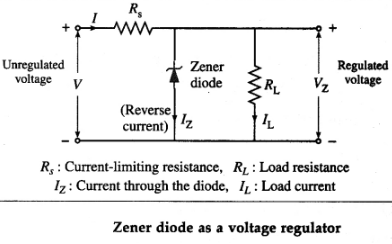
Electric circuit : The circuit for regulating or stabilizing the voltage across a load resistance RL against change in load current and supply voltage is shown in above figure. The Zener diode is connected parallel to load Rh such that the current through the Zener diode is from the n to p region. The series resistance Rs limits the current through the diode below the maximum rated value.
From the circuit,
$I = I_Z + I_L$ and $V = IR_s + V_Z$
$= (I_Z + I_L)R_s + V_Z$
Working: When the input unregulated dc voltage $V$ across the Zener diode is greater than the Zener voltage $V_Z$ in magnitude, the diode works in the Zener breakdown region. The voltage across the diode and load Rh is then $V _{ Z }$. The corresponding current in the diode is $I _{ Z }$. As the load current $( I )$ or supply voltage $( V )$ changes, the diode current $( 7 Z )$ adjusts itself at constant $V _{ Z }$. The excess voltage $V - V _{ Z }$ appears across the series resistance Rs .
For constant supply voltage, the supply current I and the voltage drop across $R _5$ remain constant. If the diode is within its regulating range, an increase in load current is accompanied by a decrease in Iz at constant $V _{ Z }$.
Since the voltage across $R_L$ remains constant at $V_Z$, the Zener diode acts as a voltage stabilizer or voltage regulator.

Need a full question paper?

Generate a complete, print-ready paper with questions like this in minutes — across 16+ boards, with answer keys.
Start Generating Free

Similar questions

A set of $12$ tuning forks is arranged in order of increasing frequencies. Each fork produces $V$ beats per second with the previous one. The last is an octave of the first. The fifth fork has a frequency of $90 Hz$. Find $V$ and the frequency of the first and the last tuning forks.
A wire $88 \ cm$ long is bent into a circular loop and kept with its plane perpendicular to a magnetic field of induction $2.5 Wb / m ^2$. Within $0.5$ second, the coil is changed to a square and the magnetic induction is increased by $0.5 Wb / m ^2$. Calculate the emf induced in the wire.
What are the conditions for obtaining good interference pattern? Give reasons.
Three capacitors of capacities $8 \mu F , 8 \mu F$ and $4 \mu F$ are connected in series and a potential difference of $120 V$ is maintained across the combination. Calculate the charge on the capacitor of capacity $4 \mu F$. Also calculate the potential difference across it.
In Fraunhoffer diffraction by a narrow slit, a screen is placed at a distance of 2 m from the lens to obtain the diffraction pattern. If the slit width is 0.2 mm and the first minimum is 5 mm on either side of the central maximum, find the wavelength of light. 
Derive an expression for the excess pressure inside a soap bubble.
OR
Derive Laplace's law for spherical membrane of a bubble due to surface tension.
Derive an expression for energy stored in a charged capacitor.
A spherical metal ball of radius $15 \ cm$ carries a charge of $2 \mu C$. Calculate the electric field at a distance of $20 \ cm$ from the center of the sphere.
Two metal spheres, of radii $2 \ cm$ and $1 \ cm$ with respective charge densities $5m\ C / m ^2$ and $-2m\ C / m ^2$, are inside a hypothetical closed surface in vacuum. What is the net electric flux through the surface?
Obtain an expression for maximum safety speed with which a vehicle can be safely driven along a curved banked road.
Using Ampere’s law, derive an expression for the magnetic induction inside an ideal toroid carrying a steady current.