Question
Explain how does the polarized dielectric modify the original external field inside it ?
Answer

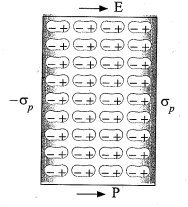
As shown in the figure, consider a rectangular (/ cuboid) dielectric slab placed in a uniform external field $\overrightarrow{ E _0}$.
Due to this, the dipole moments are aligned almost parallel to $\overrightarrow{ E _0}$.

Image
The situation shown in the figure is an ideal situation, at 0K (zero kelvin) temperature, The external field causes almost uniform polarization $\overrightarrow{ P }$ of the dielectric, Thus every volume element $\Delta V$ of the slab has a dipole moment $\overrightarrow{ P } \Delta V$.
Inside the dielectric, the net charge inside the volume element $\Delta V$ is zero. This is because the positive charge of one dipole sits close to and hence cancels out the effect of the negative charge of the neighbouring dipole. However, at the surface of the dielectric net, surface density is not zero because as shown in the figure, the positive ends of the dipoles remain unneutralized at the right surface and the negative ends at the left surface. These unbalanced charges are the induced charges due to the external electric field. Therefore, there is some net surface charge density on the surface of the dielectric.
The induced electric charge is also known as bound charge.
Thus the polarized dielectric is equivalent to two charged surfaces with induced surface charge densities, say $\sigma_p$ and $-\sigma_p$.
The field produced by these surface charges opposes the external electric field. The total field in the dielectric is, there by, reduced.

Need a full question paper?

Generate a complete, print-ready paper with questions like this in minutes — across 16+ boards, with answer keys.
Start Generating Free

Similar questions

Can two identical and independent sodium lamps act as coherent sources? Give reason for your answer.
Write a brief history of Electro Magnetic waves.
Consider the situation shown in figure. The switch is closed at $t = 0$ when the capacitors are uncharged. Find the charge on the capacitor $C_1$ as a function of time $t.$
​​​​​​​
A student records the following data for the magnitudes $(B)$ of the magnetic field at axial points at different distances $x$ from the centre of a circular coil of radius a carrying a current $I$. Verify $($for any two$)$ that these observations are in good agreement with the expected theoretical variation of $B$ with $x$.
Image
$x \rightarrow$ $x = 0$ $x - a$ $x = 2 a$ $x = 3a$
$y \rightarrow$ $B _0$ $0.25 \sqrt{2} B_0$ $0.039 \sqrt{5} B_0$ $0.010 \sqrt{10} B_0$

 
What type of extrinsic semiconductor is formed when:
  1. Germanium is doped with indium?
  2. Silicon is doped with bismuth?
Using lens maker’s formula, derive the thin lens formula $\frac{1}{\text{f}}=\frac{1}{\text{v}}-\frac{1}{\text{u}}$ for a biconvex lens.
Can a vector have zero component along a line and still have nonzero magnitude?
A telescope has been adjusted for relaxed eye. You are asked to adjust it for least distance of distinct vision, then how will you change the distance between two lenses?
Draw a graph to show a variation of resistance of a metal wire as a function of its diameter keeping its length and material constant.
Sunita and her friends went to an exhibition. The guard standing there asked them to pass through a metal detector. Sunita's friends were first afraid but when Sunita told them the reason and explain its working.
Answer the following questions :
(a) State the principle on which metal detector works.
(b) If a person passing through metal detector has some metallic object then why does it produces sound?
(c) Tell two qualities of Sunita which she showed while explaining the reason for passing through it.