Question
Define the terms magnetic declination and dip with reference to freely suspended magnet.
(a) What do you understand by the terms magnetic meridian and geographic meridian?
(b) At what places on the earth will the angle of dip be (1) maximum and (2) minimum?
Answer

Magnetic declination: The angle through which freely suspended magnetic needle is inclined to the geographic axis is known as magnetic declination.
OR
The angle between the geographic meridian and magnetic meridian it is given place is called declination.
Magnetic dip : The angle between the horizontal axis passing through freely suspended magnet and the direction of earth's magnetic field is called magnetic dip.
(a) Magnetic meridian : The vertical plane containing the magnetic axis of a freely suspended magnet at rest, under the action of magnetic intensity of earth is called magnetic meridian.
Geographic meridian: The vertical plane which contains geographic north and south pole of earth at a given place is called geographic meridian.
(b) The angle of dip is maximum e. $90^{\circ}$ at the magnetic poles. The angle of dip is minimum i.e. $0^{\circ}$ at the magnetic equator.

Need a full question paper?

Generate a complete, print-ready paper with questions like this in minutes — across 16+ boards, with answer keys.

Start Generating Free

Similar questions

State and explain the law of action and reaction. by giving two examples.
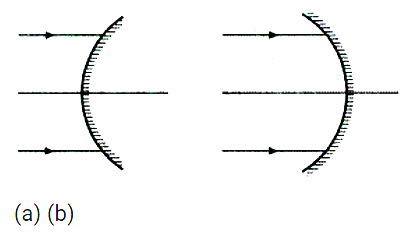
In each case (a) and (b), draw reflected rays for the given incident rays and mark focus by the symbol F.
Deduce an expression for the pressure at depth inside a liquid.
A train starts from rest and accelerates uniformly at a rate of $2 m s ^{-2}$ for $10 $s . It then maintains a constant speed for 200 s . The brakes are then applied and the train is uniformly retarded and comes to rest in $50$ s . Find (i) The maximum velocity reached, (ii) The retardation in the last $50 s$ , (iii) The total distance travelled, (iv) The average velocity of the train.
State two advantages and two limitations of producing electricity from solar energy.
Energy from various sources is considered to have been derived from the Sun. Do you agree? Justify your answer by giving two examples.
What are the fundamental units in the SI system? Name them along with their symbols.
Using Archimedes' principle, describe an experiment to find the relative density of a solid denser than water.
Different bars are brought near each pole of a compass needle. Complete the following table:
Nature of bar Action on the compass needle
North pole South pole
(i) Glass No action __________
(ii) _________ Attracted Attracted
(iii) North pole of a bar magnet __________ ___________
(iv) The south pole of a bar magnet __________ repulsion
Draw a neat and labelled diagram of a screw gauge.
Name its main parts and state their functions.