Question
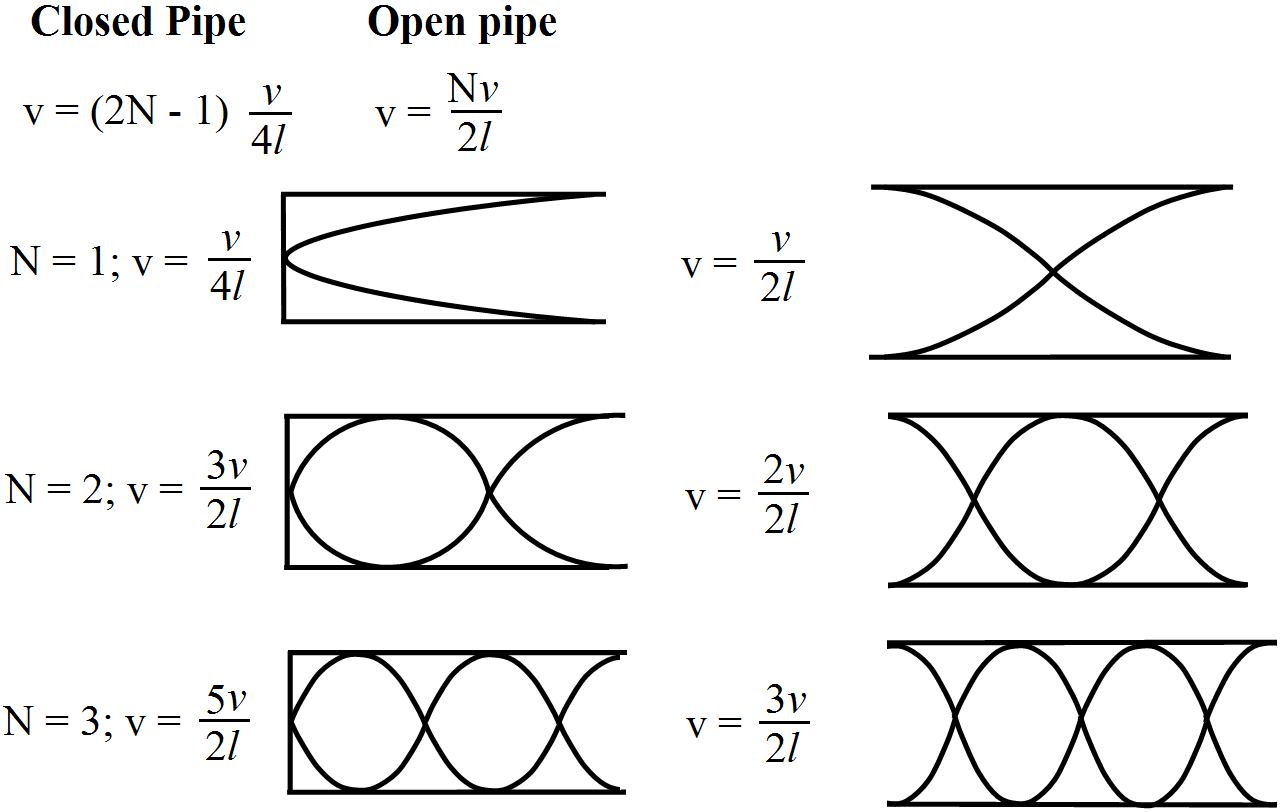
Explain how stationary waves are formed in open and closed pipes. Compare the first three harmonics produced in them.

Answer

Stationary or Standing Waves: Formed by two waves moving in opposite directions interacting. They may have equal or unequal amplitudes and generally equal frequencies are $\text{Y}=\pm2\text{A}\sin\text{kx}\cos\omega\text{t}$ refers to a standing wave, where nodes and antinodes are alternatively formed with a separation $\frac{\lambda}{2}.$ In closed pipes, there will be a node at the closed end and antinode at open end while both ends will be antinodes in an open pipe. The frequency in them are given by:
This type of pattern is being formed. On observation, one can conclude that only odd harmonics are available in a closed pipe, while all harmonics are available in an open pipe.

Need a full question paper?

Generate a complete, print-ready paper with questions like this in minutes — across 16+ boards, with answer keys.
Start Generating Free

Similar questions

We would like to prepare a scale whose length does not change with temperature. It is proposed to prepare a unit scale of this type whose length remains, say $10cm$. We can use a bimetallic strip made of brass and iron each of different length whose length (both components) would change in such a way that difference between their lengths remain constant. If $a_{iron} = 1.2 \times 10^{-5}/ K$ and $a_{brass} = 1.8 \times 10^{-5}/ K$, what should we take as length of each strip?
An electron and a proton are detected in a cosmic ray experiment, the first with kinetic energy 10 keV , and the second with 100 keV . Which is faster, the electron or the proton? Obtain the ratio of their speeds. (electron mass = $9.11 \times 10^{-31} \mathrm{~kg}$, proton mass $=1.67 \times 10^{-27} \mathrm{~kg}, 1 \mathrm{eV}=1.60 \times 10^{-19} \mathrm{~J}$ ).
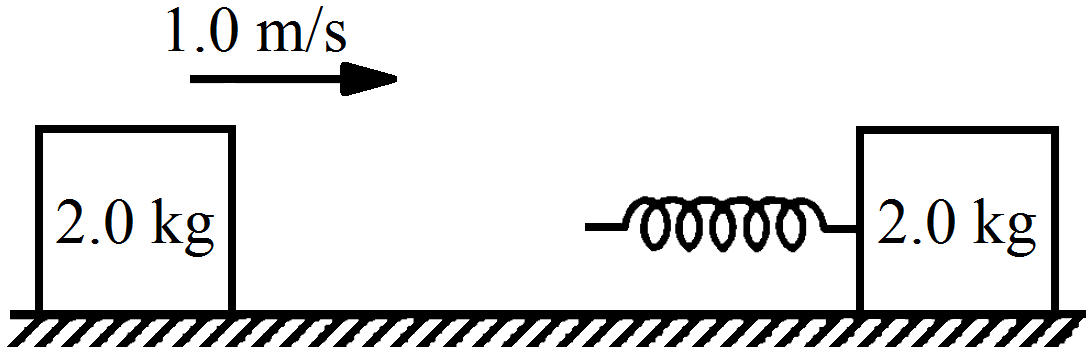
A block of mass 2.0kg is moving on a frictionless horizontal surface with a velocity of 1.0m/s towards another block of equal mass kept at rest. The spring constant of the spring fixed at one end is 100N/m. Find the maximum compression of the spring.
Explain why A spinning cricket ball in air does not follow a parabolic trajectory.
Obtain an expression for the acceleration due to gravity on the surface of the earth in terms of man of the earth and its radius. Discuss the variation of acceleration due to gravity with altitude and depth. If a body is taken to a height equal to $\frac{\text{R}}{4}$ from the surface of the earth then find percentage decrease in the weight of the body? Where R is radius of the earth.
Suppose there existed a planet that went around the sun twice as fast as the earth. What would be its orbital size as compared to that of the earth?
Explain Doppler effect in sound. Obtain an expression for apparent frequency of sound when source moves and listener is at rest.
A calorimeter of negligible heat capacity contains 100 cc of water at $40^{\circ} \mathrm{C}$. The water cools to $35^{\circ} \mathrm{C}$ in 5 minutes. The water is now replaced by K -oil of equal volume at $40^{\circ} \mathrm{C}$. Find the time taken for the temperature to become $35^{\circ} \mathrm{C}$ under similar conditions. Specific heat capacities of water and K -oil are $4200 \mathrm{Jkg}^{-1} \mathrm{~K}^{-1}$ and $2100 \mathrm{Jgg}^{-1} \mathrm{~K}^{-1}$ respectively. Density of K-oil $=800 \mathrm{kgm}^3$.
A particle slides on the surface of a fixed smooth sphere starting from the topmost point. Find the angle rotated by the radius through the particle, when it leaves contact with the sphere.
A block of mass $200g$ is suspended through a vertical spring. The spring is stretched by $1.0cm$ when the block is in equilibrium. A particle of mass $120g$ is dropped on the block from a height of $45cm$. The particle sticks to the block after the impact. Find the maximum extension of the spring. Take $g = 10m/s^2$.