Question
Explain why A spinning cricket ball in air does not follow a parabolic trajectory.

Answer

A spinning cricket ball has two simultaneous motions – rotatory and linear. These two types of motion oppose the effect of each other. This decreases the velocity of air flowing below the ball. Hence, the pressure on the upper side of the ball becomes lesser than that on the lower side. An upward force acts upon the ball. Therefore, the ball takes a curved path. It does not follow a parabolic path.

Need a full question paper?

Generate a complete, print-ready paper with questions like this in minutes — across 16+ boards, with answer keys.
Start Generating Free

Similar questions

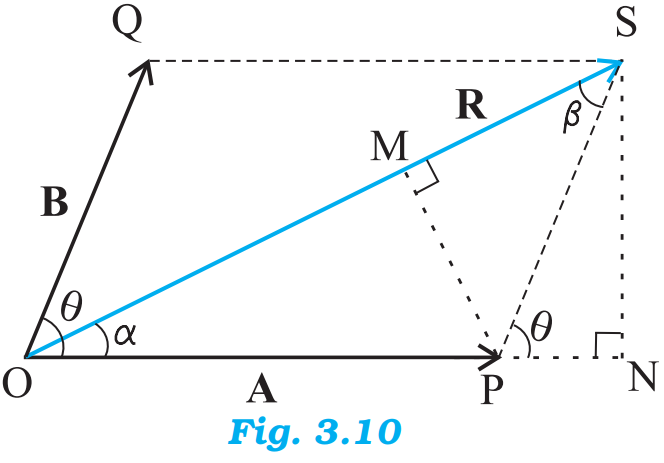
Find the magnitude and direction of the resultant of two vectors $A$ and $B$ in terms of their magnitudes and angle $\theta $ between them.
Image
In an experiment on the specific heat of a metal, a 0.20 kg block of the metal at $150^{\circ} \mathrm{C}$ is dropped in a copper calorimeter (of water equivalent 0.025 kg ) containing $150 \mathrm{~cm}^3$ of water at $27^{\circ} \mathrm{C}$. The final temperature is $40^{\circ} \mathrm{C}$. Compute the specific heat of the metal. If heat losses to the surroundings are not negligible, is your answer greater or smaller than the actual value for specific heat of the metal?
A balloon partially filled with Helium has a volume of $30m^3$, at the earth's surface, where pressure is $76cm$ of Hg and temperature is $27°C$. What will be the increase in volume of gas if balloon rises to a height, where pressure is $7.6cm$ of Hg and temperature is $-54°C$?
A long wire carrying a current i is bent to form a plane angle $\alpha.$ Find the magnetic field B at a point on the bisector of this angle situated at a distance x from the vertex.
Io, one of the satellites of Jupiter, has an orbital period of $1.769$ days and the radius of the orbit is $4.22 \times 10^8m$. Show that the mass of Jupiter is about one-thousandth that of the sun.
A solid disc and a ring, both of radius 10 cm are placed on a horizontal table simultaneously, with initial angular speed equal to $10 \pi rad s ^{-1}$. Which of the two will start to roll earlier? The co-efficient of kinetic friction is $\mu_k=$
A scooter company gives the following specifications about its product.
  • Weight of the scooter $-\ 95\ kg$.
  • Maximum speed $-\ 60\ km/h$.
  • Maximum engine power $-\ 3.5hp$.
  • Pick up time to get the maximum speed $-\ 5s$.
  • Check the validity of these specifications.
The mass of the planet Jupiter is $1.9 \times 10^{27} \mathrm{~kg}$ and that of the Sun is 1.991030 kg . The mean distance of the Jupiter from the Sun is $7.8 \times 10^{11} \mathrm{~m}$. Calculate the gravitational force which the Sun exerts on Jupiter, assuming that Jupiter moves in circular orbit around the Sun. Calculate the speed of the Jupiter. G $=6.6710^{-11} \mathrm{Nm}^2 \mathrm{~kg}^{-2}$
A rocket is fired vertically with a speed of $5 \mathrm{~km} \mathrm{~s}^{-1}$ from the earth's surface. How far from the earth does the rocket go before returning to the earth? Mass of the earth $=6.0 \times 10^{24} \mathrm{~kg}$; mean radius of the earth $=6.4 \times 10^6 \mathrm{~m}$; $\mathrm{G}=6.67$ $\times 10^{-11} \mathrm{Nm}^2 \mathrm{~kg}^{-2}$.
Compute the bulk modulus of water from the following data: Initial volume = $100.0$ litre, Pressure increase = 100.0 atm ($1\ atm = 1.013 × 10⁵ Pa$), Final volume = $100.5$ litre. Compare the bulk modulus of water with that of air (at constant temperature). Explain in simple terms why the ratio is so large.