Question
Explain how the formula for critical velocity $(v_c)$ is derived?
Answer

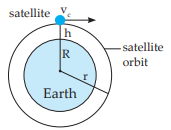
If a satellite of mass $'m \ '$ is revolving around the earth in an orbit of height $'h \ '$ with speed $v_c$ then as seen in the chapter on 'Gravitation', a centripetal force $\frac{ mV _{ c }^2}{ r }$ will act on it.
Here, $'r \ '$ is the orbital radius of the satellite from the centre of the earth.
This centripetal force is provided by the gravity of the earth.
Therefore, centripetal force $=$ gravitational force between the Earth and the satellite.
Image
$ \frac{ mV _{ c }^2}{ R + h } =\frac{ GMm }{( R + h )^2}$
$V _{ c }^2 =\frac{ GM }{ R + h }$
$V _{ c } =\sqrt{\frac{ GM }{ R + h }}$

Need a full question paper?

Generate a complete, print-ready paper with questions like this in minutes — across 16+ boards, with answer keys.

Start Generating Free

Similar questions

Explain Bayer’s process.
What is a decomposition reaction? Give an example of a decomposition reaction. Describe an activity to illustrate such a reaction by heating.
Refraction observed in the atmosphere.
Identify the class of given animals and write one characteristic of each animal:
i. Kangaroo
ii. Penguin
iii. Crocodile
iv. Frog
v. Sea-horse
What is meant by ‘reflection of light’? Define the following terms used in the study of reflection of light by drawing a labelled ray-diagram :
  1. Incident ray.
  2. Point of incidence.
  3. Normal.
  4. Reflected ray.
  5. Angle of incidence.
  6. Angle of reflection.
The following diagram shows a part of the periodic table in which the elements are arranged according to their atomic numbers.
(The letters given here are not the chemical symbols of the elements):
a
3
b
4
 
c
5
d
6
e
7
f
8
g
9
h
10
i
11
j
12
 
k
13
l
14
m
15
n
16
o
17
p
18
  1. Which element has a bigger atom, a or f?
  2. Which element has a higher valency, k or o?
  3. Which element is more metallic, i or k?
  4. Which element is more non-metallic, d or g?
  5. Select a letter which represents a metal of valency 2.
  6. Select a letter which represents a non-metal of valency 2.
From incident white light how will you obtain white emergent light by making use of two prisms?
 An object thrown vertically upwards reaches a height of 500 m . What was its initial velocity? How long will the object take to come back to the earth? Assume $g =10 m / s ^2$
In the previous example, how much time the satellite will take to complete one revolution around the earth?
Draw a neat labelled diagram: Forth floatation.