Gujarat BoardEnglish MediumSTD 12 SciencePhysicsATOMS3 Marks
Question
Explain how the scattering experiment can be analyzed in detail from Rutherford's nuclear model.
✓
Answer
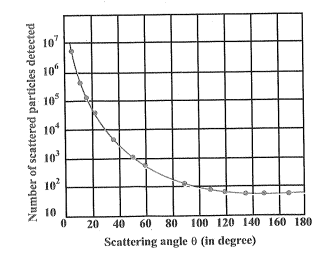
→The figure shows a graph of the number of $\alpha$-particles scatterd versus the angle of scattering. →The scattering experiment can be analysed in detail from Rutherford's nuclear model. Since the gold foil is very thin, it can be assumed that $\alpha$-particles will suffer not more than one scattering during their passage through it. Hence it is sufficient to calculate the path (trajectory) of an $\alpha$-particle scattered by a single nucleus. →$\alpha$-particles are nuclei of helium atoms, so they have two units mass of positive charge $2 e$ and mass equal to that of a helium atom. The charge of the gold nucleus is Ze , where Z is the atomic number of the atom; for gold $Z =79$. →Since the nucleus of gold is about 50 times heavier than an $\alpha$-particle, it remains stationary throughout the scattering process. →The trajectory of an $\alpha$-particle can be calculated using newton's second law of motion and the coulomb's law for electrostatic force of repulsion between the $\alpha$-particle and the positively charged nucleus. →The magnitude of this force is $F =\frac{1}{4 \pi \varepsilon_0} \frac{(2 e)( Ze )}{r^2}$ Where, $r$ is the distance between the $\alpha$-particle and the nucleus. →The force is directed along the line joining the $\alpha$-particle and the nucleus. →The magnitude and direction of the force on an $\alpha$-particle changes continuously as it moves towards and away from the nucleus.
Need a full question paper?
Generate a complete, print-ready paper with questions like this in minutes — across 16+ boards, with answer keys.