Question
Explain in brief: Nuclear reactor

Answer

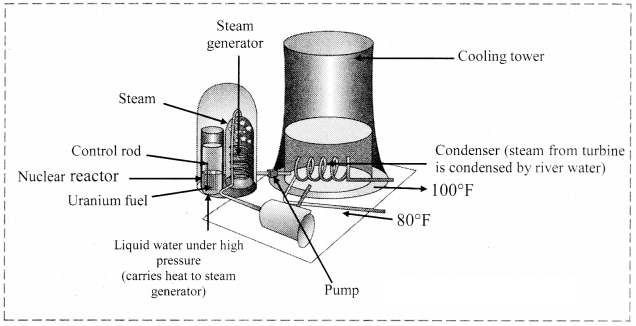
Nuclear reactor: Nuclear reactor is a device for using atomic energy in controlled manner for peaceful purposes. During nuclear fission energy is released. The released energy can be utilized to generate electricity in a nuclear reactor.
Working of a nuclear reactor:
  • In a nuclear reactor, $U^{235}$ or $U^{239},$ a fissionable material is stacked with heavy water $(D_2O$ deuterium oxide$)$ or graphite called moderator.
  • The neutrons produced in the fission pass through the moderator and lose a part of their energy. The slow neutrons produced during the process are captured which initiate new fission.
  • Cadmium rods are inserted in the moderator as they have ability to absorb neutrons. This controls the rate of chain reaction.
  • The energy released during the reaction appears as heat and removed by circulating a liquid $($coolant$).$ The coolant which has absorbed excess of heat from the reactor is passed over a heat exchanger for producing steam.
  • Steam is then passed through the turbines to produce electricity. Thus, the atomic energy produced with the use of fission reaction can be controlled in the nuclear reactor.
  • This process can be explored for peaceful purpose such as conversion of atomic energy into electrical energy which can be used for civilian purposes, ships, submarines, etc.
    Note: Schematic diagram of nuclear power plant:Image

Need a full question paper?

Generate a complete, print-ready paper with questions like this in minutes — across 16+ boards, with answer keys.
Start Generating Free

Similar questions

Explain the variation in the following properties of the group 14 elements,
i. Atomic radii
ii. Ionization enthalpy
iii. Electronegativity
Explain the resonance structures of benzene using the orbital overlap concept.
Naina is a school going kid. Every morning her mother makes her drink a glass of milk. When she asked her mother that why she has to drink a glass of milk daily, her mother told her that it is beneficial in maintaining healthy bones and teeth. Regular consumption of milk is recommended because it is a rich source of calcium.
$i.$ In which form is calcium important for bones and teeth?
$ii.$ Calcium belongs to which family in the modern periodic table?
$iii.$ Write its electronic configuration.
$iv.$ Calcium contain how many valence electrons?
$v.$ Give any two$-$biological importance of calcium.
Urea $[(NH_2)_2CO]$ is prepared by reacting ammonia with carbon dioxide.
$2NH_{3(g)} + CO_{2(g)} \rightarrow (NH_2)_2CO_{(aq)} + H_2O_{(l)}$
In one process, $637.2 g \ of \ NH_3$ are treated with $1142 g \ of \ CO_2.$
$i.$ Which of the two reactants is the limiting reagent?
$ii.$ Calculate the mass of $(NH_2)_2CO$ formed.
$iii.$ How much excess reagent (in grams) is left at the end of the reaction?
Calculate the number of moles and molecules of urea present in 5.6 g of urea.
Describe the shape of $3d$ orbitals.
Discuss the nature and structure of the following compounds. $i.$ Nitric acid $ii.$ Phosphoric acid
Describe heterogeneous catalysis with the help of one example.
Describe the preparation of sodium hydroxide by Castner-Kellner process. ### Explain the electrolysis method for preparation of sodium hydroxide.
Explain graphically the effect of the following factors on the adsorption of gases by solids.
i. Temperature of the adsorbent surface
ii. Pressure of the gas (adsorbate)