Questions

Answer the following questions in detail.

Take a timed test

4 questions · self-marked practice — reveal the answer and mark yourself.

Question 16 Marks
Differentiate between chemical reactions and nuclear reactions.
Answer
Chemical reactions Nuclear reactions
  • Rearrangement of atoms by breaking and forming of chemical bonds.
  • Elements or isotopes of one element are converted into another element in a nuclear reaction.
  • Different isotopes of an element have same behaviour.
  • Isotopes of an element behave differently.
  • Only outer shell electrons take part in the chemical reaction.
  • In addition to electrons, protons, neutrons, other elementary particles may be involved.
  • The chemical reaction is accompanied by relatively small amounts of energy.
    e.g. chemical combustion of $1.0 g$ methane releases only $56 \ kJ$ energy.
  • The nuclear reaction is accompanied by a large amount of energy change, e.g. The nuclear transformation of $1 g$ of Uranium $– 235$ release $8.2 \times 10^7 \ kJ$
  • The rates of reaction are influenced by the temperature, pressure, concentration and catalyst.
  • The rate of nuclear reactions is unaffected by temperature, pressure and catalyst.
View full question & answer
Question 26 Marks
Explain in brief: Nuclear reactor
Answer
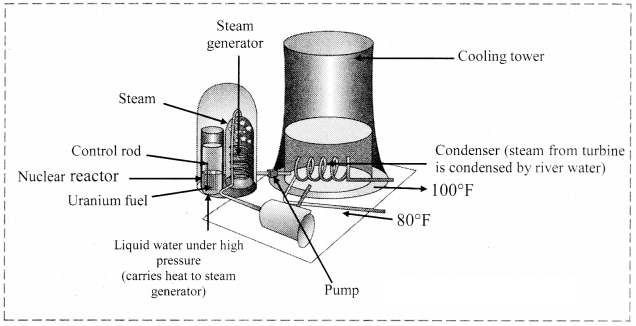
Nuclear reactor: Nuclear reactor is a device for using atomic energy in controlled manner for peaceful purposes. During nuclear fission energy is released. The released energy can be utilized to generate electricity in a nuclear reactor.
Working of a nuclear reactor:
  • In a nuclear reactor, $U^{235}$ or $U^{239},$ a fissionable material is stacked with heavy water $(D_2O$ deuterium oxide$)$ or graphite called moderator.
  • The neutrons produced in the fission pass through the moderator and lose a part of their energy. The slow neutrons produced during the process are captured which initiate new fission.
  • Cadmium rods are inserted in the moderator as they have ability to absorb neutrons. This controls the rate of chain reaction.
  • The energy released during the reaction appears as heat and removed by circulating a liquid $($coolant$).$ The coolant which has absorbed excess of heat from the reactor is passed over a heat exchanger for producing steam.
  • Steam is then passed through the turbines to produce electricity. Thus, the atomic energy produced with the use of fission reaction can be controlled in the nuclear reactor.
  • This process can be explored for peaceful purpose such as conversion of atomic energy into electrical energy which can be used for civilian purposes, ships, submarines, etc.
    Note: Schematic diagram of nuclear power plant:Image
View full question & answer
Question 36 Marks
Explain the term: Radiocarbon dating in detail.
Answer
Radiocarbon dating: The technique is used to find the age of historic and archaeological organic samples such as old wood samples and animal or human fossils.
Radioisotope used for carbon dating is $^{14}C.$
$i.$ Radioactive $^{14}C$ is formed in the upper atmosphere by bombardment of neutrons from cosmic ray on $^{14}N.$
${ }_7^{14} N +{ }_0^1 n \longrightarrow{ }_6^{14} C +{ }_1^1 H$
$ii. \ ^{14}C$ combines with atmospheric oxygen to form $^{14}CO_2$ which mixes with ordinary $^{12}CO_2.$
$iii.$ This carbon dioxide is absorbed by plants during photosynthesis.
$iv.$ Animals eat plants which have absorbed a carbon dioxide $(^{14}CO_2 + ^{12}CO_2).$ Hence, $^{14}C$ becomes a part of plant and animal bodies.
$v.$ As long as the plant is alive, the ratio $^{14}C/^{12}C$ remains constant.
$vi.$ When the plant dies, photosynthesis will not occur and the ratio $^{14}C/^{12}C$ decreases with the decay of radioactive $^{14}C$ which has a half$-$life $5730 \ years.$
$vii.$ The decay process of $^{14}C$ is given below:
${ }_6^{14} C \longrightarrow{ }_7^{14} N +{ }_{-1}^0 e$
$viii.$ The activity $(N)$ of given wood sample and that of fresh sample of live plant $(N0)$ is measured, where, $N0$ denotes the activity of the given sample at the time of death.
$ix.$ The age of the given wood sample, can be determined by applying following Formulae:
$t =\frac{2.303}{\lambda} \log _{10} \frac{ N _0}{ N }$
$\text { where } \lambda=\frac{0.693}{5730 y }=1.21 \times 10^{-4} y ^{-1} .$
View full question & answer
Question 46 Marks
Derive the expression for nuclear binding energy for a nuclide.
Answer
Expression for nuclear binding energy:
$i.$ Consider a nuclide ${ }_z^A X$ that contains $Z$ protons and $(A-Z)$ neutrons.
Suppose the mass of the nuclide is $m$. The mass of proton is $m_p$ and that of neutron is mn.
$ii.$ Total mass $=(A-Z) m_n+Z m_p+Z m_e$
$\Delta m=\left[(A-Z) m_n+Z m_p+Z m_e\right]-m$
$=\left[(A-Z) m_n+Z\left(m_p+m_e\right]-m\right.$
$=\left[(A-Z) m_n+Z m_H\right]-m \ldots . .(2)$
Where $\left(m_p+m_e\right)=m_H=$ mass of $H$ atom.
Thus, $(\Delta m)=\left[Z m_p+(A-Z) m_n\right]-m$
Where $Z=$ atomic number
$A=$ mass number
$(A-Z)=$ neutron number
$m_p$ and $m_n=$ masses of proton and neutron, respectively
$m =$ mass of nuclide
$iii.$ The mass defect, $\Delta m$ is related to binding energy of nucleus by Einstein's equation,
$\Delta E =\Delta m \times c ^2$
Where, $\Delta E =$ Binding energy, $\Delta m =$ mass defect.
$iv.$ Nuclear energy is measured in million electro volt $(MeV).$
$v.$ The total binding energy is then given by,
$\text { B.E. }=\Delta m(u) \times 931.4$Where $1.00 u =931.4 MeV$$
\text { B.E. }=931.4\left[Z m_H+(A-Z) m_n-m\right]$ Total binding energy of nucleus containing $A$ nucleons is the $B.E.$
$vi.$ The binding energy per nucleon is then given by,
$\bar{B}= B.E./A$
View full question & answer