RAY OPTICS AND OPTICAL INSTRUMENTS — Physics STD 12 Science — Question
Rajasthan BoardEnglish MediumSTD 12 SciencePhysicsRAY OPTICS AND OPTICAL INSTRUMENTS3 Marks
Question
Explain internal reflection and total internal reflection and also derive the necessary formula for it.
✓
Answer
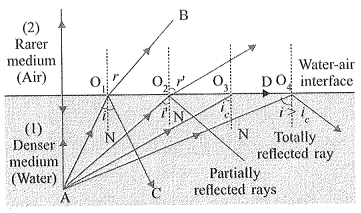
→When a ray of light travels from an optically denser medium to a rarer medium at the interface, it is partly reflected back into the same medium and partly refracted to the second medium. This reflection is called the internal reflection. →When a ray of light enters from a denser medium to a rarer medium it bends away from the normal. →$AO _1$ is the incident ray to ray $AO _1 B . O _1 C$ is partially reflected and $O _1 B$ is the partially refracted ray. Here, the ray passes from denser medium to the rarer medium, so incidence angle $(i) <$ refraction angle $(r)$. →As we move from $O _1$ to $O _2, O _3 \ldots$. the value of incidence angle increases, As a result the value of refraction angle also increases. →The angle of refraction is $90^{\circ}$ for the ray $AO _3$. →Here the refracted ray becomes parallel to the surface separating the two media. This is shown in figure by the ray $AO _3 D$. →The angle of incidence for which the refraction angle becomes $\frac{\pi}{2}$, that incidence angle is called critical angle. →If the angle of incidence is increased still further (ray $AO _4$ ) refraction is not possible and the incident ray is totally reflected. This is called total internal reflection. →According to Snell's law at point $O _3$, $\begin{aligned}& n_1 \sin i_{ C }=n_2 \sin 90^{\circ} \\\therefore & \sin i_{ C }=\frac{n_2(1)}{n_1} \\\therefore & \sin i_{ C }=\frac{n_2}{n_1}=n_{21}\end{aligned}$ (where, $n_{21}$ is refractive index of medium 2 with respect to medium 1) →If $n_2=1$ (air) and $n_1=n$, then $\therefore \sin i_{ C }=\frac{1}{n}$
Need a full question paper?
Generate a complete, print-ready paper with questions like this in minutes — across 16+ boards, with answer keys.