Question
Explain Linkage & Recombination.

Answer

→ The crosses were similar to the dihybrid crosses carried out by Mendel in peas.
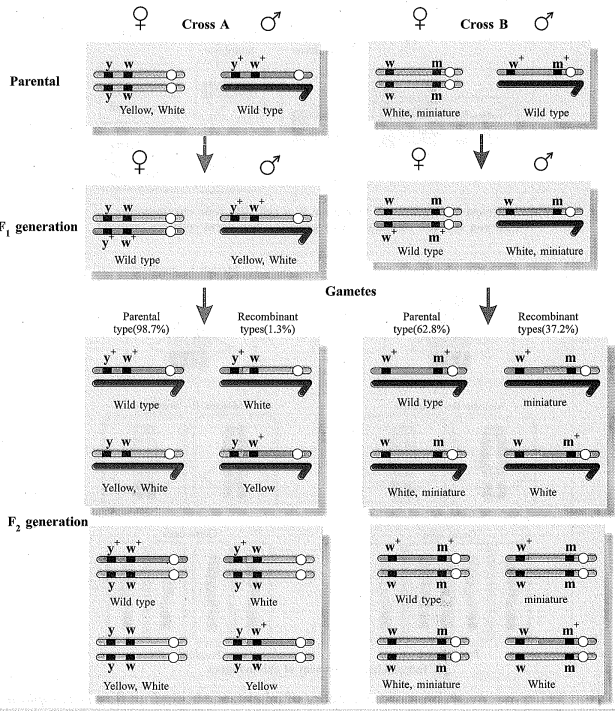
→ For example Morgan hybridised yellow-bodied, white-eyed females to brown-bodied, red-eyed males and intercrossed their F1 progeny.
→ He observed that the two genes did not segregate independently of each other and the F2 ratio deviated very significantly from the 9:3:3:1 ratio (expected when the two genes are independent).
→ Morgan and his group knew that the genes were located on the X chromosome and saw quickly that when the two genes in a dihybrid cross were situated on the same chromosome, the proportion of parental gene combinations were much higher than the non-parental type.
→ Morgan attributed this due to the physical association or linkage of the two genes and coined the term linkage to describe this physical association of genes on a chromosome and the term recombination to describe the generation of non-parental gene combinations.
→ Morgan and his group also found that even when genes were grouped on the same chromosome, some genes were very tightly linked (showed very low recombination (Cross A) while others were loosely linked (showed higher recombination) (Cross B)
→ For example he found that the genes white and yellow were very tightly linked and showed only 1.3 percent recombination while white and miniature wing showed 37.2 percent recombination.
→ His student Alfred Sturtevant used the frequency of recombination between gene pairs on the same chromosome as a measure of the distance between genes and 'mapped' their position on the chromosome.
Image

Need a full question paper?

Generate a complete, print-ready paper with questions like this in minutes — across 16+ boards, with answer keys.

Start Generating Free

Similar questions

Read the following and answer any four questions from (i) to (v) given below:

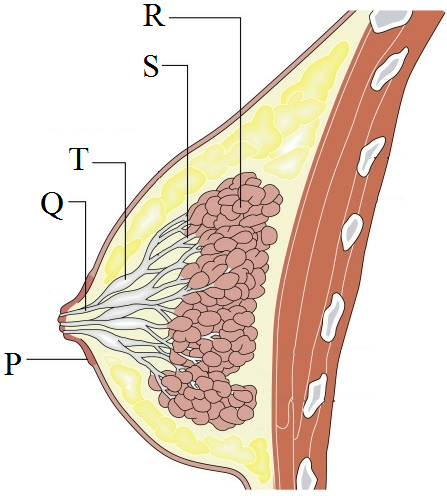
A functional mammary gland is characteristic of all female mammals. Mammary glands are paired structures that contain glandular tissue and variable amount of fat. Refer to the given figure of a mammary gland and answer the following questions.

  1. Mammary glands are modified:
  1. Sweat glands.
  2. Sebaceous glands.
  3. Sudoriferous glands.
  4. Lacrimal glands.
  1. Identify the incorrectly matched pair.
  1. P - Areola.
  2. Q - Lactiferous duct.
  3. S - Mammary duct.
  4. T - Mammary alveoli.
  1. Mammary ducts expand to form:
  1. Mammary alveoli.
  2. Mammary ampullae.
  3. Lactiferous ducts.
  4. Mammary tubules.
  1. What is areola?
  1. Grape-like clusters of milk secreting structures.
  2. Fatty tissue between the mammary lobes.
  3. Circular pigmented area of skin around nipple.
  4. Connective tissue that supports the alveoli and ducts.
  1. Assertion: The size of breast depends on the amount of adipose tissue.

Reason: The adipose tissue supports the alveoli and the ducts.

  1. Both assertion and reason are true, and reason is the correct explanation of assertion.
  2. Both assertion and reason are true, but reason is not the correct explanation of assertion.
  3. Assertion is true, but reason is false.
  4. Both assertion and reason are false.
Read the following and answer any four questions from (i) to (v) given below:

Gene manipulation is a fast emerging science. It started with development of recombinant DNA molecule. It is named variously as DNA manipulation biotechnology, recombinant DNA technology and genetic engineering. This technology, that mostly involves cutting and pasting of desired DNA fragments, is based on two important discoveries in bacteria, i.e., presence of plasmid in bacteria and restriction endonucleases. Paul Berg was able to introduce a gene ofSV-40 into a bacterium. The science of recombinant DNA technology took birth when Cohen and Boyer (1973) were able to introduce a piece of gene containing foreign DNA into plasmid of E.coli.

  1. Biotechnology is also known as:
  1. DNA manipulation biotechnology.
  2. Recombinant DNA technology.
  3. Genetic engineering.
  4. All of these.
  1. A bacterial plasmid is a/ an,
  1. Extra chromosomal material that do not replicate.
  2. Extra chromosomal material that undergo replication with or without chromosomal DNA.
  3. Tubular structures that help in conjugation.
  4. Bristle like solid structure that help in adhesion.
  1.  Father of genetic engineering is:
  1. Paul Berg.
  2. Arber.
  3. Nathan.
  4. Smith.
  1. Which of the following is used by Paul Berg to introduce a gene of SV-40 in a bacterium?
  1. E. coli.
  2. cos-plasmids.
  3. Lambda phage.
  4. None of these.
  1.  Read the given statements and select the correct option.

Assertion: Biotechnology started with the development of recombinant DNA molecule.

Reason: Biotechnology mostly involves cutting and pasting of desired DNA fragments.

  1. Both assertion and reason are true and reason is the correct explanation of assertion.
  2. Both assertion and reason are true but reason is not the correct explanation of assertion.
  3. Assertion is true but reason is false.
  4. Both assertion and reason are false.
Give a brief account of evolution of vertebrates.
Suggest some methods to assist infertile couples to have children.
Read the following text carefully and answer the questions that follow:
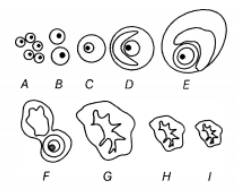
The following is the illustration of the sequence of ovarian events (A-I) in a humans female.
Image
i. Identify the figure that illustrates ovulation and mention the stage of oogenesis it represents. (1)
ii. Name the ovarian hormone and the pituitary hormone that have caused the above mentioned event. (1)
iii. Explain the changes that occur in the uterus simultaneously in anticipation. (2)
OR
Write the differences between C and H. (2)
Read the following and answer any four questions from 7(i) to 7(v) given below:

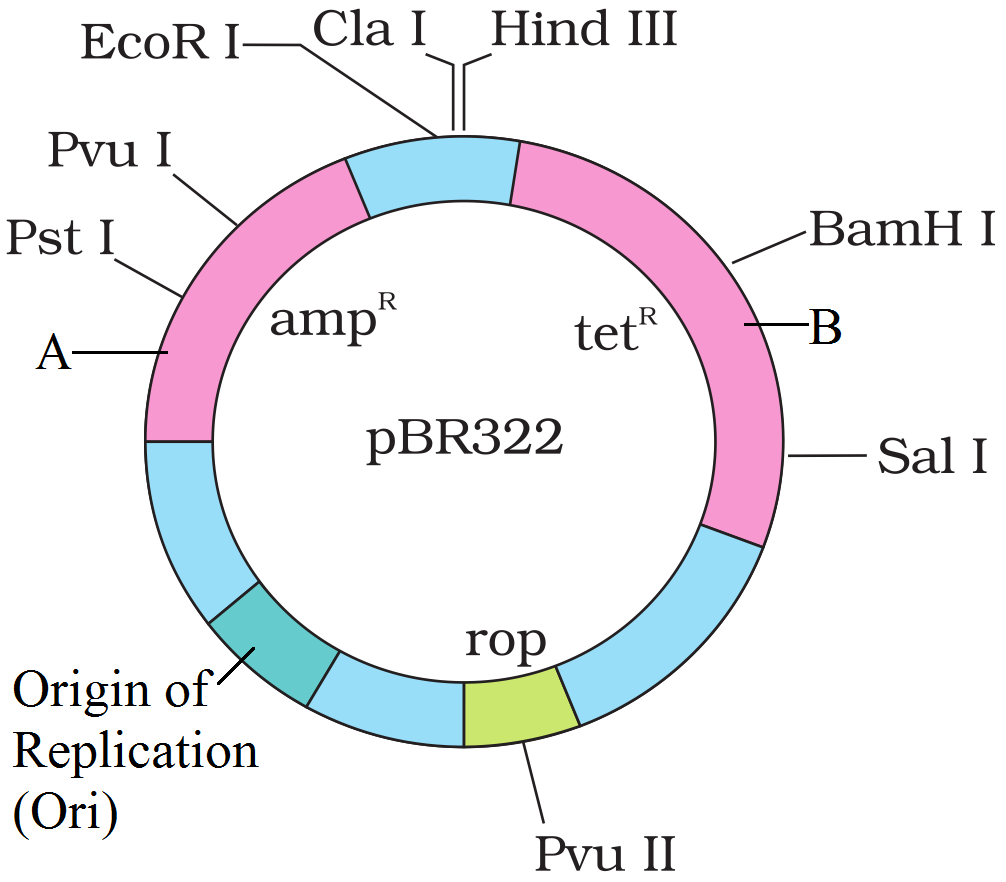
The vectors are DNA molecules that can carry a foreign DNA segment and replicate inside the host cell. Vectors may be plasmids, bacteriophages (viruses that attack bacteria), cosmids, yeast artificial chromosomes (YACs), Bacterial artificial chromosomes (BACs) and viruses. The most widely used, versatile, easily manipulated vector pBR 322 is an ideal plasmid vector. Features that are required to facilitate cloning into a vector includes origin of replication (Ori) which is a specific sequence of DNA bases responsible for initiating replication, selectable marker genes and cloning sites

  1. Pin pBR 322 denotes that it is a:
  1. plasmid
  2. prokaryote
  3. protist
  4. plant cell.
  1. Ori is a specific DNA sequence that help in.
  1. Attachment of primers.
  2. Initiation of replication.
  3. Extension of DNA base.
  4. Initiation of denaturation.
  1. A and B shown in the figure respectively indicates:

  1. Pvu II and Cla I.
  2. ROP and Sal I.
  3. ampR and tetR.
  4. tetR and ampR.
  1. Selectable markers in vector,
  1. Are responsible for replication.
  2. Help in selecting transformants from non-transform ants.
  3. Code for proteins involved in the replicating plasmids.
  4. Contain unique recognition sites.
  1.  Plasmid vectors are:
  1. dsDNA molecule
  2. Extra-chromosomal
  3. Present in bacteria and yeast
  4. All of these.
Explain loss of biodiversity.
Explain exponential growth equation with well labeled diagram.###Explain exponential growth.
Explain: separation and isolation of DNA fragments.###How will you make separation and isolation of DNA fragments by using gel electrophoresis?
Write a short note on pollination by wind.