Question
Write a short note on pollination by wind.
Answer

Image
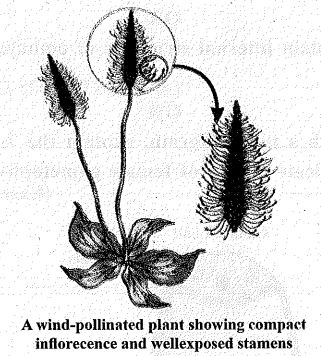
→ Pollination by wind is more common amongst abiotic pollinations.
→ Wind pollination also requires that the pollen grains are light and non-sticky so that they can be transported in wind currents.
→ They often possess well-exposed stamens so that the pollens are easily dispersed into wind currents, and large often-feathery stigma to easily trap air-borne pollen grains.
→ Wind pollinated flowers often have a single ovule in each ovary and numerous flowers packed into an inflorescence.
→ A familiar example is the corn cob the - tassels you see are nothing but the stigma and style which wave in the wind to trap pollen grains.
→ Wind-pollination is quite common in grasses.

Need a full question paper?

Generate a complete, print-ready paper with questions like this in minutes — across 16+ boards, with answer keys.

Start Generating Free

Similar questions

Read the following and answer any four questions from (i) to (v) given below:

Age sex structure of a population can be depicted in the form of a pyramid by plotting the percentage of population of each sex in each age class. Two age sex pyramids are as follows.

  1. Which of the following is correct regarding pyramid B?
  1. It represents stable population.
  2. It represents expanding population.
  3. It represents declining population.
  4. Both (a) and (b).
  1. Total number of individuals of a species per unit area per unit time is called.
  1. Population size.
  2. Population density.
  3. Demography.
  4. Population dynamics.
  1. Which of the following is correct regarding age sex pyramid A and B?
  1. A represents the age sex pyramid of developed country.
  2. B represents the age sex pyramid of developing country.
  3. A represents rapidly growing population.
  4. Both (a) and (b).
  1. A population with a large proportion of older individuals than younger ones will likely to:
  1. Grow larger first and then decline.
  2. Continue to grow indefinitely.
  3. Decline.
  4. None of these.
  1. Assertion: Bell shaped age pyramid represents a stable population.

Reason: ln a stable population, proportion of individuals in reproductive age group is higher than the individuals in pre reproductive age group.
  1. Both assertion and reason are true and reason is the correct explanation of assertion.
  2. Both assertion and reason are true but reason is not the correct explanation of assertion.
  3. Assertion is true but reason is false.
  4. Both assertion and reason are false.
Read the following and answer any four questions from (i) to (v) given below:

Pollen-pistil interaction is the group of events that occur from the time of pollen deposition over the stigma to the time of pollen tube entry into ovule. It is a dynamic process which has checks at several places for promotion or inhibition of pollen growth. Pollen-pistil interaction is a safety measure to ensure that illegitimate crossings do not occur. Compatibility and incompatibility of the pollen-pistil is determined by special proteins. The compatible pollens are able to absorb water and nutrients from the surface of the stigma. They germinate and produce pollen tubes. Pollen tubes grow into the style. Their growth and path through the style are also determined by specific chemicals.

  1. Which of the following parts of gynoecium determines the compatible nature of pollen?
  1. Stigma.
  2. Style.
  3. Ovary.
  4. Thalamus.
  1. In Triforium, which type of self-incompatibility is found?
  1. Gametophytic self-incompatibility (GSI).
  2. Sporophytic self-incompatibility (SSI).
  3.  Both GSI and SSI.
  4. None of these.
  1. Select the incorrect statement.
  1. In Asteraceae, incompatibility is due to the genotype of the sporophytic stigmatic tissues.
  2. In members of Brassicaceae, incompatibility is due to the genotype of the pollen.
  3. Nature has imposed self-incompatibility to avoid highly homozygous individuals, which have a very low survival value.
  4. None of these.
  1. Which of the following are examples of self incompatibility?
  1. Tobacco.
  2. Potato.
  3. Crucifers.
  4. All of these.
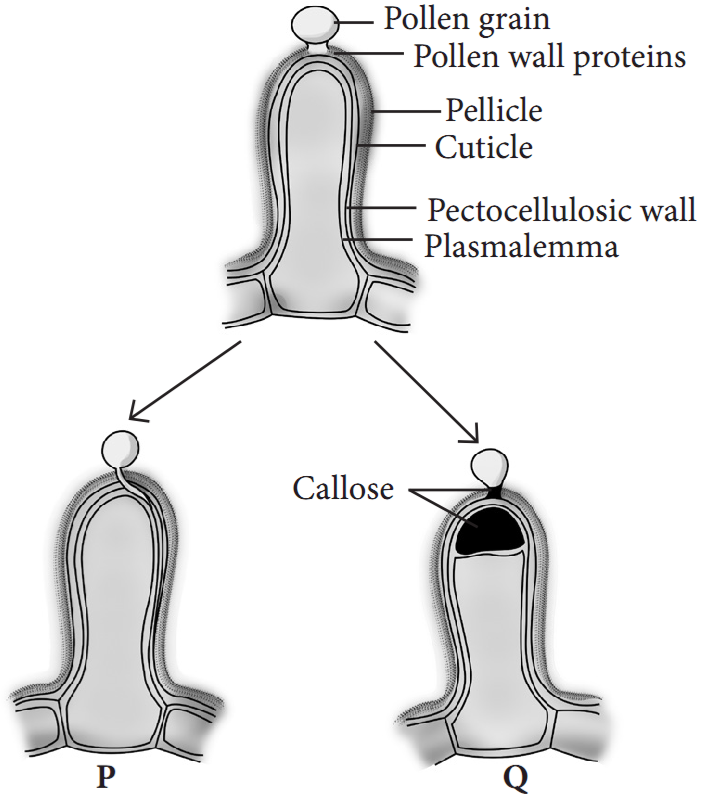
  1. Given figures show the pollen-stigma interaction, where pollen wall proteins are released onto the pellicle of stigmatic papillae, where a recognition reaction occurs.

Which of the following statements drawn from given figures is incorrect?
  1. P indicates compatible reaction in which the pollen tube penetrates the cuticle and grows down the papilla.
  2. Development of callose plug between the plasma membrane and pectocellulosic layer of stigmatic papillae results in the incompatibility reaction in Q.
  3. A callose plug, which appears at the tip of pollen in Q, is dissolved by callase enzyme secreted by stigma resulting in compatibility reaction.
  4. Deposition of callose can be employed as a reliable bioassay to detect compatibility or incompatibility reactions of pollen and stigma.
Explain in situ approach for conservation of biodiversity.
Origin and Evolution of Man:
Read the following text carefully and answer the questions that follow:
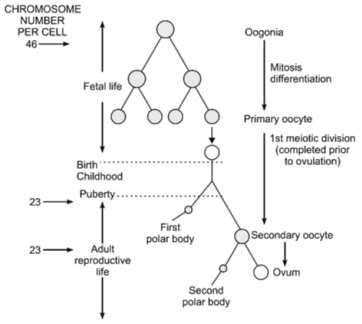
The process of formation of a mature female gamete is called oogenesis which is markedly different from spermatogenesis. A schematic representation of Oogenesis is shown below study the flow chart carefully.

Image
i. How is a primary oocyte different from a secondary oocyte? (1)
ii. Mention the changes taking place during the transition of a secondary follicle to Graafian follicle in the oogonia. (1)
iii. How many primary follicles are left in each ovary in a human female at puberty? (2)
OR
What happen to graafuan follicle after ovulation? (2)
Explain co-dominance in humans with the help of example.
Read the following text carefully and answer the questions that follow:
Malaria and dengue fever are major mosquito-borne public health problems in tropical countries. The authors report a malaria and dengue co-infection in an 11-year-old boy who presented with sustained fever for 10 days. The physical examination revealed a flushed face, injected conjunctivae and left submandibular lymphadenopathy. His peripheral blood smear showed few ring-form trophozoites of Plasmodium falciparum. His blood tests were positive for dengue NS-1 antigen and IgM antibody, and negative for IgG antibody. After the initiation of antimalarial treatment with artesunate and mefloquine, his clinical condition gradually improved. However, he still had low-grade fever that persisted for 6 days. Finally, he recovered well without fluid leakage, shock or severe bleeding.
i. Name the fish that help in eradication of mosquito larvae.
ii. What is the reason of symptoms of malaria?
iii. Name the body parts and host in which following events takes place in life cycle of plasmodium.
a. asexual reproduction
b. sexual reproduction.
OR
Name some vector borne diseases and their vector.
Read the following and answer any four questions from (i) to (v) given below:

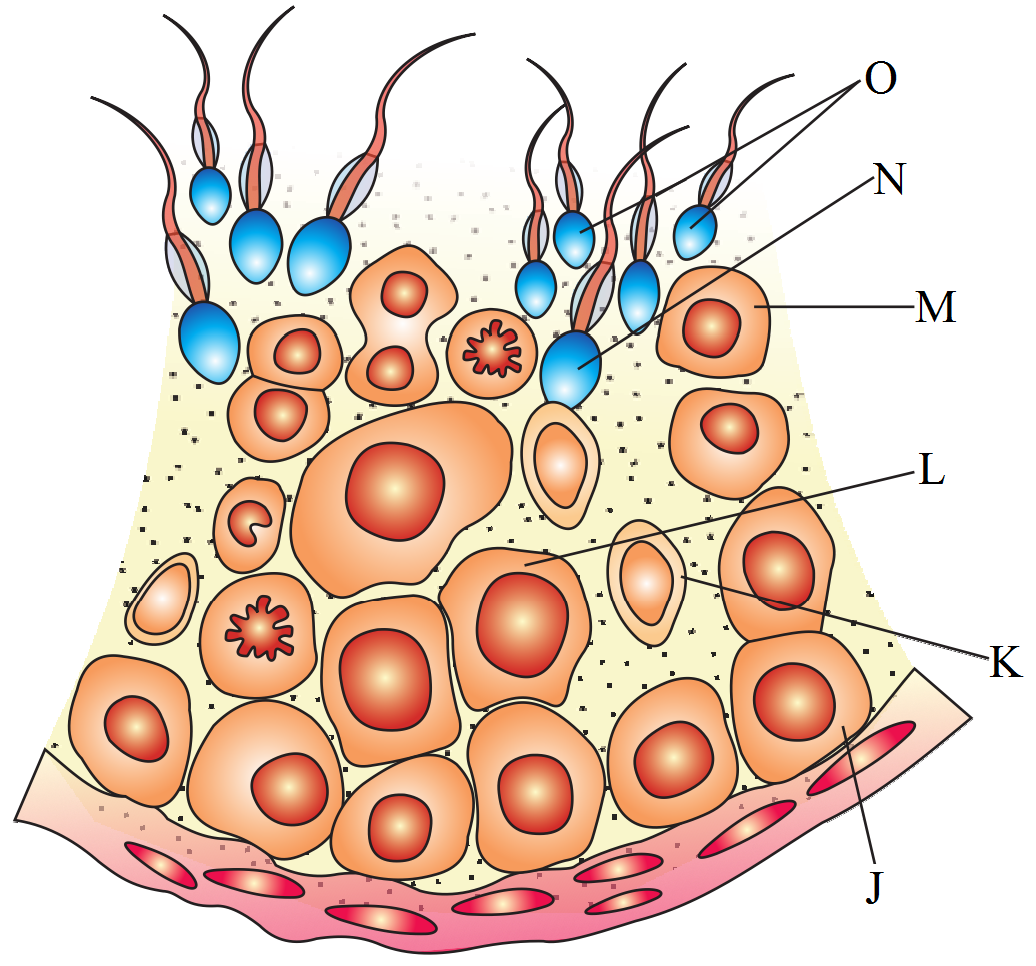
Each testicular globule of testis contains one to three highly coiled seminiferous tubules. Wall of each seminiferous tubule is formed of single layered germinal epithelium. Majority of cells in this epithelium are cuboidal, called male germ cells. Study the transverse section of part of seminiferous tubule and answer the following questions.

  1. What is the characteristic of K?
  1. K is spermatogonium which grows into primary spermatocyte.
  2. K is Sertoli cell which provides nutrition to spermatids.
  3. K is secondary spermatocyte which undergo meiosis II to form spermatid.
  4. K is spermatid being converted into sperm.
  1. Which of the following cell undergo reduction division to form secondary spermatocyte?
  1. J
  2. M
  3. L
  4. K
  1. How many among the following have 46 chromosomes?

  1. 2
  2. 4
  3. 5
  4. 3
  1. Select an option that correctly identifies different labels.
  1. L- Primary spermatocyte, N - Spermatozoa, M - Secondary spermatocyte.
  2. J - Spermatogonium, K - Sertoli cell, O - Spermatozoa.
  3. L- Primary spermatocyte, M - Secondary spermatocyte, N - Spermatozoa.
  4. J - Spermatogonium, K - Primary spermatocyte, N - Spermatid.
  1. Which hormone initiates spermatogenesis at puberty?
  1. FSH
  2. ICSH
  3. ABP
  4. GnRH
Read the following text carefully and answer the questions that follow:
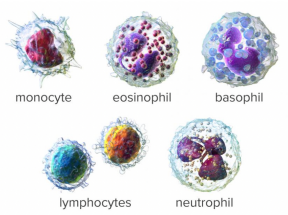
A lymphocyte isa type of white blood cell. Enlarge. Blood cells. Blood contains many types of cells: white blood cells (monocytes, lymphocytes, neutrophils, eosinophils, basophils, and macrophages), red blood cells (erythrocytes), and platelets. Blood circulates through the body in the arteries and veins.
Image
i. Why are the antigens called antibody-generating chemicals? (1)
ii. Which two types of lymphocytes are involved in immunity? (1)
iii. Give the common site of formation of two types of lymphocytes. (2)
OR
What is the site of differentiation of two types of lymphocytes? (2)
Microbes are useful in household products. Explain this with suitable examples