Question
Explain national income equilibrium through aggregate demand and aggregate supply. Use diagram. Also explain the changes that take place in an economy when the economy is not in equilibrium.
Answer


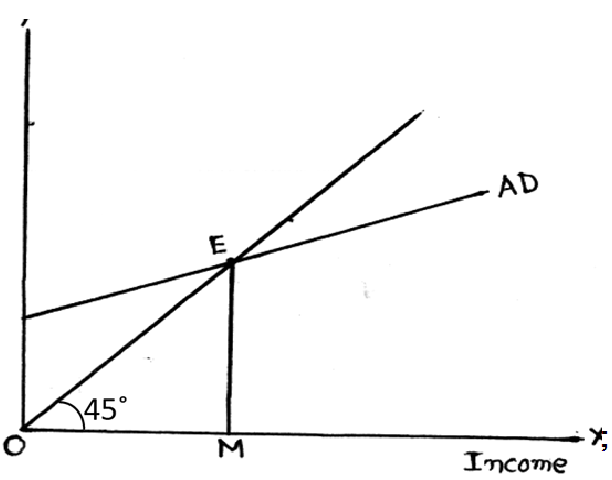
The national income is in equilibrium when $AD = AS$. In the figure the equilibrium is at $E$, the intersection of the $AD$ curve and the $45^o$ line. The equilibrium income is OM.
When the economy is not in equilibrium $AD$ is not equal to AS. Suppose $AD>AS$, will lead to fall in inventories with the producers. The producers in turn will produce more to reach the desired level of inventories: This raises AS till it becomes equal to $AD$.

Need a full question paper?

Generate a complete, print-ready paper with questions like this in minutes — across 16+ boards, with answer keys.

Start Generating Free

Similar questions

When is an economy in equilibrium? Explain with the help of saving and investment functions. Also explain the changes that take place in an economy when the economy is not in equilibrium. Use diagram.
Find Gross Domestic Product at Factor Cost and Personal Disposable Income:
    (₹ crore)
(i) Personal tax 100
(ii) Net National Disposable Income 800
(iii) Corporation tax 50
(iv) Net factor income to abroad (–) 10
(v) Retained income 20
(vi) Indirect tax 170
(vii) Private income 600
(viii) Subsidy 30
(ix) Consumption of fixed capital 60
(x) Net current transfer from abroad 10
Explain briefly the determination of equilibrium level of income. Use diagram.
OR
Explain with the help of a diagram how equilibrium level of income is determined by aggregate demand and aggregate supply.
How is the exchange rate determined under a flexible exchange rate regime?
C = 100 + 0.4 Y is the consumption Function of an economy where C is Consumption Expenditure and Y is National Income. Investment expenditure is 1100. Calculate.
  1. Equilibrium level of National Income.
  2. Consumption expenditure at equilibrium level of national income.
Explain the production method of estimating national income.
What are the elements that private investor demand for investment depends?
Calculate National Income from the following data:
  (Rs. in crores)
  1. Private final consumption expenditure
900
  1. Profit
100
  1. Government final consumption expenditure
400
  1. Net indirect taxes
100
  1. Gross domestic capital formation
250
  1. Change in stock
50
  1. Net factor income from abroad
(-)40
  1. Consumption of fixed capital
20
  1. Net imports
30
Given saving curve, derive consumption curve and state the steps in doing so. Use diagram.
What is ‘liquidity trap’?