Question
Why do we need to manage our natural resources?

Answer

We need to manage our natural resources because:
  1. The resources of the earth are limited and our population is increasing day by day.
  2. The proper management of natural resources takes into consideration long term perspective and prevents their exploitation to the hilt for short term gains.
  3. The proper management can ensure equitable distribution of natural resources so that all the people can benefit from the development of these resources.
  4. The proper management will take into consideration the damage caused to the environment during the extraction or use of the natural resources and find ways and means to minimise this damage.

Need a full question paper?

Generate a complete, print-ready paper with questions like this in minutes — across 16+ boards, with answer keys.
Start Generating Free

Similar questions

When a female child is born, her ovaries already contain thousands of immature eggs (or ova) contained in immature structures A. On maturing, A bursts open and an egg shoots out of the ovary in a process called B. The process B starts in the females at puberty and occurs again and again after a time period x. Before every occurrence of process B, the inner lining of uterus becomes thick and soft with lots of blood vessels in it. When the egg cell gets fertilised by a sperm, then an event C occurs in the life of mature human female which lasts for time period y leading to the birth of baby. If, however, the egg cell released by the ovary does not get a sperm to fuse with, then the thick and soft inner lining of uterus breaks down and comes out of the female's body in an event called D. The occurrence of event D is controlled by chemical substances E.
  1. What are A?
  2. What is process B?
  3. What is the time period x?
  4. Name the event C.
  5. How much is the time period y?
  6. What is the name of process D?
  7. Name the chemical substances E.
The partially digested food coming from the stomach of a person enters a long and narrow organ A in his body. The organ A receives the secretion of two glands: liver and pancreas. Liver secretes a greenish - yellow liquid B which is normally stored in the organ C. Pancreas secretes pancreatic juice which contains three digestive enzymes D, E and F. The intestinal juice completes the process of digestion of food. The inner wall of organ A has millions of tiny finger - like projections G which help in the rapid absorption of digested food into blood stream. The undigested part of food then passes into wider tube H which absorbs most of the water from undigested food. The last part of tube H called I stores this undigested food (or waste) for some time. The undigested food is then passed out though opening J as faeces in the process known as K.
  1. Name the organ A.
  2. Name liquid B and organ C.
  3. What are the digestive enzymes D, E and F?
  4. Name the projections G present on the inner wall of organ A.
  5. Name Tube H, Part I, Opening J and Process K.
In a house two 60W electric bulbs are lighted for 4 hours, and three 100W bulbs for 5 hours everyday. Calculate the electric energy consumed in 30 days.
Write word equations and then balanced equations for the reaction taking place when–
  1. Dilute sulphuric acid reacts with zinc granules.
  2. Dilute hydrochloric acid reacts with magnesium ribbon.
  3. Dilute sulphuric acid reacts with aluminium powder.
  4. Dilute hydrochloric acid reacts with iron filings.
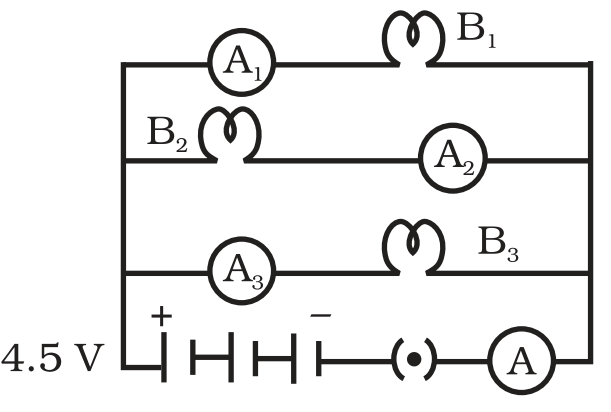
$B_1, B_2$ and $B_3$ are three identical bulbs connected as shown in Figure. When all the three bulbs glow, a current of 3 A is recorded by the ammeter A
.
i. What happens to the glow of the other two bulbs when the bulb $B_1$ gets fused?
ii. What happens to the reading of $A_1, A_2, A_3$ and $A$ when the bulb $B_2$ gets fused?
iii. How much power is dissipated in the circuit when all the three bulbs glow together?
  1. What is meant by 'power of a lens'?
  2. State and define the S.I. unit of power of a lens.
  3. A convex lens of focal length 25 cm and a concave lens of focal length 10 cm are placed in close contact with each other. Calculate the lens power of this combination.
"A convex lens can form a magnified erect as well as magnified inverted image of an object placed in front of it." Draw ray diagram to justify this statement stating the position of the object with respect to the lens in each case.
An object of height 4 cm is placed at a distance of 20 cm from a concave lens of focal length 10 cm. Use lens formula to determine the position of the image formed.
DNA copies generated will be similar, but may not be completely identical to the original.’ Explain the statement concerning asexually reproducing organisms.’
A compound$ A ($molecular formula $C_3H_6O_2)$ reacts with sodium metal to form compound B and evolves a gas which burns with a pop sound. The compound $A$ on treatment with alcohol $C,$ found in beer$,$ in presence of concentrated sulphuric acid$,$ forms a sweet smelling compound $D ($molecular formula $C_5H_{10}O_2)$. On addition of $\text{NaOH}$ to $A$ it also gives $B$ and water. $D$ on treatment with $\text{NaOH}$ gives back $B$ and $C.$ Identify $\text{A, B, C}$ and $D$ and write down the chemical equations of the reactions involved.
State any five physical properties of metals and five physical properties of non-metals.