Question
Explain negative deviation from Raoult's law with an example.

Answer

In case of negative deviation in the mixtures of two liquids A and B, the force of attraction between A-A an B-B is weaker than that between A-B. Due to this vapour pressure decreases.
Example: Mixture of phenol and aniline. In this situation the intermolecular hydrogen bond between the phenolic proton and the lone pair of electron of the nitrogen atom of aniline is stronger than the hydrogen bond between similar molecules.
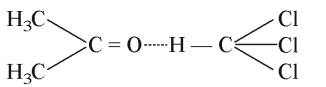
Similarly, the mixture of chloroform and acetone also shows negative deviation from Raoult's law. This is because the chloroform forms hydrogen bond with acetone.
Image

Need a full question paper?

Generate a complete, print-ready paper with questions like this in minutes — across 16+ boards, with answer keys.

Start Generating Free

Similar questions

Write down the difference between $SN^{1}$ and $SN^{2}$ reaction.
Write names of monomer of the following polymer and classify them as addition or condensation polymer.
  1. Teflon.
  2. Bakelite.
  3. Natural Rubber.
In the button cell widely used in watches and other devices the following reaction takes place:
$Zn(s)+Ag_2 O(s)+H_2 O(l) \rightarrow Zn^{2+}(a q)+2 Ag(s)+2 OH^{-}(a q)$
Determine $\Delta_r G^{(-)}$and $E ^{(-)}$for the reaction
Given $Z n \rightarrow Z n^{2+}+2 e^{-}, E ^0=0.76 V$
Given $Ag \rightarrow Ag ^{+}+2 e^{-}, E ^0=0.344 V$
Complte the following reaction :
Image
Write the equations of the following reactions:
(i) Friedel-Crafts acetylation of benzene.
(ii) Gattermann-Koch aldehyde synthesis.
(iii) Gattermann aldehyde synthesis.
$A\ 5\%$ solution (by mass) of cane sugar in water has freezing point of $271K.$ Calculate the freezing point of $5\%$ glucose in water if freezing point of pure water is $273.15\ K.$
Account for the following :
  1. $Eu^{2+}$ is a strong reducing agent.
  2. Orange colour of dichromate ion changes to yellow in alkaline medium.
  3. $E^o(M^{2+}/M)$ values for transition metals show irregular variation.
  1. Draw the structures of all isomeric alcohols of molecular formula $C_5H_{12}O$ and give their IUPAC names.
  2. Classify the isomers of alcohols in question $11.3\ (i)$ as primary, secondary and tertiary alcohols.
  1. ​​​​What is the role of activated charcoal in gas mask?
  2. A colloidal sol is prepared by the given method in figure. What is the charge on hydrated ferric oxide colloidal particles formed in the test tube? How is the sol represented?
  1. How does chemisorption vary with temperature?
Write the role of
  1. $I_2$ in the van Arkel method of refining.
  2. Cryolite in the extraction of aluminium.
  3. Dilute NaCN in the extraction of silver.