Questions

4 Marks Questions

Take a timed test

5 questions · self-marked practice — reveal the answer and mark yourself.

Question 14 Marks
What is boiling point? What is elevation of boiling point? Explain Molal elevation constant and derive It's formula.
Answer
→ Boiling Point:
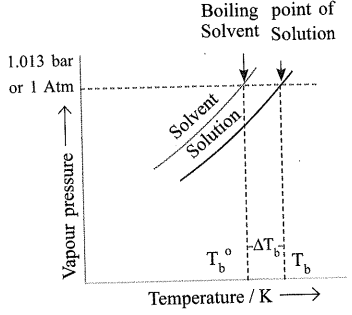
→ "The temperature at which, the vapour pressure of solution is equal to the atmospheric pressure, such temperature is known as boiling point of such solution."
→ For example, water boils at 373.15 K (100° C) because at this temperature the vapour pressure of water is 1.013 bar (1 atmosphere).
→ Vapour pressure of the solvent decreases in the presence of non-volatile solute.
→ The vapour pressure of an aqueous solution of sucrose is less than 1.013 bar at 373.15 K. In order to make this solution boil, its vapour pressure must be increased to 1.013 bar by raising the temperature above the boiling temperature of the pure solvent (water).
→ Thus, the boiling point of a solution is always higher than that of the boiling point of the pure solvent
Image
→ Let $T_{ b }^0$ be the boiling point of pure solvent and $T_{ b }$ be the boiling point of solution. The increase in the boiling point $\Delta T_{ b }=T_{ b }-T_{ b }^0$ is known as elevation of boiling point.
→ Experiments have shown that for dilute solutions the elevation of boiling point $\left(\Delta T_{ b }\right)$ is directly proportional to the molal concentration of the solute in a solution.
$
\begin{array}{l}
\Delta T_{ b } \propto m \\
\therefore \Delta T_{ b }= K _{ b } . m \ldots .(1)
\end{array}
$
Where, $K _{ b }$ is called Boiling Point Elevation Constant or Molal Elevation Constant (Ebullioscopic Constant).
→ Molal elevation Constant:
→"Increase in boiling point of a solution prepared by dissolving one gram molar mass of Non volatile solute in one kg of solvent is called as Molal elevation constant."
→ Unit of $K _{ b }= K \cdot kg \cdot Mol ^{-1}$
→ If $w_2$ gram of solute of molar mass $M _2$ is dissolved in $w_1$ gram of solvent, then molality, m of the solution is given by the expression :
$m=\frac{ W _2 \times 1000}{ M _2 \times W _1}$
Substituting value of molality in eq. (1)
$\begin{array}{l}\Delta T_{ b }=\frac{K_{ b } \times 1000 \times w_2}{M_2 \times w_1} \\ M_2=\frac{1000 \times w_2 \times K_{ b }}{\Delta T_{ b } \times w_1}\end{array}$
Where, $w_2=\mathrm{wt}$. of Solute

Where, $\begin{aligned}
w_2 & =\text { wt. of Solute }
\\ w_1 & =\text { wt. of Solvent }
\\ M _2 & =\text { Molar mass of Solute }\end{aligned}$
View full question & answer
Question 24 Marks
What is depression of Freezing point ? What is molal depression constant $(K_f)$ ? Derive it's formula of finding molar mass of solute.
Answer
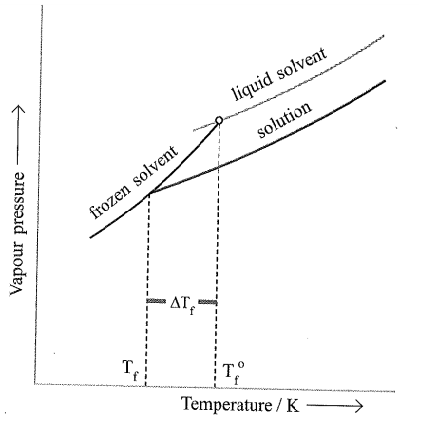
$\rightarrow$ Freezing point of a substance may be defined as, "the temperature at which the vapour pressure of the substance in its liquid phase is equal to its vapour pressure in the solid phase"
$\rightarrow$ A solution will freeze when its vapour pressure equals the vapour pressure of the pure solid solvent.
$\rightarrow$ According to Raoult's law, when a non $-$ volatile solid is added to the solvent its vapour pressure decreases and now it would become equal to that of solid solvent at lower temperature.
$\rightarrow$ Thus, the freezing point of the solvent decreases.
$\rightarrow$ Freezing point of a substance may be defined as, "the temperature at which the vapour pressure of the substance in its liquid phase is equal to its vapour pressure in the solid phase"
$\rightarrow$ A solution will freeze when its vapour pressure equals the vapour pressure of the pure solid solvent.
$\rightarrow$ According to Raoult's law, when a non-volatile solid is added to the solvent its vapour pressure decreases and now it would become equal to that of solid solvent at lower temperature.
$\rightarrow$ Thus, the freezing point of the solvent decreases.
Image
$\rightarrow$ Let $T_f^0$ be the freezing point of pure solvent and $T_f$ be its freezing point when non $-$ volatile solute is dissolved in it. The decrease in freezing point.
$\rightarrow \Delta T_f=T_f^0-T_f$ is known as depression in freezing point.
$\rightarrow$ Depression of freezing point $(\Delta T)$ for dilute solution is directly proportional to molality $ (M)$ of the solution.
$\Delta T_f \propto m$
$\therefore \Delta T_f= K _f, m.....(1)$
where, $\mathrm{K}_f=$ Molal Depression Constant
OR
Freezing point depression Constant
OR
Cryoscopic constant
$\rightarrow$ The unit of $K _f$ is $k. \ \text{kg.mol} { }^{-1}$
$m=\frac{ W _2 \times 1000}{ M _2 \times W _1}$
$\rightarrow$ Substituting this value of molality in eq. $(1)$
$\Delta T_f= K _f \cdot \frac{ W _2 \times 1000}{ M _2 \times W _1}$
$\therefore M _2= K _f \cdot \frac{ W _2 \times 1000}{\Delta T_f \times W _1}$
Where,
$ W _2= wt . \text { of solute }$
$W _1=\text { wt. of solvent }$
$M _2=\text { Molar mass of solute } $
$\rightarrow$ Let $T_f^0$ be the freezing point of pure solvent and $T_f$ be its freezing point when non $-$ volatile solute is dissolved in it. The decrease in freezing point.
$\rightarrow \Delta T_f=T_f^0-T_f$ is known as depression in freezing point.
$\rightarrow$ Depression of freezing point $(\Delta T)$ for dilute solution is directly proportional to molality $( m )$ of the solution.
$\Delta T_f \propto m$
$\therefore \Delta T_f= K _f, m.....(1)$
where, $\mathrm{K}_f=$ Molal Depression Constant
OR
Freezing point depression Constant
OR
Cryoscopic constant
$\rightarrow$ The unit of $K _f$ is $k. \ \text{kg.mol} { }^{-1}$
$ m=\frac{ W _2 \times 1000}{ M _2 \times W _1} $
$\rightarrow$ Substituting this value of molality in eq. $(1)$
$\Delta T_f= K _f \cdot \frac{ W _2 \times 1000}{ M _2 \times W _1}$
$\therefore M _2= K _f \cdot \frac{ W _2 \times 1000}{\Delta T_f \times W _1}$
Where,
$ W _2= wt . \text { of solute }$
$W _1=\text { wt. of solvent }$
$M _2=\text { Molar mass of solute } $
View full question & answer
Question 34 Marks
Write Raoult's Law for Non-Volatile solute and volatile solvent and derive it's formula.
Answer
→ The vapour pressure of a solvent in solution is less than that of the pure solvent.
→ Raoult established that the lowering of vapour pressure depends only on the concentration of the solute particles and it is independent of their identity.
→ A relation between vapour pressure of the solution, mole fraction and vapour pressure of the solvent,
$p_1=p_1^0 \cdot x_1$
→ The reduction in the vapour pressure of solvent $\left(\Delta p_1\right)$ is given as :
$
\begin{aligned}
\Delta p_1 & =p_1^0-p_1 \\
\therefore \Delta p_1 & =p_1^0-p_1^0 \cdot x_1 \\
\therefore \Delta p_1 & =p_1^0\left(1-x_1\right) \\
\therefore \Delta p_1 & =p_1^0 x_2
\end{aligned}
$
→ The lowering of the vapour pressure is directly proportional to mole-Fraction of solute.
$\begin{aligned} \therefore \frac{\Delta p_1}{p_1^0} & =x_2 \\ \therefore \frac{p_1^0-p_1}{p_1^0} & =x_2 \\ \therefore \frac{p_1^0-p_1}{p_1^0} & =\frac{n_2}{n_1+n_2} \quad\left(\because x_2=\frac{n_2}{n_1+n_2}\right)\end{aligned}$
Where, $n_1=$ Moles of solvent
$n_2=$ Moles of solute
→ For dilute solutions $n _2 \ll n _1$
$\begin{aligned} \frac{p_1^0-p_1}{p_1^0} & =\frac{n_2}{n_1} \\ \therefore \frac{p_1^0-p_1}{p_1^0} & =\frac{ W _2 \times M _1}{ M _2 \times W _1}\end{aligned}$
Where, $\begin{aligned} W _1 & =\text { Weight of solvent } \\ W _2 & =\text { Weight of solute } \\ M _1 & =\text { Molar mass of solvent } \\ M _2 & =\text { Molar mass of solute } \\ p_1^0 & =\text { Vapour pressure of pure solvent } \\ p_1 & =\text { Vapour pressure of solution }\end{aligned}$
View full question & answer
Question 44 Marks
Explain Raoult's Law for volatile solute and Volatile solvent and derive formula for total vapour pressure with graph.
Answer
$\rightarrow$ Let us consider a binary solution of two volatile liquids and denote the two components as $1$ and $2$ .
$\rightarrow$ When taken in a closed vessel, both the components would evaporate and eventually an equilibrium would be established between vapour phase and the liquid phase.
$\rightarrow$ Suppose $p_1$ and $p_2$ partial vapour pressure of component $1$ and $2$ and $x_1$ and $x_2$ are MoleFraction of component $1$ and $2$ respectively.
$\rightarrow$ The French chemist, Francois Marte Raoult gave the quantitative relationship between them. The relationship is known as the Raoult's law
$\rightarrow$ "For a solution of volatile liquids the partial vapour pressure of each component of the solution is directly proportional to its mole fraction present in solution."
$\rightarrow$ For component $-1 .$
$p_1 \propto x_1$
$\therefore p_1=p_1^\circ \cdot x_1$
where $p_1^\circ$ is the vapour pressure of pure component $1$
$\rightarrow$ Similarly for component $-2$
$p_2 \propto x_2$
$\therefore p_2=p_2^\circ \cdot x_2$
where $p_2^\circ$ is the vapour pressure of pure component $2$
$\rightarrow$ According to Dalton's law of partial pressures,
$\rightarrow$ Total pressure over the solution phase in the container will be the sum of the partial pressures of the components of the solution
$ p_{\text {Total }} =p_1+p_2$
$= p_1^\circ \cdot x_1+p_2^\circ \cdot x_2$
$= p_1^\circ\left(1-x_2\right)+p_2^\circ \cdot x_2$
$= p_1^\circ-p_1^\circ \cdot x_2+p_2^\circ \cdot x_2$
$p_{\text {Total }} =p_1^\circ+x_2\left(p_2^\circ-p_1^\circ\right)$
$\rightarrow$ Following conclusions can be drawn from above equation
$(i)$ Total vapour pressure over the solution can be related to the mole fraction of any one component.
$(ii)$ Total vapour pressure over the solution varies linearly with the mole fraction of component $2.$
$(iii)$ Depending on the vapour pressures of the pure components $1$ and $2$, total vapour pressure over the solution decreases or increases with the increase of the mole fraction of component $1.$
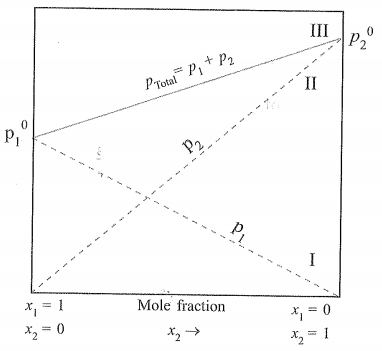
$\rightarrow$ A plot of $p_1$ or $p_2$ versus the mole fractions $x_1$ and $x_2$ for a solution gives a linear plot as shown in Fig.
Image
$\rightarrow$ These lines $(I$ and $II)$ pass through the points for which $x_1$ and $x_2$ are equal to unity.
$\rightarrow$ Similarly the plot $($line $III)$ of $p_{\text {total }}$ versus $x_2$ is also linear Fig.
$\rightarrow$ The minimum value of $p_{\text {Total }}$ is $p_1^\circ$ and the maximum value is $p_2^\circ$, assuming that component $-1$ is less volatile than component $-2\left(p_1^\circ < p_2^\circ\right)$
$\rightarrow$ The composition of vapour phase in equilibrium with the solution is determined by the partial pressures of the components.
$\rightarrow$ If $y_1$ and $y_2$ are the mole$-$fraction of the component $1$ and $2$ respectively in vapour phase then,
$\rightarrow$ Using Dalton's Law of partial pressure
$p_1=y_1 \cdot p_{\text {Total }}$
$p_2=y_2 \cdot p_{\text {Total }}$
$\rightarrow$ In general
$p_i=y_i\ p _{\text {Total }}$
View full question & answer
Question 54 Marks
What is Osmosis? What is Osmotic Pressure? Derive it's formula.
Answer
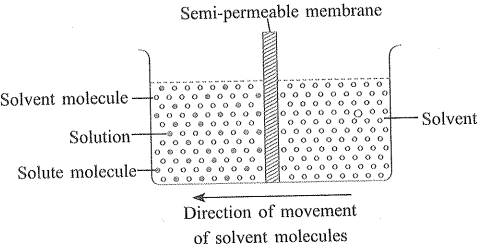
$\rightarrow$ If semi permeable membrane is placed between the solvent and solution as shown fig. the solvent molecules will flow through the membrane from pure solvent to the solution.
This process of flow of the solvent is called osmosis.
Image
$\rightarrow$ The flow will continue till the equilibrium is attained
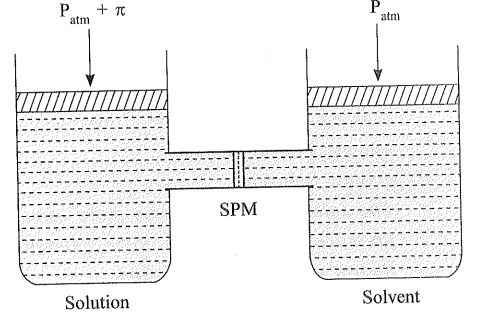
$\rightarrow$ The flow of the solvent from its side to solution side across a semipermeable membrane can be stopped if some extra pressure is applied on the solution.
This pressure that just stops the flow of solvent is called osmotic pressure of the solution.
Image
$\rightarrow$ The osmotic pressure of a solution is the excess pressure that must be applied to a solution to prevent osmosis,
$\rightarrow$ Osmotic pressure is a colligative property as it depends on the number of solute molecules and not on their identity.
$\rightarrow$ osmotic pressure is proportional to the molarity$, C$ of the solution at a given temperature $T$.
$\pi=\text { CRT }$
Where, $\pi=$ Osmotic pressure
$R =$ gas constant
$ \therefore \pi =\frac{n_2 R T}{V} \ \left(\because C=\frac{n_2}{V}\right)$
$\pi =\frac{W_2 R T}{M_2 V}$
$ W _2= Wt . \text { of Solute }$
$M _2=$ Molar mass of Solute 
$V =$ Volume of Solution $(L)$
$T =$ Temperature
View full question & answer