RAY OPTICS AND OPTICAL INSTRUMENTS — Physics STD 12 Science — Question
Rajasthan BoardEnglish MediumSTD 12 SciencePhysicsRAY OPTICS AND OPTICAL INSTRUMENTS4 Marks
Question
Explain refraction at spherical surfaces and derive formula $-\frac{n_1}{n}+\frac{n_2}{v}=\frac{n_2-n_1}{ R }$.
✓
Answer
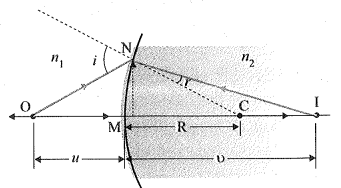
$\rightarrow$ As shown in figure, a point like object $O$ is placed on the principal axis of the spherical surface.
$A$ spherical surface has centre of curvature $^ prime C'$ and radius of curvature $R$.
$\rightarrow $ Rays emerge from a medium having refractive index $n_1$.
Here $,OM$ and $ON$ are the incident rays.
$\rightarrow$ They refract in a medium having refractive index $n_2$.
Here $NI$ and $M$I are the refractive rays.
As a result, image $I$ of the point object $O$ is obtained.
$\rightarrow$ Assume that the aperture of the spherical surface is small compared to the object distance, image distance and radius of curvature, so that the angles can be taken small.
$\rightarrow$ Since the aperture of the surface is assumed to be small here $,NM$ will be taken to be nearly equal to the length of the perpendicular from the point $N$ on the principal axis.
$\rightarrow$ From figure,
$\tan \angle NOM \approx \angle NOM =\frac{ MN }{ OM }......(1)$
$\tan \angle NCM \approx \angle NCM =\frac{ MN }{ MC }......(2)$
$\tan \angle NIM \approx \angle NIM =\frac{ MN }{ MI }......(3)$
$\rightarrow$ For $\triangle $\text{NOC},$ i$ is the exterior angle.
Therefore,
$i=\angle NOM +\angle NCM$
Substituting values from equation $(1)$ and equation $(2),$
$\therefore i=\frac{ MN }{ OM }+\frac{ MN }{ MC }......(4)$
$\rightarrow$ From figure for $\triangle NIC , \angle NCM$ is the exterior angle.
$\therefore \angle NCM =r+\angle NIM$
$ r=\angle NCM -\angle NIM$
$\therefore r=\frac{ MN }{ MC }-\frac{ MN }{ MI }......(5)$
$\rightarrow$ By applying Snell's law at point $N$,
${c} \ n_1 \sin i=n_2 \sin r$
$\text { But, } \sin i \approx i$
$\therefore \sin r \approx r$
$\therefore n_1 i=n_2 r$
$\rightarrow$ Substituting $i$ and $r$ from equation $(4)$ and equation $(5)$,
$\therefore n_1\left(\frac{ MN }{ OM }+\frac{ MN }{ MC }\right)=n_2\left(\frac{ MN }{ MC }-\frac{ MN }{ MI }\right)$
$\therefore \frac{n_1}{ OM }+\frac{n_1}{ MC }=\frac{n_2}{ MC }-\frac{n_2}{ MI }$
$\therefore \frac{n_1}{ OM }+\frac{n_2}{ MI }=\frac{n_2}{ MC }-\frac{n_1}{ MC }$
$\therefore \frac{n_1}{ OM }+\frac{n_2}{ MI }=\frac{n_2-n_1}{ MC }$
$\rightarrow$ But from figure, applying Cartesian sign convention,
$ OM =-u, MI =v $ and $MC = R$
$\therefore -\frac{n_1}{u}+\frac{n_2}{v}=\frac{n_2-n_1}{ R }$
$\rightarrow$ Above equation gives us a relation between object and image distance in terms of refractive index of the medium and the radius of curvature of the curved spherical surface.
Need a full question paper?
Generate a complete, print-ready paper with questions like this in minutes — across 16+ boards, with answer keys.